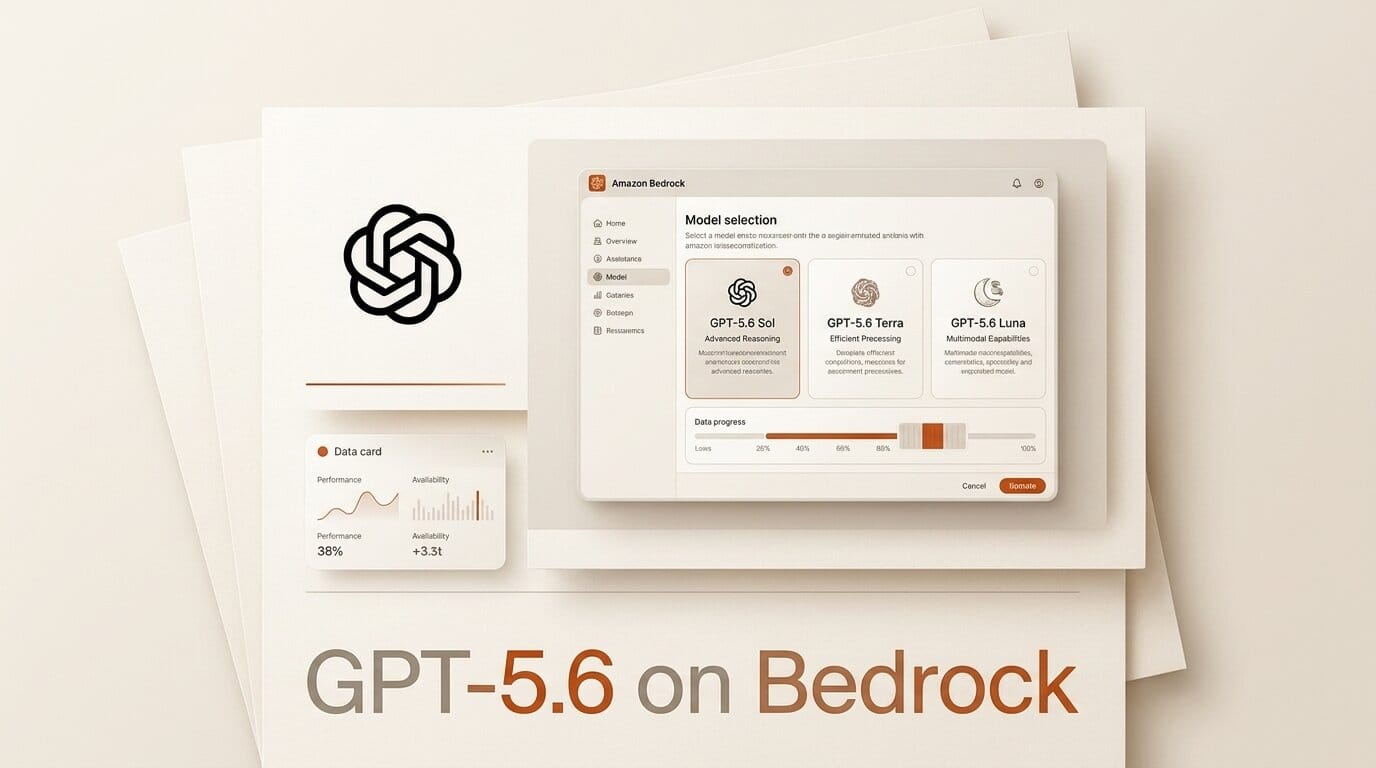
OpenAI's GPT-5.6 family is now available on Amazon Bedrock, giving builders three distinct model tiers, Sol, Terra, and Luna, inside the same AWS environment they already use for storage, auth, and billing. The launch on July 24, 2026 matters less because the models are new (they went public on July 9) and more because of where they now live: a builder can call the same flagship reasoning model that powers ChatGPT and Codex without leaving Bedrock, paying through existing AWS cost commitments. This is a router-shaped decision, and picking the wrong tier is the fastest way to burn budget or ship something slow.
What Happened
Amazon added all three GPT-5.6 variants to Bedrock as first-class foundation models, accessible through the OpenAI Responses API and Bedrock's standard invoke path. Each model carries a 272K-token context window, accepts both text and image inputs, returns text, and exposes an adjustable reasoning effort dial that runs from "none" to "max." Pricing on Bedrock matches OpenAI's first-party rates, and usage counts toward the AWS spend commitments many teams have already negotiated.
Regional availability differs by tier. Sol, the flagship, is limited to US East regions at launch. Terra is available across three US regions, and Luna is positioned for the high-volume, latency-sensitive traffic that tends to run everywhere. The exact Bedrock model identifiers (for example openai.gpt-5.6-sol) are published in the Bedrock model ID reference, which is what you pass to the API rather than the marketing name.

Sol vs Terra vs Luna: Which Model for Which Job
The three names are not marketing gloss over one model. They are genuinely different price and performance points, and OpenAI has been explicit about the intended workload for each. Sol targets the hardest problems: autonomous coding, security research, scientific analysis, and deep multi-step reasoning. Sam Altman claimed at the July 9 public launch that Sol is 54% more token efficient on coding tasks than the prior generation, which changes the real cost math even at a higher sticker price. Terra is the everyday production workhorse. Luna is built for volume: classification, summarization, routing, and anything where latency and unit cost matter more than raw reasoning.
| Model | Best for | Input price | Output price | Bedrock regions |
|---|---|---|---|---|
| Sol | Autonomous coding, security research, deep reasoning | $5.00 | $30.00 | US East only |
| Terra | Everyday production, internal tools, document analysis | $2.50 | $15.00 | Three US regions |
| Luna | Classification, summarization, routing, high volume | $1.00 | $6.00 | Broad |
The spread is a 5x difference in input cost and output cost between Sol and Luna. For a creator building an app, that gap is the whole design question. A one-shot code generation feature that runs a few times a day can afford Sol. A background pipeline that summarizes thousands of user uploads should never touch it. The 272K context window is shared across all three, so long-document workflows do not force you up a tier the way they did on older families.

Why It Matters for Builders
The interesting part is not that another model landed on Bedrock. It is that OpenAI's frontier lineup now sits next to Anthropic's Claude, Meta's Llama, and Amazon's own Nova inside one API surface, billed through one account. For anyone building on AWS, that removes the last real friction of using GPT-5.6 in production: a separate vendor relationship, a separate invoice, and a separate data-residency conversation. Requests stay inside your AWS boundary and inherit the IAM, logging, and guardrail tooling you already run.
It also turns model selection into a routing problem you can solve programmatically. Because all three tiers speak the same Responses API and share a context window, you can start every request on Luna and escalate to Terra or Sol only when a confidence check or a task classifier says the job is hard. That pattern, cheap model first and expensive model on demand, is exactly the cost-routing approach we covered in our look at Cursor's model router, and Bedrock makes it a native part of your stack rather than a bolt-on.
How to Start Using GPT-5.6 on Bedrock
Getting a first call out takes minutes if your AWS account already has Bedrock enabled. The steps below are the fast path.
1. Request model access. In the Bedrock console, open Model access and enable the GPT-5.6 tiers you want. Sol requires a US East region, so set your client region accordingly.
2. Grab the model ID. Use the identifier from the model ID reference, not the display name. Passing "Sol" instead of the real ID is the most common first error.
3. Call the Responses API. Send your prompt with a reasoning effort setting. Start at "none" or "low" for Luna-class work and reserve "max" for Sol on genuinely hard tasks, because reasoning effort drives both latency and output token count.
4. Watch the token bill. Check live rates on the Bedrock pricing page before you scale. Output tokens dominate cost on reasoning models, and a high reasoning-effort setting can quietly multiply your output token count.

Key Details
Models: GPT-5.6 Sol, Terra, and Luna
Platform: Amazon Bedrock, via the OpenAI Responses API
Context window: 272K tokens, all tiers
Inputs: Text and image. Output: text
Reasoning control: Adjustable effort from none to max
Bedrock availability date: July 24, 2026 (models first launched July 9, 2026)
Billing: Matches OpenAI first-party rates, counts toward AWS commitments
Frequently Asked Questions
Is GPT-5.6 on Bedrock the same model as in ChatGPT?
Yes. Sol is the same flagship model that powers ChatGPT and Codex. Bedrock is a new distribution surface for it, not a distinct or distilled version. The difference is where the request runs and how you are billed.
Which GPT-5.6 tier should I use?
Match the tier to the job. Use Luna for high-volume, latency-sensitive work like classification and summarization, Terra for balanced everyday production, and Sol only for hard reasoning, autonomous coding, or security research where its capability justifies the 5x cost premium over Luna.
How much does GPT-5.6 cost on Bedrock?
Per million tokens: Sol is $5 input and $30 output, Terra is $2.50 input and $15 output, and Luna is $1 input and $6 output. Bedrock pricing matches OpenAI's first-party rates. Check the Bedrock pricing page for the current figures in your region.
Why is Sol only in US East regions?
Amazon rolls out flagship models to a limited set of regions first, then expands as capacity allows. At launch, Sol is US East only, while Terra covers three US regions and Luna is broadly available. Set your client region to US East if you need Sol today.
Can I route between the three tiers automatically?
Yes, and it is the recommended pattern. Because all three share the Responses API and a 272K context window, you can start requests on Luna and escalate to Terra or Sol based on a confidence check or task classifier, keeping most traffic on the cheapest tier.
What is the reasoning effort setting?
It is a dial from "none" to "max" that controls how much the model deliberates before answering. Higher effort improves hard-problem accuracy but increases latency and output token count, so it directly affects your bill. Tune it per request rather than leaving it at max.