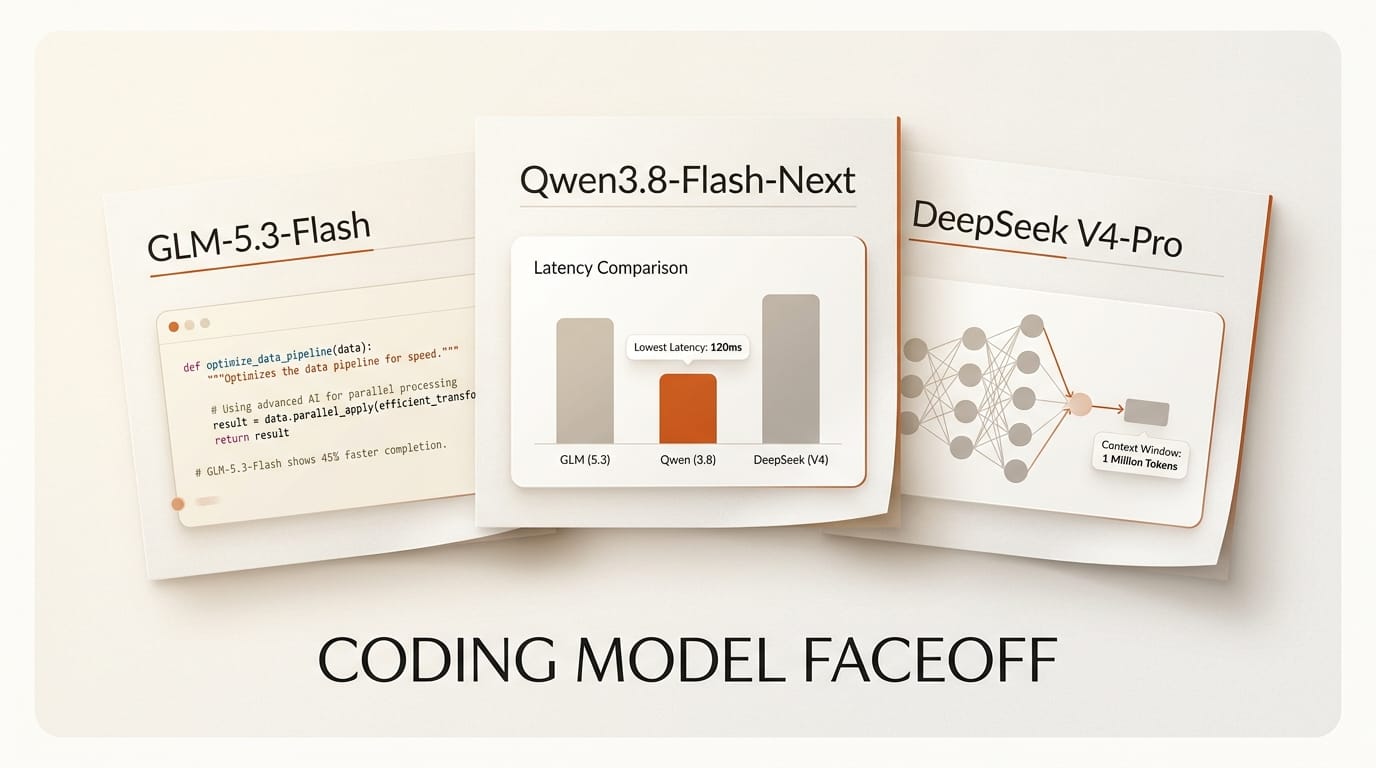
If you want an open-weights coding model you can route an agent to today or pull onto your own hardware, the honest answer in late 2026 is that it depends on what you own and what you trust. GLM-5.3-Flash from Z.ai is the cheapest hosted option and the current leaderboard darling, Qwen3.8-Flash-Next is the lightest model to self-host and a preview of Alibaba's next architecture, and DeepSeek V4-Pro is the battle-tested flagship with the only fully audited coding scores of the three. This comparison lines them up on the numbers each vendor actually published, with a clear note wherever those numbers do not line up.
Methodology: every specification and benchmark below comes from the model's own release page, its Hugging Face card, or a primary benchmark source, not from our own test bench. Where a vendor has not disclosed a number, this piece says so rather than estimating one. GLM-5.3-Flash and Qwen3.8-Flash-Next both shipped on August 26, 2026; DeepSeek V4-Pro reached general availability on August 12, 2026 and serves as the established baseline.
The Three Models at a Glance
All three are mixture-of-experts models with a roughly 1-million-token context window, and all three publish downloadable weights. That is where the similarity ends. Total size, active parameters, license terms, and hosted pricing differ enough to change which one is realistic for your setup.
| Model | GLM-5.3-Flash | Qwen3.8-Flash-Next | DeepSeek V4-Pro |
|---|---|---|---|
| Vendor | Z.ai (Zhipu) | Alibaba (Qwen) | DeepSeek |
| Total / active params | 320B / 18B | 125B / 6B | 1.6T / 49B |
| Context window | 1M | 262K native, 1M scaled | 1M in, up to 384K out |
| License | MIT | qwen-community-1.0 | MIT |
| Hosted price (in / out per 1M) | $0.15 / $0.50 | Self-host (no first-party price yet) | $0.435 / $0.87 |
| Modality | Text | Text | Text |
| Released | Aug 26, 2026 | Aug 26, 2026 | Aug 12, 2026 |

Quick Picks: Which One Fits Your Setup
Pick GLM-5.3-Flash if you want the lowest hosted cost and the model that is topping usage charts right now. At $0.15 per million input tokens it is roughly one-tenth the cost of the previous GLM generation, and it is free on OpenRouter and OpenCode during its preview window.
Pick Qwen3.8-Flash-Next if you self-host and want the smallest model to run. At 125B total and only 6B active, with a first-party FP8 build, it fits on far less hardware than a 1.6T flagship, and it doubles as an early look at the Qwen4 architecture.
Pick DeepSeek V4-Pro if you need proven, audited coding performance and are willing to pay for hosted inference or run serious hardware. It is the only one of the three with published SWE-bench Verified and LiveCodeBench numbers.
Head to Head: Size and Self-Host Footprint
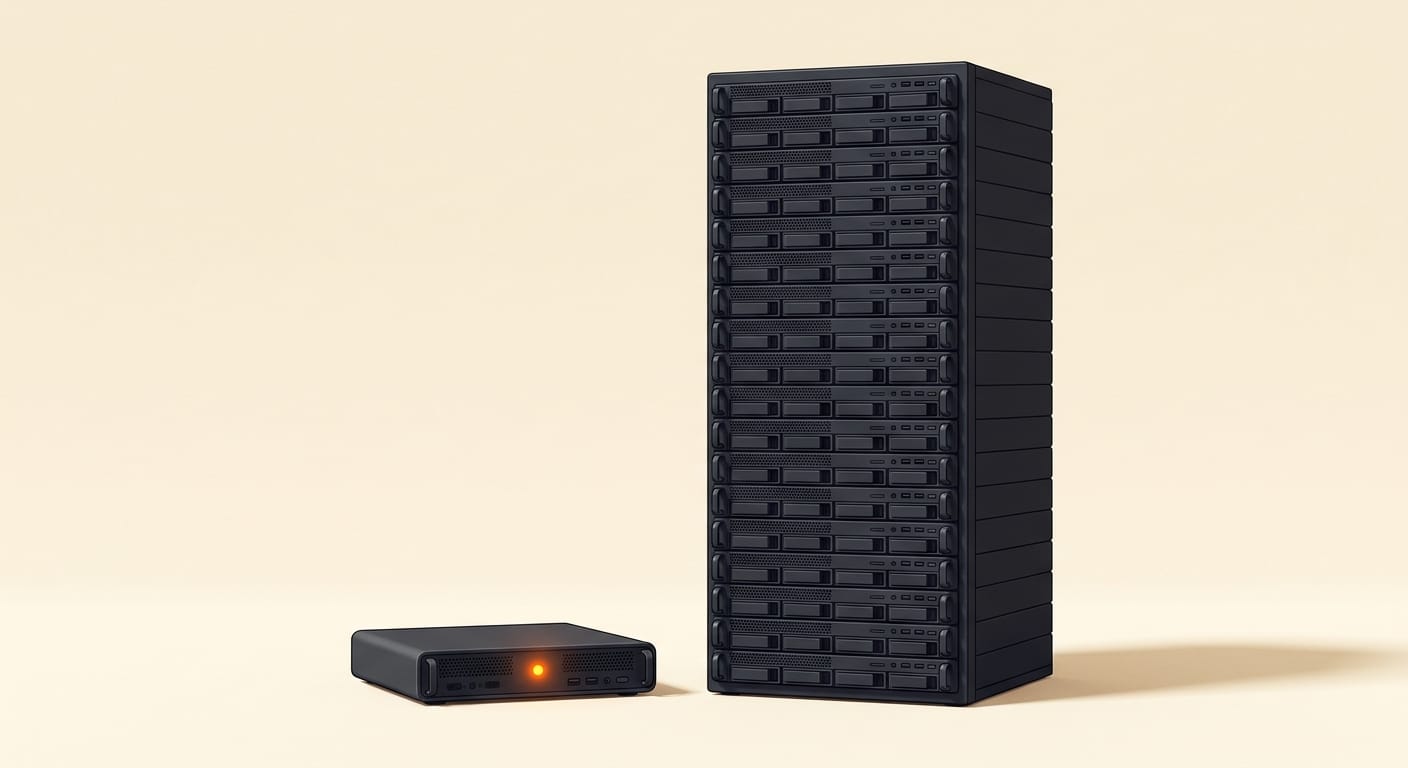
The single biggest practical difference is how much machine each model demands. Qwen3.8-Flash-Next is the outlier in the right direction: 125 billion total parameters with just 6 billion active per token, plus a 51-billion-parameter n-gram embedding and a 4-billion-parameter multi-token-prediction module. Its hybrid attention design combines Gated DeltaNet with Qwen Sparse Attention across 48 layers and 512 experts, and Alibaba shipped an FP8 variant specifically so memory-constrained builders can load it, as TechNode reported at launch.
GLM-5.3-Flash sits in the middle at 320 billion total and 18 billion active, down from 32 billion active in Z.ai's earlier GLM-4.5. It publishes weights on Hugging Face with deployment paths through SGLang, vLLM, and TokenSpeed. DeepSeek V4-Pro is the heavyweight at 1.6 trillion total and 49 billion active, pre-trained on more than 32 trillion tokens. Self-hosting a 1.6T model is a data-center exercise, not a workstation one, which is why most builders will reach for DeepSeek through a hosted endpoint rather than the weights.
Head to Head: Coding and Agent Benchmarks
This is where the comparison gets honest about its own limits. The three vendors did not report the same benchmarks, so a clean single-number ranking is not available. DeepSeek V4-Pro is the most thoroughly measured: 80.6% on SWE-bench Verified, 93.5% on LiveCodeBench, and 90.1% on GPQA Diamond, per DeepSeek's own release. Those are frontier-tier coding numbers on the industry-standard suites.
GLM-5.3-Flash publishes a different set. Artificial Analysis places it at an Intelligence Index of 57, with DeepSWE v1.1 at 63.4 and AutomationBench at 48.8. Those are strong agentic-coding results, but they are not SWE-bench Verified, so setting "63.4" next to DeepSeek's "80.6" would be comparing two different tests. The viral claim that the stealth model, since revealed as GLM-5.3-Flash, beats GPT-5.6 Sol and Claude Fable 5 came from an informal 10-task run; broader boards such as LiveBench rank it lower, so treat leaderboard supremacy as provisional.
Qwen3.8-Flash-Next is the least measured of the three. As a fresh open-weights preview of the Qwen4 architecture, it shipped without a formal benchmark table. That is not a knock on the model so much as a caution: you cannot yet cite an audited coding score for it, and anyone who quotes one is guessing. The upside is that the weights are public, so you can run your own SWE-bench or repo-level evaluation before trusting it in production.
Pricing and Total Cost to Run
On hosted pricing, GLM-5.3-Flash is the clear budget winner at $0.15 per million input tokens and $0.50 per million output, and it is temporarily free through OpenRouter's free models and OpenCode during the preview. DeepSeek V4-Pro runs $0.435 per million input on a cache miss and $0.87 per million output, but its cache-hit input price collapses to $0.003625 per million, which makes repeated long-context work over the same codebase remarkably cheap if your prompts are stable.
Qwen3.8-Flash-Next has no first-party hosted price to quote yet, because the release is weights-first on Hugging Face and ModelScope. That reframes its cost question entirely: instead of paying per token, you pay for the hardware once and run unlimited inference. For a small active-parameter model like this one, that trade tips in favor of self-hosting faster than it does for the 1.6T DeepSeek. The MIT license on GLM-5.3-Flash and DeepSeek V4-Pro also permits commercial derivatives outright, while Qwen ships under the more restrictive qwen-community-1.0 terms, which matters if you plan to redistribute a fine-tune.
When Each Model Wins
GLM-5.3-Flash wins on cost-to-try. If you want to route a coding agent at a new model this afternoon and pay almost nothing while you evaluate it, nothing here is cheaper, and the MIT weights are there when you outgrow the API. Its weakness is benchmark ambiguity: the headline scores are impressive but not on the suites everyone else reports.
Qwen3.8-Flash-Next wins on hackability. It is the model to pull onto your own GPUs, quantize, and fold into a local harness, and it gives you a head start on the Qwen4 design before the full family lands. Its weakness is the missing benchmark table and the community license, so it is a builder's model rather than a plug-and-play production default today.
DeepSeek V4-Pro wins on proof. It is the only one with audited frontier coding numbers and a mature API that speaks OpenAI, Anthropic Messages, and its own Responses format, with three reasoning depths. Its weakness is scale: 1.6 trillion parameters make self-hosting impractical for most, and DeepSeek has signaled that hosted prices may rise.
The Verdict
There is no single winner, and that is the real state of open-weights coding models in 2026: the frontier is now crowded enough that the right pick is set by your constraints, not by a leaderboard. Route an agent at GLM-5.3-Flash to spend the least while you evaluate, pull Qwen3.8-Flash-Next if you self-host and value a small footprint, and lean on DeepSeek V4-Pro when you need audited performance and a production-grade API. Whichever you choose, benchmark it on your own repository before you commit, because your codebase is the only test that reflects your work. For deeper background, see our coverage of Z.ai's earlier GLM-5.3 open-weight release, the DeepSeek V4-Pro launch, and the Qwen3.8-Flash-Next release.
Frequently Asked Questions
Which open-weights coding model is cheapest to run?
On hosted pricing, GLM-5.3-Flash is cheapest at $0.15 per million input tokens, and it is free during its OpenRouter and OpenCode preview. If you self-host, Qwen3.8-Flash-Next is cheapest to run long term because it has the smallest footprint at 125B total and 6B active, so it removes per-token cost entirely once you own the hardware.
Can I self-host all three models?
Yes, all three publish downloadable weights. Qwen3.8-Flash-Next and GLM-5.3-Flash are realistic on a well-equipped workstation or a single serious GPU node, especially in quantized or FP8 form. DeepSeek V4-Pro is 1.6 trillion parameters, so self-hosting it is a data-center task; most teams use its hosted API instead.
Do the benchmark numbers compare directly?
No. DeepSeek V4-Pro reports SWE-bench Verified (80.6%) and LiveCodeBench (93.5%). GLM-5.3-Flash reports an Artificial Analysis Intelligence Index of 57 with DeepSWE v1.1 and AutomationBench. Qwen3.8-Flash-Next has not published a formal benchmark table yet. Because they use different suites, run your own evaluation for an apples-to-apples read.
What licenses do these models use?
GLM-5.3-Flash and DeepSeek V4-Pro both ship under the MIT license, which permits commercial use and derivatives. Qwen3.8-Flash-Next ships under qwen-community-1.0, a more restrictive community license, so review its terms before redistributing a fine-tuned version.
Is Qwen3.8-Flash-Next the same as Qwen4?
No. It is billed as the first public preview of the Qwen4 architecture, not the finished Qwen4 lineup. It lets you evaluate the new design and adapt your prompts and harness now, but Alibaba has signaled a fuller Qwen4 family will follow.