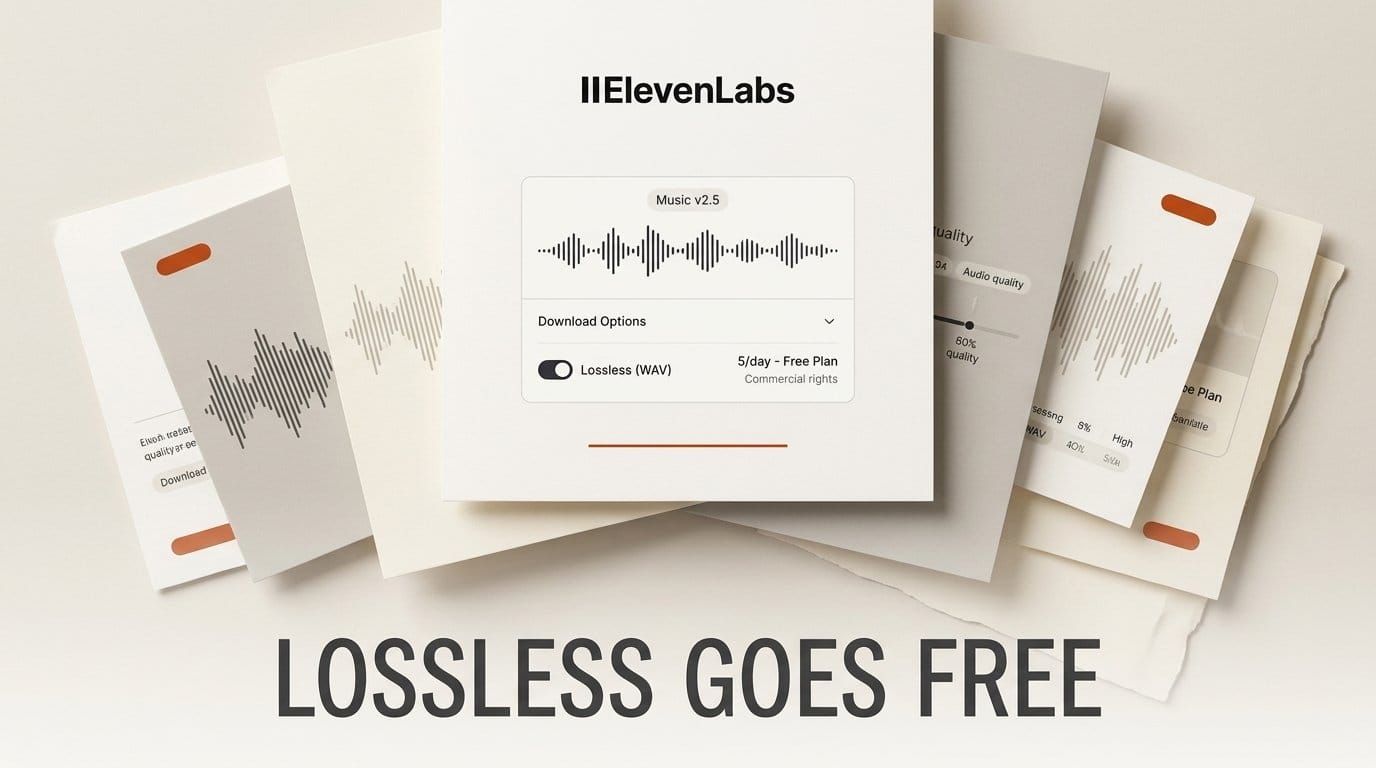
ElevenLabs released Music v2.5 on 11 September 2026, and made one decision that matters more than the model itself: lossless downloads are now available on every plan, including Free, which gets five a day.
That landed eight days after Suno's new download caps took effect and two days after Suno shipped v6. Suno's free tier allows seven downloads for the entire life of the account, personal use only, no commercial rights. A free ElevenMusic account passes that lifetime allowance on its second day.
Both companies signed major-label agreements within 48 hours of each other, and both now build on licensed catalogs. The models are converging. What is diverging is what you are permitted to carry out of the session, and under what terms. For anyone who actually ships work, that is now the more useful comparison, and almost nobody is making it.
What ElevenLabs shipped
Music v2.5 is now the default for prompted and reference generation in ElevenMusic. Music v2 has not been retired and remains selectable, which is a quieter choice than it sounds: Suno announced the opposite, that it would move the product entirely onto v6 and retire what came before.
The model claims are the ordinary ones. Instruments sound closer to a live take, arrangements hold more layers and keep their structure across a full track, and the gains are concentrated in vocal-led and acoustic material: R&B, soul, hip-hop, rock, metal, orchestral and cinematic. ElevenLabs did not publish audio benchmarks, because no accepted one exists for generative music.
The distribution matters as much as the model. Music v2.5 is live in ElevenCreative, in ElevenMusic and in the ElevenLabs API, and it slots into Studio scoring and Flows nodes, so it reaches the pipeline builders as well as the people typing prompts into a box. Per the Eleven Music documentation, generated tracks run from three seconds to five minutes and export as MP3 at 44.1kHz, 128 to 192kbps, or as WAV. That WAV path is what "lossless" means here, and putting it on the free tier is the actual news.
The download became the product
For two years the competitive axis in AI music was output quality. It has moved. Both leading products now rest on licensed training data and label partnerships, which flattens the quality argument and pushes the fight onto export rights.
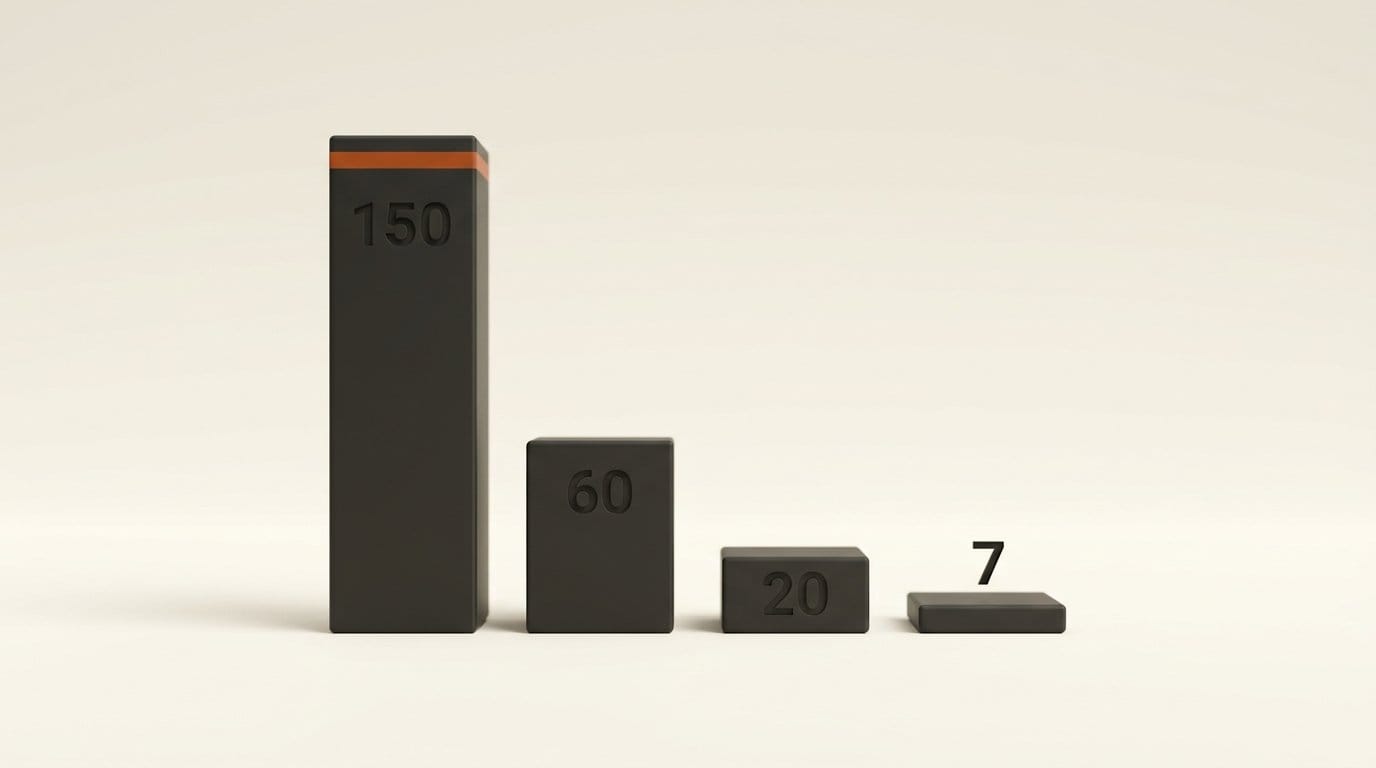
Suno went one direction. As we covered when the download caps landed, from 3 September a free Suno account gets seven downloads total, for the life of the account, for personal use only. Pro at $8 a month gets 20 a month with commercial rights. Premier at $24 a month gets 60. Suno framed it as an anti-abuse measure against users mass-exporting tracks to farm streaming royalties, which is a real problem, and it followed the watermarking changes from a month earlier. The v6 launch tightened the free tier again on a second axis: v6 and v6-wild are restricted to Pro and Premier, and free users get v6-mini only.
ElevenLabs went the other direction in the same month. Five lossless downloads a day on Free, with commercial use permitted so long as you credit ElevenMusic. Run that out and a free account can export roughly 150 lossless files in a month, more than twice what Suno's top consumer tier allows for $24.
| Plan | Downloads allowed | Commercial rights | Lossless |
|---|---|---|---|
| ElevenMusic Free | 5 per day (about 150 a month) | Yes, with ElevenMusic credit | Yes |
| ElevenMusic Pro | 400 per month | Yes | Yes |
| Suno Free | 7 total, for the life of the account | No, personal use only | Not specified |
| Suno Pro, $8 a month | 20 per month | Yes | Not specified |
| Suno Premier, $24 a month | 60 per month | Yes | Not specified |
| Suno Premier with Studio | Unlimited stems and samples | Yes | Not specified |
One caution on that table. ElevenLabs named only two endpoints, Free and Pro, and published no plan-by-plan download grid. Its main pricing page lists a Pro plan at $99 a month alongside Starter at $6 and Creator at $11, and the announcement does not say whether the Pro carrying 400 downloads is that same tier or an ElevenMusic-specific one. Until ElevenLabs publishes the grid, the free tier is the only number a creator can plan against with confidence.
There is a second provision in the announcement that deserves more attention than the headline number. Terms lock to a track at the moment you create it. Cancelling or downgrading does not retroactively change the usage rights on music you already made. That is unusual. Most creative AI subscriptions treat commercial rights as a property of your current plan, meaning the day you downgrade, your back catalog becomes a liability you have to audit. Locking terms at creation removes an entire category of risk from anyone who has shipped client work through the tool and does not want to keep paying purely to stay compliant.
A blind test with no win rate
ElevenLabs did publish one number for model quality: across 47,885 comparative pairs generated from identical prompts, listeners preferred v2.5 "the majority of the time."
The sample size is genuinely large and the methodology, identical prompts across both models, is the right one. But a majority is anything above half. A 50.4% preference and an 80% preference are both correctly described by that sentence, and they imply completely different things about whether you should regenerate your existing library. The number ElevenLabs chose to withhold is the only one that would settle it.
Worth noting too that the ElevenMusic version of the same announcement omits the blind test entirely. The 47,885 figure appears only on the ElevenLabs blog. Two posts, same launch, different audiences, and the more technical readership got the sample size without the result.
Treat the model gain as real but unquantified, and let your own ears decide on material you actually make. The download policy, by contrast, is fully specified, which is a reasonable signal about which change the company thinks will move people.
The carve-out that collides with the UMG deal
One line in the v2.5 announcement sets up a structural problem: tracks that reference other artists are excluded from downloading.
That is consistent with ElevenLabs' standing Eleven Music terms, which prohibit submitting any artist's real or stage name, living or deceased, as part of a prompt, and prohibit generating output that replicates or mimics the voice, likeness or identifiable characteristics of a recording artist. Reasonable rules for a company that has so far avoided the copyright suits stacking up around its competitors.
Now set that against what ElevenLabs announced the day before. On 10 September, Universal Music Group and ElevenLabs disclosed a multi-year strategic agreement covering licensing and product development, starting with a licensed AI music creation platform. Per the announcement, the platform will let fans co-create with music from participating artists through remixes, mashups, new interpretations and personalized vocal experiences.
Every one of those four things is currently forbidden by the terms governing the product that shipped a day later. The UMG platform is not a feature of ElevenMusic; it is a separate thing still in development, with no announced launch date and no pricing. The ElevenMusic post says plainly that the UMG agreement is separate from Music v2.5.
So the carve-out is not a contradiction today. It is a preview of the seam. When the licensed platform ships, ElevenLabs has to run two regimes at once: an unrestricted-prompt product where you can export freely but cannot name an artist, and a licensed product where you can name participating artists but where the export terms are unwritten and will be negotiated with a label rather than set by ElevenLabs. The more successful the UMG platform is at what it promises, the larger the share of a user's output that sits in the bucket with the unknown download rights.
Suno has the same structural question and reached it first. Its v6 generation was built with Warner Music Group, BMG and Believe, and we broke down what that meant for existing users when every older Suno model was retired. Suno's answer so far has been to meter the export hard and keep one product. ElevenLabs' answer is to make export nearly free on the unlicensed side and defer the licensed side entirely.
What to do with this now
If you need music beds for video, podcasts or client work, the free ElevenMusic tier is now the cheapest legitimate source of commercially usable lossless audio on the market, at five files a day with a credit line. That is worth an evening of testing against whatever you currently pay for.
If you already have a Suno library, do not migrate on the strength of a model claim that has no published win rate. Migrate, if at all, on the export math: count how many finished tracks you actually download in a normal month and check it against your tier's cap.
And whichever tool you settle on, save the terms page as a PDF on the day you generate anything a client will pay for. The licensing ground under both products moved three times in September alone, and the only defensible record of what you were granted is the one you kept yourself.
Frequently asked questions
Is ElevenLabs Music v2.5 free to use commercially?
Yes, on the free tier, with a credit to ElevenMusic. That is a meaningful difference from Suno, whose free downloads are personal use only. Commercial rights on paid ElevenLabs plans have been available since the Starter tier at $6 a month.
How many songs can I download on the free plan?
Five lossless downloads a day, which works out to roughly 150 a month. Listening and generating are governed separately by your monthly credit allowance, so the download cap is not the only limit you can hit.
What happens to my tracks if I cancel or downgrade?
The terms attached to a track are locked at the moment it was created, so cancelling or downgrading does not retroactively remove the rights on music you have already made. This is not how most creative AI subscriptions work, and it is the single most useful provision in the announcement for anyone doing client work.
Can I prompt Music v2.5 with an artist's name?
No. The Eleven Music terms prohibit submitting any artist's real or stage name as part of a prompt, living or deceased, and prohibit output that mimics a recording artist's voice or identifiable characteristics. Tracks that reference other artists are also excluded from downloading. The forthcoming UMG platform is the intended route for artist-referencing work, and it has not launched.
Is Music v2.5 better than Suno v6?
There is no neutral benchmark that would answer this, and neither company published one. ElevenLabs reports a preference win over its own v2 across 47,885 pairs without stating the margin; Suno describes v6 as its best models yet. Decide on export terms, format support and your own listening test on the genre you actually work in.
Does Music v2.5 replace Music v2?
No. v2.5 becomes the default for prompted and reference generation, but v2 stays selectable. This is the opposite of Suno's approach with v6, which the company said would replace its earlier models entirely as it rolls out.
What audio formats does Eleven Music export?
MP3 at 44.1kHz, between 128 and 192kbps, or WAV. WAV is the lossless option that the v2.5 announcement extended to every plan. Track length runs from three seconds to five minutes.