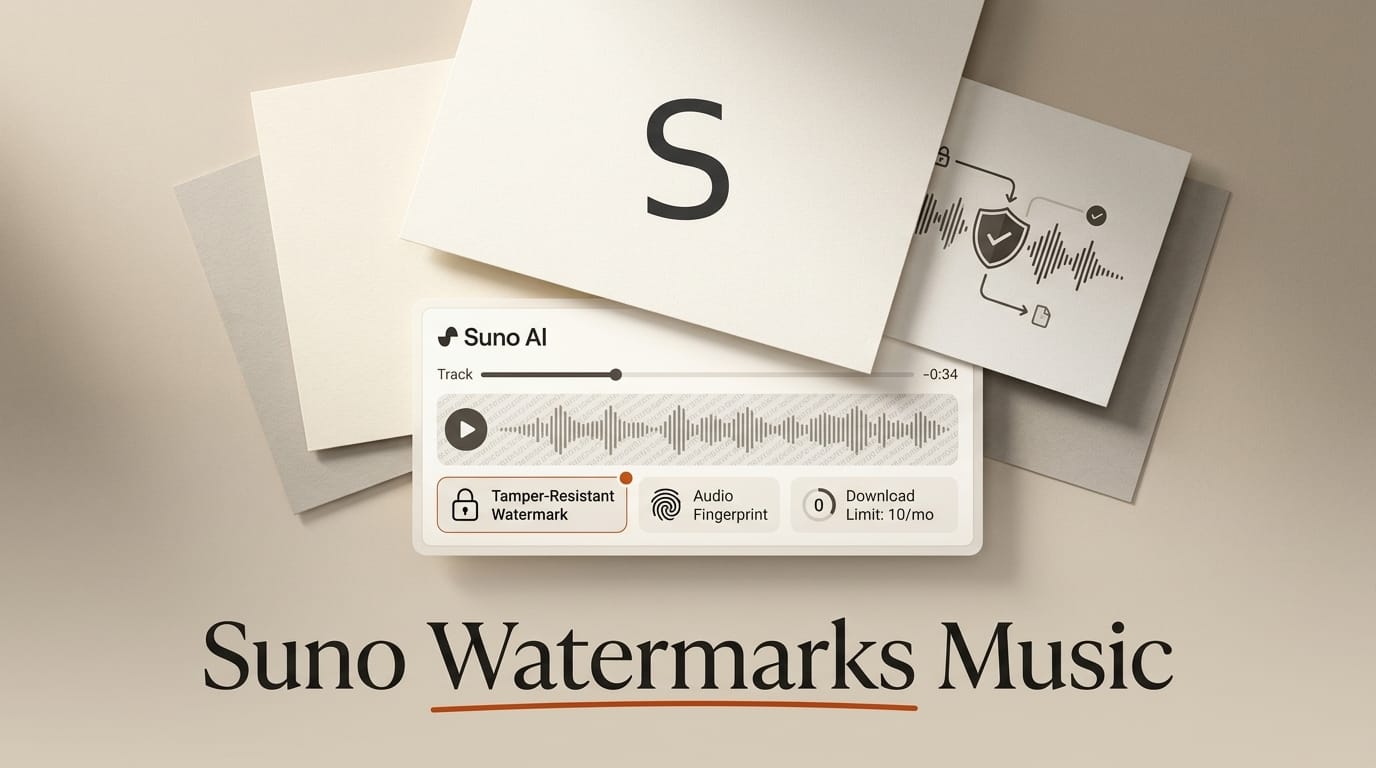
Suno, the AI music generator behind hundreds of millions of AI-created songs, announced on August 6, 2026 that it will add audio watermarking and fingerprinting to every track it produces, tighten how songs can be downloaded and mass-distributed, and rewrite its community guidelines to ban unauthorized voice cloning and deceptive audio. The changes, detailed in a company blog post and first reported by TechCrunch, arrive while Suno is still fighting record-label copyright suits. For the millions of creators who use Suno to make music, the practical question is simpler than the legal one: what changes about how you make and release AI songs?
What Suno Announced
In a post titled "Building the Future of Music Responsibly," Suno laid out four concrete moves. First, it is adopting audio watermarking and fingerprinting that CEO Mikey Shulman describes as "durable and resistant to tampering, without affecting the listening experience." The watermark is meant to let streaming platforms and rights organizations automatically identify a track as Suno-generated. Second, Suno is screening uploaded audio through third-party detection systems, naming content-recognition provider Audible Magic and metadata company Musixmatch as partners for spotting copyrighted or unlicensed material at upload time.
Third, a forthcoming downloads policy will "limit the ability to mass distribute songs on streaming platforms, while preserving the professional, creative, and personal ways people use Suno." The company stresses this "won't affect the vast majority of our users, but it will make large-scale abuse much harder." Fourth, updated community guidelines now explicitly prohibit recreating existing songs, uploading unlicensed material, using someone's voice without consent, scams, spam, fake engagement, and bot evasion, with enforcement escalating from warnings to permanent bans and referrals to authorities. You can read the full policy in Suno's announcement.

How Suno's Approach Compares
Watermarking AI audio is no longer novel. Google DeepMind's SynthID embeds an inaudible signature into audio at generation time and has become a de facto provenance standard, adopted across Google's Lyria music model and beyond. The pressure is also regulatory: the EU AI Act's Article 50 transparency obligations, enforceable from August 2, 2026, require AI-generated content to carry machine-readable labels. Suno did not say whether it will use SynthID or build its own scheme, but the direction of travel across the industry is the same.
| Measure | What it does | Who it affects |
|---|---|---|
| Audio watermarking | Embeds a tamper-resistant, inaudible marker identifying tracks as Suno-generated | Every creator; invisible in normal listening |
| Audio fingerprinting | Lets platforms match a track against a Suno reference database | Distributors and streaming services |
| Upload screening (Audible Magic, Musixmatch) | Flags copyrighted or unlicensed audio at upload | Creators uploading reference audio or stems |
| Download and distribution limits | Caps mass distribution to streaming platforms | High-volume uploaders and abusers |
| Community guidelines | Bans voice cloning without consent, song recreation, spam | All users; escalating enforcement |
The Legal Backdrop Driving This
None of this is happening in a vacuum. The Recording Industry Association of America sued Suno and rival Udio in June 2024, alleging their models were trained on copyrighted recordings without permission. Warner Music Group settled with Suno in late 2025 and, per Rolling Stone, agreed to a licensing partnership under which Suno will roll out new licensed models in 2026. Cases from Universal Music and Sony remain unresolved. Provenance tooling like watermarking is exactly what a licensing-era Suno needs: it gives labels and streaming services a verifiable way to tell licensed AI music from unlicensed uploads, which is the foundation any royalty or attribution system would rest on.
What This Means for Creators
For the hobbyist making a track for a video or a personal project, almost nothing changes day to day. The watermark is inaudible, and Suno says normal creative, professional, and personal use is preserved. The real shift is for anyone who treats Suno as a content pipeline: uploading dozens or hundreds of tracks to Spotify, TIDAL, or Deezer to farm streams. That workflow is the explicit target of the download limits, and watermarking makes those tracks trivially identifiable to platforms now rolling out mandatory AI-disclosure systems.
The guideline change on voice is the other one to watch. Suno now bans using a person's voice without consent, which mirrors the wider reckoning over AI voice cloning that has already reshaped tools across the audio space, from music to voice-cloning platforms. If your workflow involved mimicking a known artist's vocals, that path is now against the rules and increasingly detectable.

How to Adapt Your Suno Workflow
If you release AI music seriously, treat this as the moment to move your process onto solid ground. Here is a practical checklist.
- Disclose AI generation on your releases. Streaming platforms are enforcing AI-content labels this year. Mark your tracks as AI-assisted in your distributor's metadata rather than hoping the watermark goes unnoticed.
- Stop cloning recognizable voices. The updated guidelines ban unauthorized voice use and enforcement now escalates to permanent bans. Build original vocal styles or use consented voices only.
- Right-size your distribution. If your model was uploading large batches of tracks for stream revenue, expect that to be throttled. Focus on fewer, higher-quality releases you can actually promote.
- Keep your source material clean. With Audible Magic and Musixmatch screening uploads, any copyrighted stems or reference audio you feed in can be flagged. Use material you own or have licensed.
- Watch for the licensed models. Suno's Warner deal points to new licensed models in 2026. Those may unlock legitimate use of catalog music, which could be a bigger opportunity than the gray-area workflows being closed off.
The through-line is that AI music is professionalizing. The watermark is not a restriction on making music; it is the price of admission to a distribution ecosystem that is about to start checking IDs at the door.
Frequently Asked Questions
Will the watermark change how my Suno songs sound?
No. Suno says the watermark is designed to be inaudible and to not affect the listening experience. It is embedded in the audio signal below the threshold of human hearing, so a normal listener cannot detect it.
Can I still download my Suno songs?
Yes for ordinary creative, professional, and personal use. The forthcoming downloads policy targets mass distribution to streaming platforms, not individual downloads. Suno says the change will not affect the vast majority of users.
Does this mean my existing AI tracks will be removed from Spotify?
Suno has not announced retroactive takedowns of already-distributed tracks. The measures focus on future watermarking, upload screening, and distribution limits. However, streaming platforms are independently rolling out AI-disclosure requirements this year.
Why is Suno doing this now?
Suno is settling and negotiating copyright litigation with major record labels. Warner Music settled in late 2025 with a licensing partnership, while Universal and Sony cases continue. Watermarking and provenance tools give labels and platforms a way to distinguish licensed AI music from unlicensed uploads.
Is watermarking unique to Suno?
No. Google DeepMind's SynthID has become a widely adopted audio provenance standard, and the EU AI Act's transparency rules push all AI tools toward machine-readable labels. Suno has not confirmed whether it will use SynthID or a proprietary system.
Can I still clone a singer's voice in Suno?
No. The updated community guidelines explicitly prohibit using someone's voice without consent, alongside recreating existing songs and uploading unlicensed material. Enforcement escalates from warnings to permanent bans and referral to authorities.