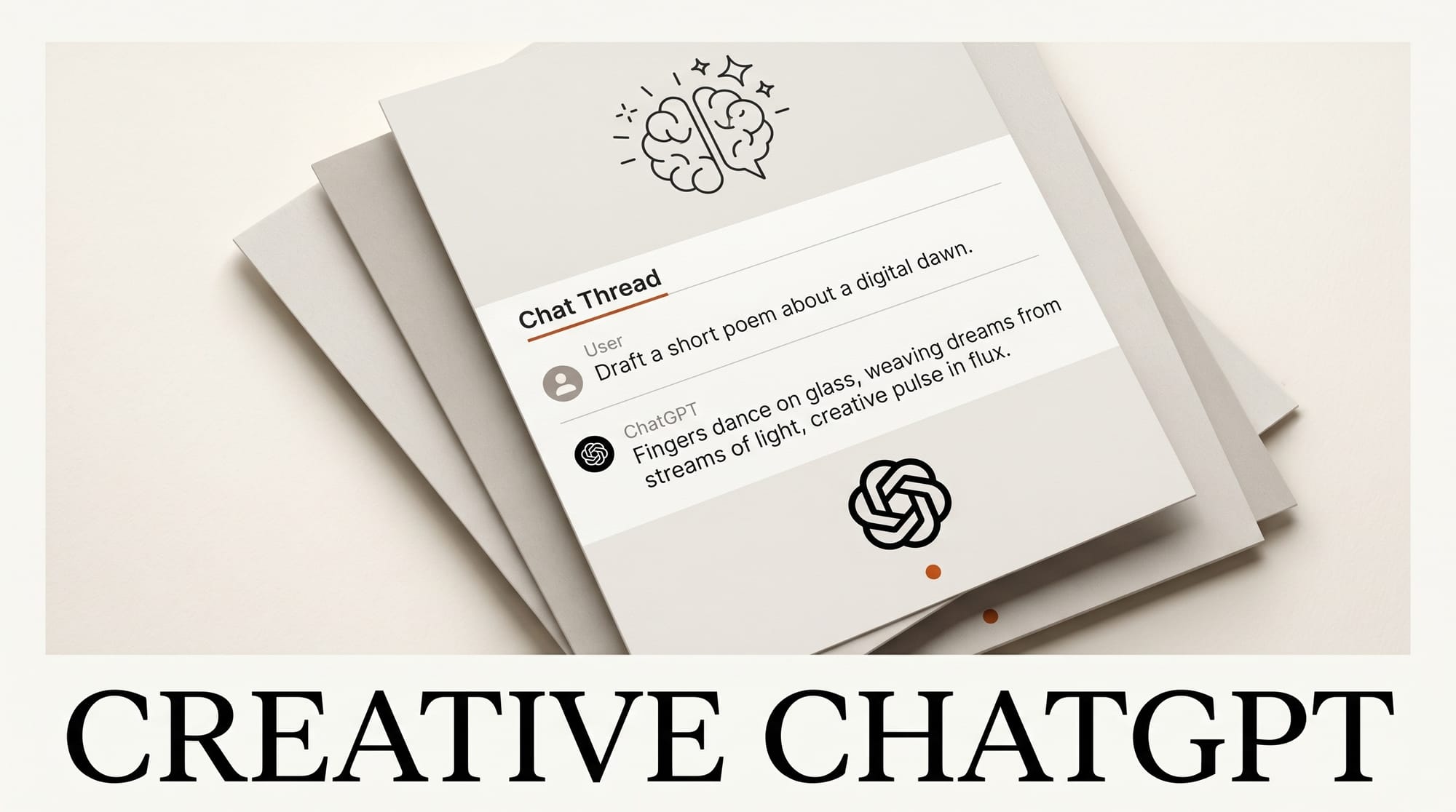
ChatGPT in 2026 is no longer a chat product. It is a creative workstation: text, image, video, voice, code, and file analysis from one entry point, with a desktop app that sits inside the working creator's flow alongside Photoshop, Premiere, Logic, and Blender. This is the working creator's complete guide to ChatGPT for creative work in 2026: which features actually ship, which workflows are production-ready, and where ChatGPT slots into a real creative pipeline.
Filtered for production use. Every workflow below has been used to ship real client work, original content, or commercial output in the last 90 days.
What ChatGPT does for creative work in 2026
ChatGPT runs on the GPT-5.5 frontier model with image generation through GPT Image 1 and voice through Advanced Voice. The desktop app on macOS and Windows reads your screen, opens files, and writes back to local apps. The Custom GPT system lets each creator save brand voice, style rules, and reference materials as a reusable assistant. The Code Interpreter executes Python in a sandbox, useful for everything from CSV-to-shot-list conversion to Blender Python scripting.
What it does not do natively: music generation, motion graphics, or vector design. Those still belong to Suno, After Effects, and Illustrator. ChatGPT slots in as the brief writer, asset ideator, and asset-finisher across those other tools.
Designer workflow: brand voice, hero images, and copy
The designer who lives in Figma, Photoshop, and Illustrator gets the most direct lift from ChatGPT in 2026. The pattern that ships:
- Build a Custom GPT once. Paste the brand brief, voice guidelines, sample copy, and 5-10 example assets. Name it BrandName Designer Assistant. Every conversation inside it inherits the brand context, so prompts stay short.
- Generate hero images with GPT Image 1 directly in ChatGPT. Reference style sheets pasted in as image attachments anchor the output. Image generation respects the style sheet at 80-90 percent fidelity, enough to use as production drafts.
- Pipe the brief into Figma via the Figma Make connector. Figma agents pick up the ChatGPT-written brief and generate component-level layouts grounded in your existing design system.
- Send rejected drafts back to ChatGPT with a screenshot. GPT Vision reads the image, the Custom GPT carries the brand context, and the next iteration shifts in the right direction.
Specific creator-tier wins: a freelance brand designer can produce 3-5 hero concepts plus one full brand brief in 90 minutes versus the 4-6 hours that block of work used to cost.
Video editor workflow: storyboards, scripts, and editing notes
For video editors working in Premiere Pro, DaVinci Resolve, or Final Cut, ChatGPT's contribution is preproduction and review. A video model such as Runway or Kling 3 covers the storyboard and rough-shot side; GPT-5.5 covers the language layer.
- Storyboards: have ChatGPT turn the script into per-scene prompts, then generate them in Runway or Kling 3. Output is rough video, but it is enough to lock blocking, pacing, and shot order before live shoot day.
- VO scripts: ChatGPT writes a tight script in your brand voice from a rough outline. Pair with ElevenLabs or OpenAI Advanced Voice for placeholder audio during edit.
- Editing notes: drop a rough cut screenshot or timecoded text export into ChatGPT. GPT-5.5 writes scene-by-scene critique with timecode references.
- YouTube descriptions and chapter markers: a single prompt with the full transcript yields title, description, chapter timestamps, and tags ready to paste into Studio.
What does not work yet: real-time motion graphics. ChatGPT can describe an After Effects setup in detail, but it cannot drive AE directly. The hand-off is still manual.
Music producer workflow: arrangement, lyrics, and reference analysis
ChatGPT does not generate music. It is still the best language model for the surrounding work in a music production session.
- Arrangement maps: prompt with a target song duration, tempo, and reference track. Output is a section-by-section arrangement (intro, verse, chorus, bridge, outro) with bar counts and instrumentation notes.
- Lyrics: ChatGPT writes lyrics in any voice or genre and adapts to syllable counts when given the melody contour. Pair with Suno for melodic sketching.
- Reference track analysis: paste a Spotify or YouTube link and ask for a structural breakdown. ChatGPT reads the published metadata and infers structure from the duration, BPM, and known song-form patterns.
- Mix notes: drop the export bounce into ChatGPT for a critical listen using GPT Vision plus audio analysis. Output suggests EQ moves, stereo balance, and reference comparisons.
3D and game-dev workflow: Blender, Python scripting, and reference
The 3D side of ChatGPT got serious with the Blender Add-On and Code Interpreter combination.
- Blender Add-On: install the OpenAI Blender connector. ChatGPT can read scene data, write Python scripts that modify the scene, and explain Geometry Nodes setups inline. Useful for batch operations like renaming 200 objects or rebuilding a particle system.
- Code Interpreter Python: drop a USD or FBX file into ChatGPT. The Code Interpreter runs scripts to inspect, transform, and re-export geometry. Common use: cleaning up bad UVs from imported meshes.
- Reference-image analysis: GPT Vision reads concept art, architectural references, or photo plates. Output describes lighting, mood, geometry, and shader hints in language that maps directly to Blender or Houdini terms.
- Game design docs: ChatGPT writes mechanic specs, level layouts, and dialogue trees from a one-line pitch. Pair with Unity ML-Agents or Unreal's MetaHuman for in-engine wiring.
Comparison: ChatGPT versus Claude for creative work
Both ChatGPT and Claude ship creative-tool integration suites in 2026. The split:
- ChatGPT: Stronger native image (GPT Image 1). Stronger Code Interpreter for scripting. Better Custom GPT system for reusable brand assistants. Wider integration ecosystem through GPTs.
- Claude: Stronger named-app connector suite (Adobe, Blender, Ableton, Autodesk, Resolume, SketchUp, Splice, Affinity). Stronger long-context for full project briefs. Better at structured analysis and revision passes.
- Practical pick: Designers and video editors leaning on image and video generation pick ChatGPT. Designers and 3D artists who want native-app control through Adobe and Blender pick Claude for Creative Work. Many production teams run both.
Pricing and tier picks for 2026
- ChatGPT Plus ($20/mo): Single creator. Includes GPT-5.5, GPT Image 1, Advanced Voice. The most common starting tier.
- ChatGPT Team ($25-30/user/mo): Shared Custom GPTs and workspace. The right tier for a 2-10 person studio.
- ChatGPT Enterprise (custom pricing): SOC 2, SSO, longer context, no training on data. Required for agency or studio environments handling client material under NDA.
- Edu: Discounted for schools and universities. Same feature set as Plus.
What to watch in 2026
- DALL-E 3 sunset: Shutting down May 12, 2026. Migration is a one-line model parameter swap to GPT Image 1. Audit code that still calls the old endpoint this week.
- Video in ChatGPT: OpenAI shut down Sora in September 2026; watch whether video returns to ChatGPT before planning video work around it.
- Custom GPT marketplace monetization: OpenAI revenue-share for top-distributed Custom GPTs is in private beta. Brand-voice GPTs from designers and agencies will be a salable asset.
- Native music generation: Still absent in ChatGPT through 2026. Suno, Udio, and Cursor competition keeps the pressure on, but no public OpenAI roadmap entry.
Frequently asked questions
Does ChatGPT replace Photoshop for designers?
No. ChatGPT generates raster image drafts. Photoshop is still the finisher for layered editing, masks, retouching, and print-ready output. The pattern is ChatGPT for ideation, Photoshop for production.
Can I use ChatGPT in Adobe Premiere?
Not directly through OpenAI. ChatGPT can write scripts, descriptions, and editing notes that you paste into Premiere manually. For native Premiere agent control, see Claude's connector suite.
What about copyright on GPT Image 1 output?
OpenAI grants commercial rights to images generated by paid users on Plus, Team, and Enterprise plans. Trademark and likeness still apply: you cannot generate a logo or a famous person's face for commercial use.
Is ChatGPT Plus enough for professional design work?
For most freelancers, yes. The absence of shared workspaces is the main reason studios upgrade to Team.
How does ChatGPT compare to Gemini for creative work?
Gemini ships Imagen 4 plus NotebookLM and tighter integration with Google Workspace (Docs, Slides, Drive). ChatGPT ships stronger Custom GPT branding. We compare all three in our Claude vs ChatGPT vs Gemini for Creative Work head-to-head.
Does ChatGPT work offline?
No. The desktop app requires an active internet connection. The Code Interpreter and image generation both run in OpenAI's sandbox, not locally.
Keep reading
- Claude for Creative Work: Anthropic Connector Suite Launches: the named-app connector suite from Anthropic
- AI Coding Tools 2026 Complete Guide: the developer-side companion
- AI Image Generation 2026 Complete Guide: where GPT Image 1 sits in the broader landscape
- AI for Content Creators 2026: the master resource synthesizing all seven 2026 pillars
This guide will be updated as ChatGPT and GPT Image 1 capabilities ship through 2026. Subscribe to our weekly Tuesday digest for what shipped this week and what is worth your time.