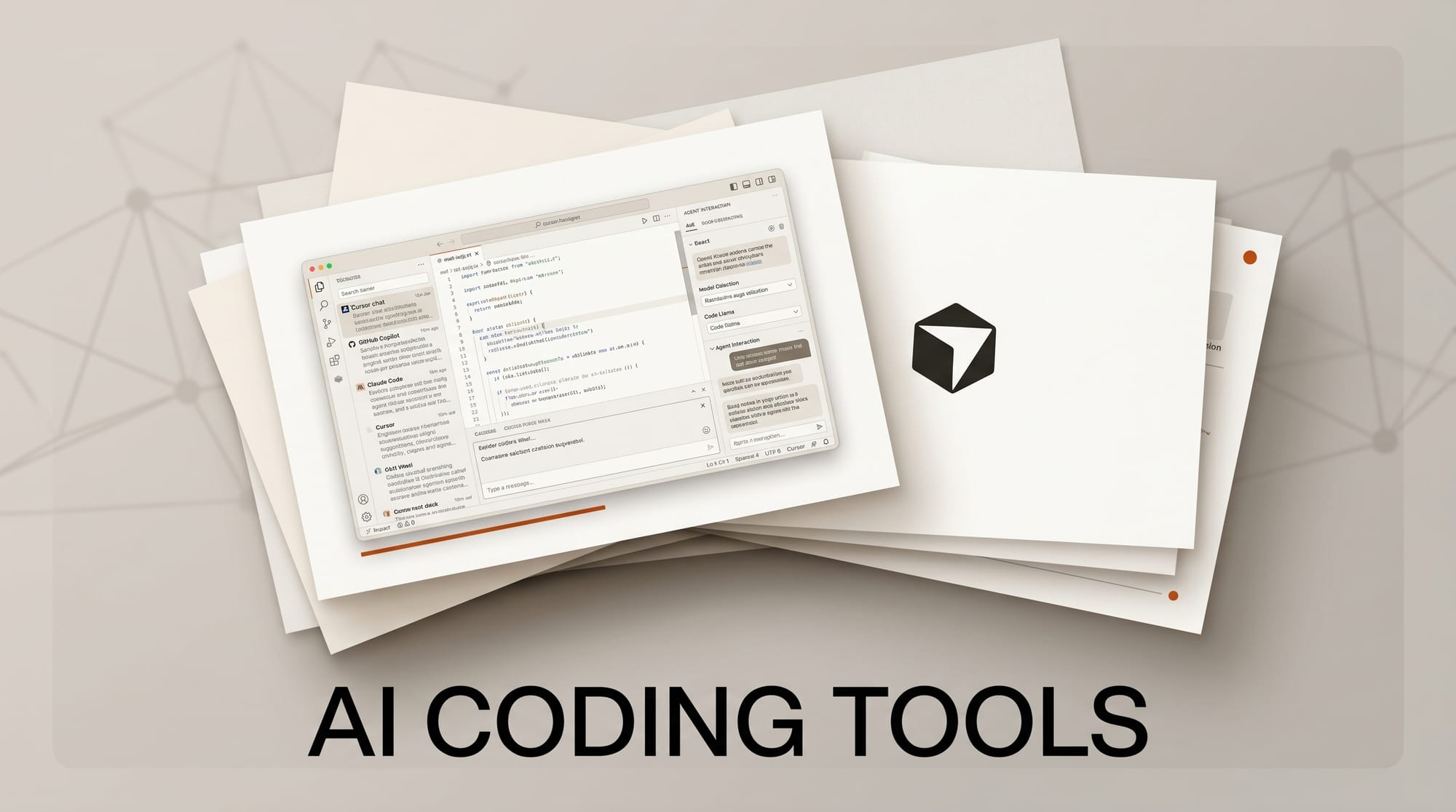
AI coding tools in 2026 are no longer optional. The JetBrains 2026 developer survey found 90 percent of working developers use at least one AI coding tool every day. The market consolidated around three platforms (Cursor, GitHub Copilot, Claude Code) with strong open-source alternatives (Aider, Continue.dev, Cline). The shift in scope is real: SpaceX inked a $10B Cursor deal with a $60B buyout option, app store traffic surged 84% as AI coding tools took off, and individual developers are shipping work at 3-5x the rate they did two years ago.
This is the working developer's complete guide to AI coding in 2026. Filtered for production use, not for novelty. Every tool below has been used to ship real code in the last 90 days, and every workflow pattern is one we have seen working teams actually run.
TL;DR -- Which AI coding tool for which job
- Best all-around code editor: Cursor 3.1 -- agent workspace, voice input, multi-agent tiled layout.
- Best for GitHub-native teams: GitHub Copilot /fleet for multi-agent CLI work, plus the standard Copilot in your IDE.
- Best for terminal / agent-first workflows: Claude Code from Anthropic.
- Best for free / open-source: Cognition SWE-1.6 at 950 tokens/sec, or Aider on top of any frontier API.
- Best for design-to-code: GLM-5V-Turbo scoring 94.8 on design-to-code benchmarks.
- Best for wireframe-to-app: Alibaba Qwen3.6-Plus.
- Best models powering all of the above: Claude Opus 4.7 for highest accuracy, GPT-5.5 and Gemini 2.5 for instruction breadth, Kimi K2.6 and Qwen3.6-Max for the open-weights frontier.
- Quick listicle ranking: our Best AI Coding Tools 2026 compares 12 tools head-to-head.
Quick comparison: leading AI coding platforms
| Tool | Strength | Pricing | Free tier | Best for |
|---|---|---|---|---|
| Cursor 3.1 | Agent workspace, multi-model | $20/mo Pro | Yes (limited) | Solo and team developers |
| GitHub Copilot + /fleet | GitHub native, multi-agent CLI | $10/mo individual | Free for OSS | GitHub-centric teams |
| Claude Code | Terminal-first agent | Pay-per-API | Limited | CLI workflows, automation |
| Aider | Open-source CLI | API costs only | Free | Custom workflows, scriptable |
| SWE-1.6 (Cognition) | Free agent | Free | Yes | OSS contributors, students |
| Continue.dev | Open IDE plugin | API costs only | Free | VS Code natives |
| Cline | Open VS Code agent | API costs only | Free | Self-hosted agent control |
| Bolt / Lovable / v0 | Build entire apps from prompts | $20-$50/mo | Limited | Rapid prototyping, full apps |
Cursor 3.1 -- Best all-around AI code editor for 2026
Cursor 3 rebuilt itself as an agent workspace in 2026, and 3.1 added tiled multi-agent layout and voice input. For working developers, Cursor remains the strongest all-in-one option in 2026. The IDE understands large codebases, generates boilerplate at near-perfect accuracy, refactors across files faster than any code-completion tool, and the agent mode now handles complete features end-to-end with human review gates.
Cursor Bugbot hit a 78% resolution rate with learned rules -- the AI bug-fixing agent that ships PRs autonomously when it can confidently solve a reported issue. For maintenance-heavy codebases, this is meaningful per-week time savings.
The strategic significance: SpaceX inked a $10B Cursor deal with a $60B buyout option. Whatever you think of the dollar figure, the signal is clear -- Cursor is enterprise-grade infrastructure now, not a startup gamble.
Cursor 3.1 specifics
- Agent workspace: Multiple AI agents run in parallel on different tasks, tiled in the editor.
- Voice input: Talk to the AI; the editor types and runs. Useful for code review, brainstorming, complex multi-file changes.
- Multi-model: Cursor exposes Claude Opus 4.7, GPT-5.5, Gemini 2.5, plus open-weights options. Switch per task.
- Bugbot: Autonomous bug-fixing agent. 78% resolution rate on tracked issues.
GitHub Copilot + /fleet -- Best for GitHub-native teams
GitHub Copilot remains the default AI coding tool for most working developers in 2026. Copilot /fleet brought multi-agent CLI work to the platform -- orchestrate multiple AI agents on parallel tasks from the terminal. Rubber Duck pairs AI models for cross-review, catching issues that a single model would miss.
Copilot's edge: native GitHub integration. Pull requests, issues, code review, and the agent system live where your code already lives. For teams whose entire workflow is GitHub-centric, the friction of switching to Cursor or Claude Code is real, and the productivity delta from Copilot's continued improvements is now meaningful.
Recent volatility worth noting: GitHub Copilot paused Pro signups and removed Opus models mid-2026 in response to capacity and licensing constraints. Plan accordingly if you depend on specific model availability.
Claude Code -- Best for terminal-first agent workflows
Claude Code from Anthropic is the strongest agent-first AI coding tool for terminal-native developers in 2026. The model handles long context (Claude Opus 4.7's million-token context window), follows complex instructions reliably, and the CLI-first design integrates cleanly into existing developer workflows without requiring an IDE switch.
Claude Code's strengths align with specific use cases: long-running automations (refactor across 50 files, fix 30 issues sequentially), agent-driven testing (write tests, run them, fix failures, iterate), and CLI-native development workflows. Anthropic's Claude Managed Agents brought hosted agent infrastructure for production AI workflows on top of Claude Code primitives.
Caveat: the Claude Code source leak via npm exposed implementation details earlier in 2026. The product is intact and continues to ship, but it remains worth understanding the boundaries of what the platform exposes.
Open-source AI coding -- production-grade in 2026
Open-source AI coding tools crossed the production threshold in 2026. Three options worth knowing:
Cognition SWE-1.6 -- Free coding agent
Cognition shipped SWE-1.6 as a free coding agent running at 950 tokens/sec. For students, OSS contributors, and developers who want agent-first workflows without paying per API call, SWE-1.6 is the leading free option in 2026.
Aider -- CLI agent on top of any frontier model
Aider remains the strongest open-source CLI coding agent in 2026. Pair it with Claude Opus 4.7, GPT-5.5, or DeepSeek V4 (cost-effective open-weights frontier model) and you have an agent that handles multi-file refactors, test generation, and feature implementation. Pay only for API tokens; the agent infrastructure is free.
Continue.dev and Cline -- Open IDE plugins
Continue.dev brings agent-first AI coding into VS Code and JetBrains as a free open-source plugin. Cline is the more agent-aggressive open VS Code plugin, exposing direct file system control and shell access to the AI agent. Both are free; both work with any API.
The models powering AI coding in 2026
The AI coding tools above are runtimes. The actual code generation comes from frontier models. The 2026 leaderboard:
Claude Opus 4.7 -- Highest accuracy
Claude Opus 4.7 remains the highest-accuracy commercial coding model in 2026. Long-context reasoning (1M tokens) means the model can hold an entire small-to-mid-size codebase in context for refactoring decisions. The vision capabilities (read and act on screenshots, design comps, error message images) extend the use cases beyond pure code.
Opus 4.7 powers Cursor, Claude Code, and is increasingly available in Copilot. For high-stakes coding work -- production systems, financial code, security-sensitive -- Opus 4.7 is the default choice.
GPT-5.5 -- Best instruction breadth
GPT-5.5 is the strongest at handling diverse coding instructions across languages, frameworks, and domains. Where Opus is the precision tool, GPT-5.5 is the breadth tool. Best for full-stack work spanning many languages, scripting tasks, and rapid prototyping.
Gemini 2.5 Pro -- Cost-effective frontier
Gemini 2.5 Pro fills the cost-conscious frontier slot -- high quality at notably lower per-token pricing than Opus or GPT-5.5. For volume coding tasks, Gemini is often the right model.
Open-weights frontier: DeepSeek V4, Kimi K2.6, Qwen3.6
The open-weights coding frontier in 2026:
- DeepSeek V4: 1M context, MIT license, strong on coding and math. The most-used open-weights model in production developer workflows.
- Kimi K2.6: Tops every coding benchmark for open-weights models. Permissive license.
- Qwen3.6-Max: Alibaba's flagship coding model, top on agentic coding benchmarks.
- Qwen3.6-27B: Open dense model that beats its 35B sibling -- efficiency leader in the dense category.
For teams that can self-host, the open-weights frontier in late 2026 is competitive with commercial Opus and GPT-5.5 on most workflows, at a fraction of the inference cost. The bottleneck is hardware and operational maturity, not model capability.
Design-to-code and wireframe-to-app
Two specialized categories in 2026 that deserve their own treatment:
Design-to-code: GLM-5V-Turbo
GLM-5V-Turbo scores 94.8 on design-to-code benchmarks. Feed a Figma export or design image, get production-ready React, Vue, or HTML code. For frontend teams that bridge design and engineering, this is meaningful weekly time savings.
Wireframe-to-app: Qwen3.6-Plus
Alibaba Qwen3.6-Plus takes wireframes and turns them into working applications, agentically. The agent handles routing, state management, API integration, and component scaffolding -- generating an entire small-to-mid app from a sketch. Useful for prototype work and internal tooling.
Build-the-whole-app: Bolt, Lovable, v0
Three platforms in 2026 ship complete apps from text prompts: Bolt (StackBlitz), Lovable, and v0 (Vercel). All three target the "non-developer needs an app" market -- solid for prototypes, MVPs, and internal tooling. Less suited to production codebases that require integration with existing infrastructure.
Working developer pipelines for 2026
Three patterns dominate working developer workflows in 2026:
- Solo developer: Cursor 3.1 Pro ($20/mo) as primary IDE, occasional Claude Code for terminal-heavy automation, GitHub Copilot Free for GitHub-native PR work. Total: $20/mo.
- Small team (3-10 devs): Cursor 3.1 Pro for everyone, GitHub Copilot Business for the GitHub workflow, Claude Code for shared automation scripts. Add a CI integration of Cursor Bugbot for automated bug-fix PRs.
- Open-source / cost-conscious: Continue.dev or Cline in VS Code, Aider for CLI agent work, DeepSeek V4 self-hosted as the model. Per-token cost approaches zero after compute is paid off.
- Enterprise / regulated: Cursor or Claude Code with self-hosted Opus through Anthropic enterprise, plus on-prem open-weights (Qwen3.6, Kimi K2.6) for IP-sensitive work.
What's coming next in AI coding
- Cursor 4 likely: Cursor's release cadence suggests Cursor 4 in late 2026 or early 2027. Expect deeper agent autonomy, longer-running task chains, and tighter Bugbot integration.
- OpenAI's GPT-Coder: A coding-specialized GPT variant has been hinted at; rumored launch late 2026.
- On-device coding models: Qwen3.6-27B's efficiency hints at a future where coding-quality models run locally on developer laptops without cloud calls.
- Voice-driven development: Cursor 3.1 added voice; expect voice-as-primary-input to become a meaningful workflow in 2026-2027.
- Agent-pair-programming: The "agent that watches you code and suggests in real time" model is moving past the autocomplete pattern toward true continuous collaboration.
Security and operational reality
Three operational issues every working developer should be tracking in 2026:
- Source leaks: The Claude Code source leak via npm in 2026 highlighted the risk of dependency compromise. Audit your AI tool dependency chains.
- Capacity volatility: The GitHub Copilot Pro signup pause and Opus removal mid-2026 showed that even mature platforms have supply-side constraints. Have a fallback plan.
- Withheld releases: Anthropic withheld Claude Mythos as too dangerous to release for cybersecurity work in 2026. The line between "useful coding assistant" and "automated vulnerability discovery tool" is blurring; expect more capability gating from frontier labs.
Frequently asked questions
Which AI coding tool is best for solo developers in 2026?
Cursor 3.1 Pro at $20/mo. The agent workspace, multi-model selection, and Bugbot autonomous fixing handle the breadth of solo developer needs better than any other tool in 2026. GitHub Copilot Free is a solid alternative for OSS work; Aider plus a Claude or DeepSeek API is the cost-conscious open-source path.
Can AI coding tools ship production code in 2026?
Yes -- and they already are at scale. The 2026 JetBrains survey found 90% of working developers use AI coding tools daily. Production code shipped with AI assistance is the norm, not the exception. The shift in 2026 is from "AI as autocomplete" to "AI as collaborator" with human review at architecture and integration boundaries.
Which model is best for AI coding in 2026?
For highest accuracy on complex code: Claude Opus 4.7. For breadth across languages and frameworks: GPT-5.5. For cost-conscious frontier work: Gemini 2.5 Pro. For open-weights / self-hosted: DeepSeek V4 or Kimi K2.6. Most working developers don't pick one -- they use Cursor or Copilot which expose multiple models, and switch per task.
Is GitHub Copilot or Cursor better in 2026?
Cursor is the stronger primary IDE; Copilot is the stronger GitHub-native integration. Many working developers use both -- Cursor for primary editor work, Copilot Free or Individual for GitHub-resident PR review and issue work. The $20/mo Cursor + $10/mo Copilot combo is the most common 2-tool setup we observe in 2026.
Are AI coding tools commercially safe to use?
Yes, with caveats. The code AI generates is yours under the terms of the tools you use. Cursor, Copilot, and Claude Code on commercial tiers all grant you ownership of generated code. Audit any code that reproduces existing copyrighted material; AI tools occasionally output near-verbatim training data. Document your AI tool use in your project history for any future IP audits.
Will AI replace developers?
The Wharton-style productivity studies suggest AI-augmented developers ship 3-5x more than control groups. That doesn't necessarily mean fewer developers -- it means small teams ship work that previously required large teams, and the demand for software keeps expanding. The shift in 2026 is that junior roles are doing senior-level work earlier; the craft expectations are rising for everyone. Demand for skilled developers is up, not down.
Can open-source AI coding tools match commercial ones?
For most workflows in 2026, yes. Aider plus Claude Opus or DeepSeek V4 ships work at parity with Cursor on most tasks. Cline plus a frontier model ships work at parity with Claude Code. The gap is mainly UX polish and built-in features (Bugbot, multi-agent tiling, voice input) -- the core code generation quality is comparable.
Next steps
If you have not adopted AI coding tools or your setup is more than 6 months old, the practical entry path: install Cursor, take the free trial, run a real project end-to-end, then decide on Pro upgrade or open-source alternative based on your budget and customization needs.
For ongoing coverage, our Best AI Coding Tools 2026 ranks 12 tools head-to-head, our ComfyUI 2026 definitive workflow guide covers the broader open-source AI ecosystem, and our weekly newsletter ships every Tuesday with what shipped this week and what is worth your time.