Anthropic on April 8 launched Claude Managed Agents in public beta, a cloud-hosted infrastructure service that handles the heavy lifting of running AI agents at production scale. The platform provides sandboxed execution, session persistence, credential management, and end-to-end tracing, replacing what the company says is "months of infrastructure work" with a composable API that can cut development timelines by 10x.
For the broader landscape, see our complete guide to AI coding tools in 2026.
What Happened
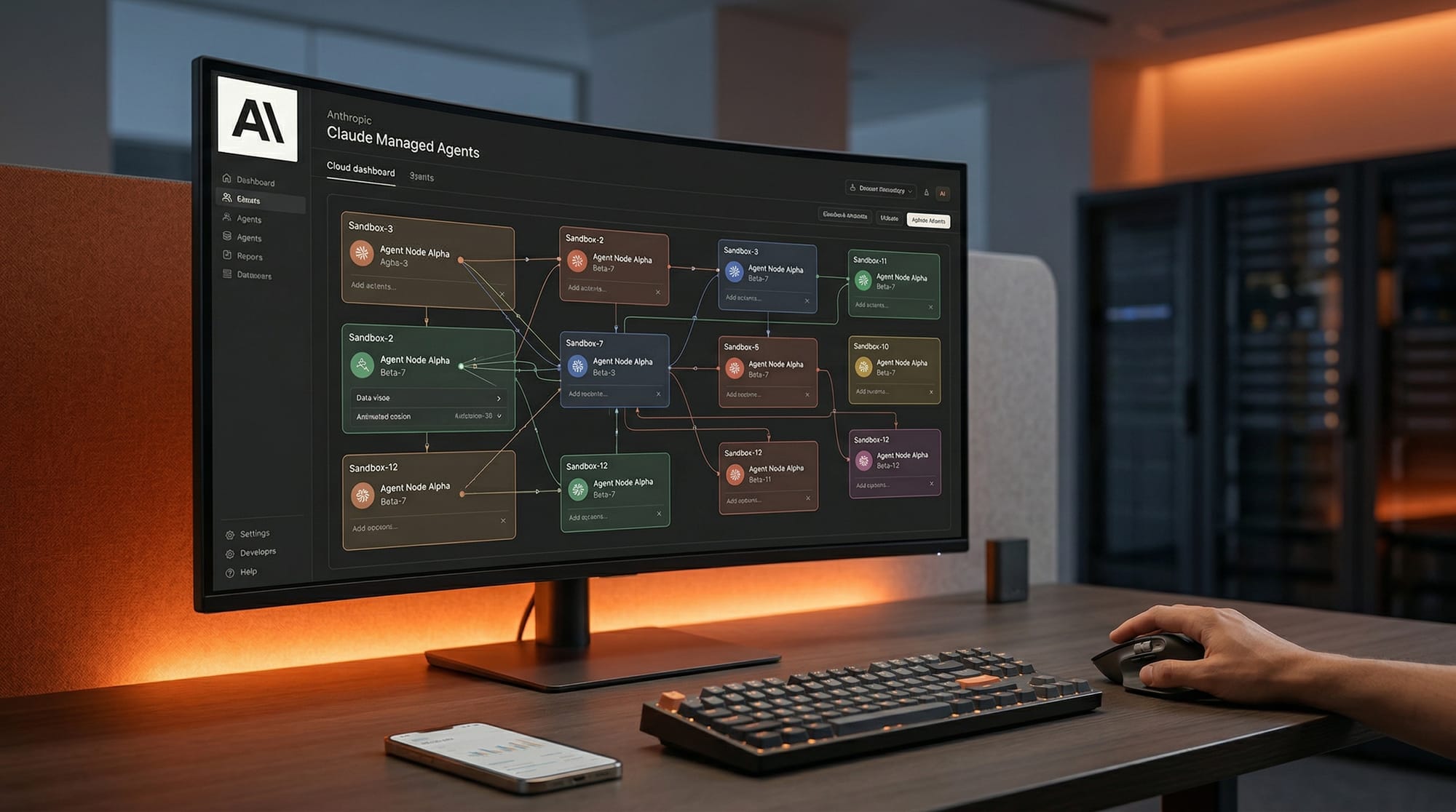
Claude Managed Agents is a suite of APIs on the Claude Platform that separates the "brain" from the "hands" of AI agents. Claude handles the reasoning and tool selection, while disposable Linux containers provide sandboxed environments for code execution, file operations, and command-line tasks.
The architecture breaks down into three core components: Sessions (append-only activity logs), Harnesses (orchestration loops routing Claude outputs to infrastructure), and Sandboxes (isolated execution environments). Each piece is independently swappable, so teams can update implementations without breaking existing agents.
Agents connect to third-party services through MCP (Model Context Protocol) servers and can be configured via natural language descriptions or YAML files. The Claude Console provides session tracing, tool call inspection, and failure mode analysis for monitoring deployed agents.
Pricing follows a consumption model: standard Claude API token rates plus $0.08 per session-hour for active runtime. Web search inside a session costs $10 per 1,000 searches. Idle time while waiting for inputs is excluded from charges.
Enterprise customers including Notion, Rakuten, and Asana have already integrated the service into production systems.
Why It Matters for Creators
For creators working with AI tools, Managed Agents signals a shift from one-shot prompts to persistent, multi-step AI workflows. The platform handles document processing, code analysis, business automation, and report generation out of the box, tasks that previously required custom orchestration code.
Two features in research preview stand out: multi-agent coordination (agents spawning other agents for complex tasks) and automatic prompt refinement, which showed up to 10-point improvements in task success rates during internal testing. These are not yet generally available but hint at where agent infrastructure is heading.
This launch arrives in a competitive landscape alongside Google's Scion multi-agent orchestrator and Azure AI Agent Service. The key differentiator Anthropic is pushing: built-in governance controls and scoped permissions that let teams define exactly which tools an agent can access and whether actions require human approval. For creative AI workflows that chain multiple tools together, managed infrastructure like this removes a major barrier to adoption.
What to Do Next
Claude Managed Agents is available now in public beta through the Claude Platform. Developers can start by defining an agent with a task description, specifying tools and security rules, then deploying via the Console. Multi-agent coordination and self-evaluation require separate access requests during the research preview phase. Pricing starts at standard API rates plus $0.08 per session-hour.