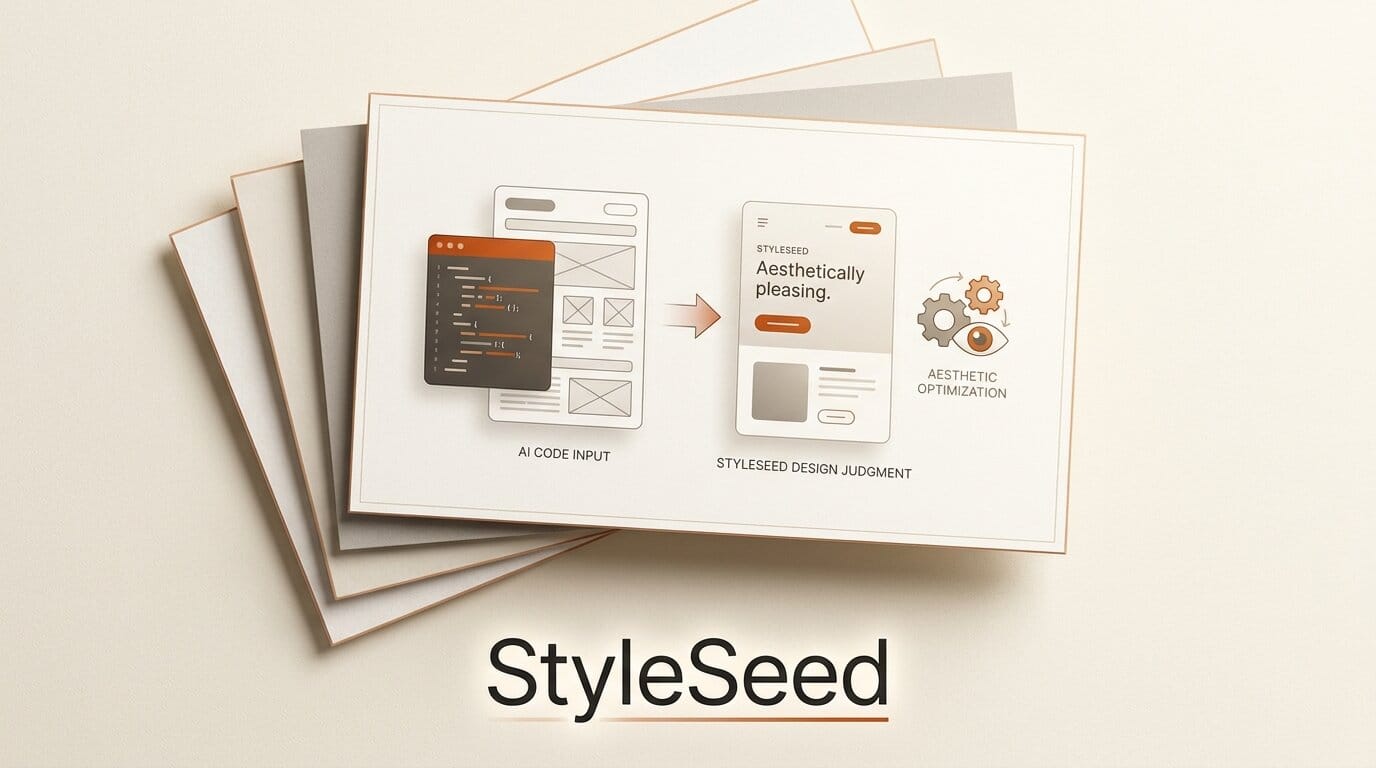
Your AI coding agent can ship a working dashboard in minutes, and it usually looks like a robot built it. StyleSeed, a free MIT-licensed project that reached version 2.10.1 on July 14, 2026, tries to fix that by giving Claude Code, Cursor, and Codex actual design judgment instead of more boilerplate.
What Happened
StyleSeed packages 74 visual design rules, 48 React components, seven brand skins modeled on Toss, Stripe, Linear, Notion, Raycast, Arc, and Vercel, and 15 AI skills into a format an agent can read and apply. A built-in quality gate scores each generated interface from 0 to 100 and auto-fixes violations before you see the result, while a design-lock file records decisions so the look does not drift between sessions. It surfaced as a Show HN launch and runs across Claude Code, Cursor, Codex, and Gemini CLI.
Try It This Afternoon
Add it to your agent with a single command, npx skills add bitjaru/styleseed, then run /ss-setup in Claude Code or $ss-setup in Codex to configure it interactively. Pick a brand skin, point the agent at an existing generic screen, and ask it to retrofit the layout. Because the rules persist in a project file, the next feature you scaffold inherits the same spacing, motion, and type system instead of a fresh coat of default gray.
Why It Matters for Creators
The gap between "AI wrote working code" and "AI wrote something I would ship" is almost always visual polish. Editor-based agents like Cursor and design-to-code tools such as Figma Make push generation forward, but most vibe-coded apps still read as templated. A rules engine that travels with the agent, rather than a one-off prompt, is a practical way to make agent-built interfaces look intentional across an entire project.
What to Do Next
Try one brand skin on a throwaway project before wiring it into client work. Because StyleSeed is open source, you can fork the rule set and encode your own brand system as a private skin, turning house style into something every future agent session enforces automatically.