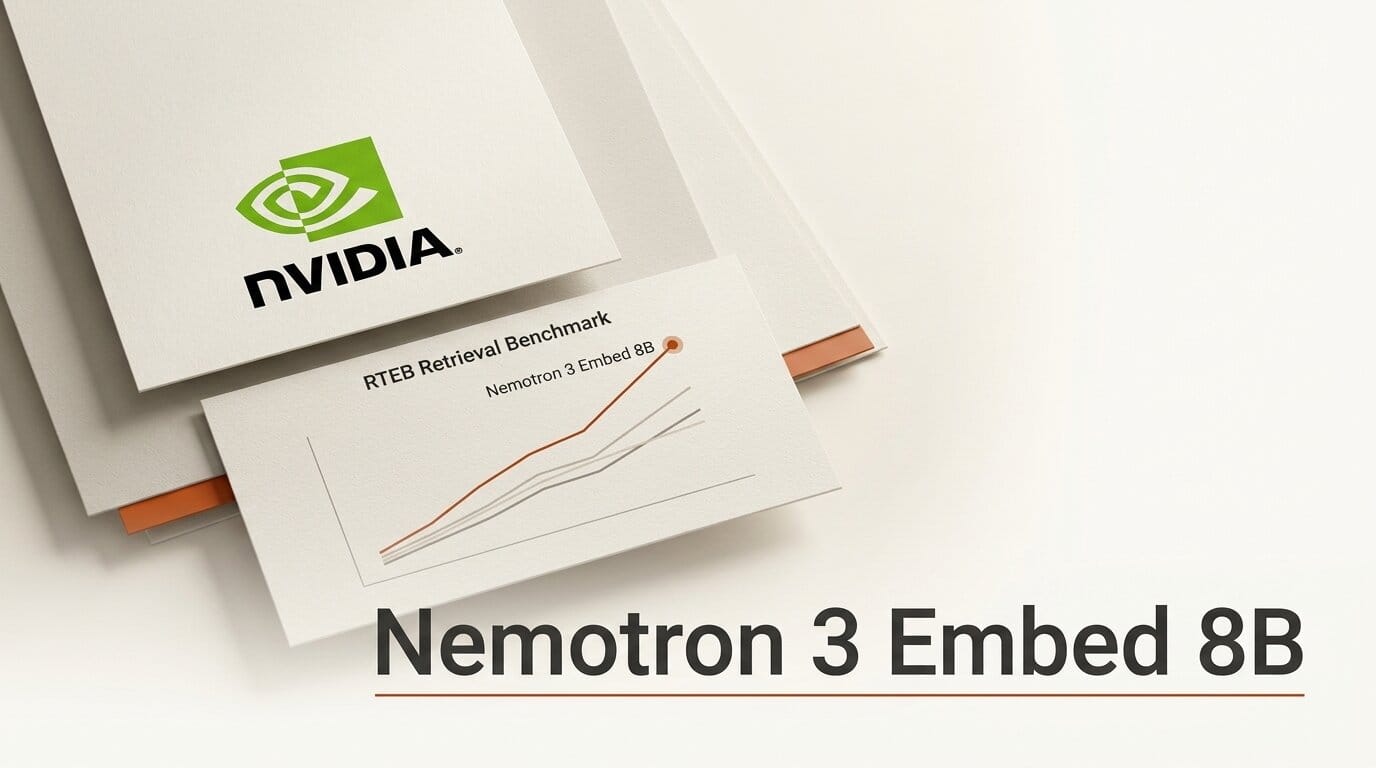
NVIDIA has released Nemotron 3 Embed, an open collection of text-embedding models whose 8B checkpoint ranks #1 overall on RTEB, the Retrieval Embedding Benchmark. Released on July 16, 2026, the models target production retrieval-augmented generation (RAG), agent memory, and code search, and they ship with open weights you can download and self-host.
How to Integrate It Into Your RAG Stack
Nemotron 3 Embed uses a standard prefix scheme (prefix inputs with "query:" or "document:") and mean pooling, so it drops into existing pipelines that already call an embedding endpoint. Pull the 8B model from Hugging Face, or start with the smaller 1B variant if you are latency- or memory-constrained, then re-embed your corpus and point your vector store at the new index. Better retrieval means your agent pulls more relevant context, which reduces wasted tokens on downstream generation.
Why It Matters for Builders
Retrieval quality is the quiet bottleneck in most RAG and agent projects: the model is only as good as the chunks you feed it. An open, top-ranked embedding model that you run yourself removes a per-call API dependency and keeps your document index private. It follows a wave of small, self-hostable models like browser-based embedding models that push retrieval closer to where builders work. The full collection spans three checkpoints for different hardware budgets.
Key Details
Benchmark: 78.5 percent average NDCG@10 on RTEB (8B), ranked #1 overall, per MarkTechPost.
Variants: Nemotron-3-Embed-8B-BF16, 1B-BF16, and a Blackwell-optimized 1B-NVFP4 (4-bit).
Context: 32,768-token inputs; embedding dimension 4096 for the 8B, 2048 for the 1B models.
Reach: Evaluated across 34 languages; available on Hugging Face, NVIDIA NIM, and partners including Baseten and OpenRouter.
What to Do Next
If you run a RAG system, benchmark Nemotron 3 Embed against your current embedder on your own queries before swapping, since benchmark wins do not always transfer to niche domains. Teams already running NVIDIA's open models can add this to the same self-hosted stack.