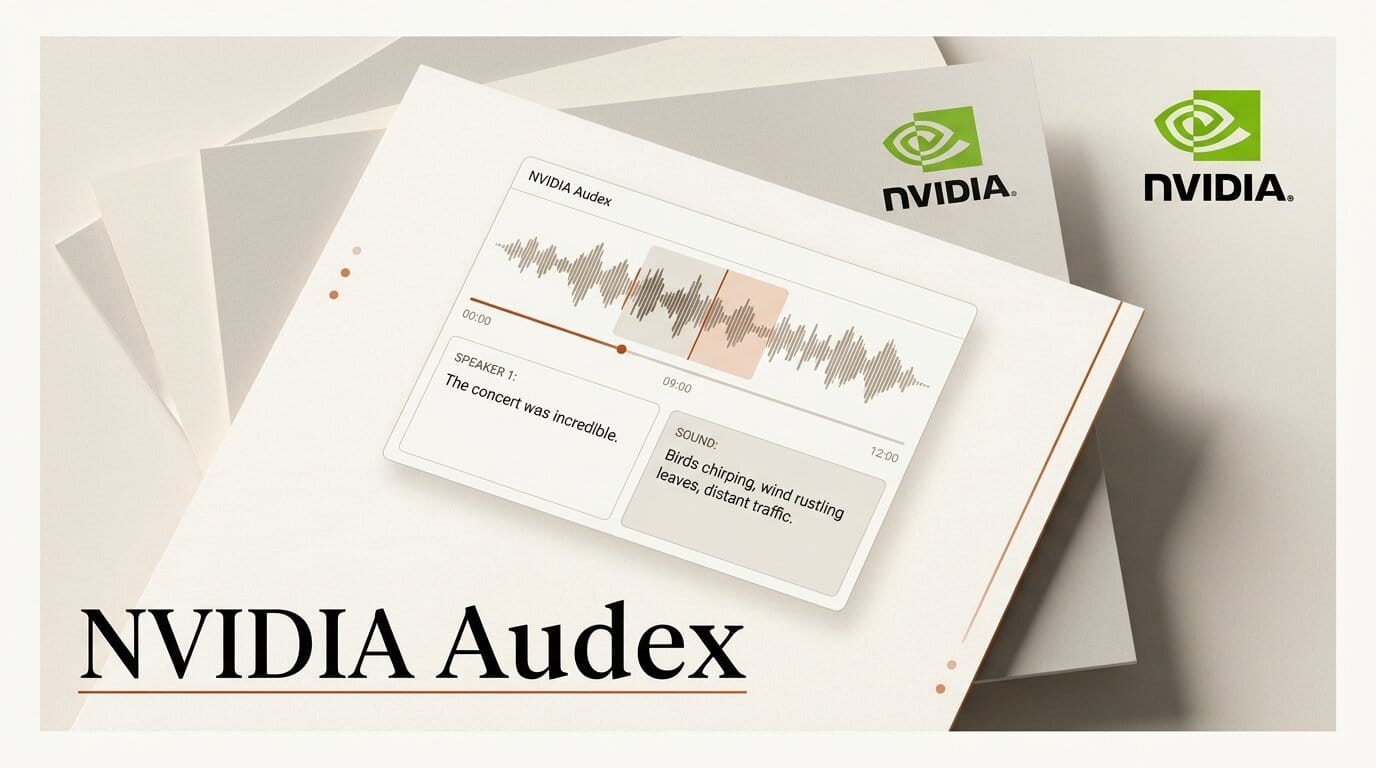
NVIDIA has released Audex, an open-weight audio-text language model that handles speech recognition, translation, text-to-speech, and general audio generation inside a single network. The model, formally named Nemotron-Labs-Audex-30B-A3B, went up on Hugging Face on July 7, 2026, alongside a smaller Audex-2B checkpoint.
What This Enables
Audex collapses a multi-tool audio stack into one model. Instead of chaining a separate transcription system, a translation model, and a text-to-speech engine, you prompt one model to transcribe a clip, translate the transcript, read it back as speech, or generate a non-speech sound from a text description. It runs in an "instruct" mode for direct tasks and a "thinking" mode for reasoning-heavy audio work, and supports up to a 1M-token context for long recordings. Because the mixture-of-experts design activates only 3B of its 30B parameters per token, you can realistically prototype an end-to-end audio pipeline from the Hugging Face checkpoints on a single workstation GPU before deciding whether to scale to hosted inference.
Why It Matters for Creators
Most open audio models do one job well. Whisper transcribes, a separate model clones a voice, another generates sound effects. Audex is notable because, as MarkTechPost reports, it is the only open model that also generates general audio, not just speech. For creators building podcasts, video soundtracks, or voice interfaces, a single model that can caption, dub, and score a clip removes the glue code between tools. It also keeps its text intelligence intact, scoring 86.4 on MMLU-Redux against its backbone's 86.3, so it can reason about the audio it processes rather than just converting formats. This lands the same week as a wave of open audio work, including our coverage of the first open diffusion ASR model.
Key Details
Model: Nemotron-Labs-Audex-30B-A3B, a mixture-of-experts transformer with 30B total and 3B active parameters, plus an Audex-2B variant.
Backbone: Built on Nemotron-Cascade-2-30B-A3B, a hybrid Mamba-Transformer text model, so audio capability is added without regressing on language tasks.
Benchmarks: 6.82 word error rate on OpenASR, ahead of Step-Audio-R1.1-33B at 7.91, and 75.6 on the MMAU audio understanding benchmark. The design is documented in the paper Unified Audio Intelligence Without Regressing on Text Intelligence.
License: NVIDIA OneWay Noncommercial License. The weights are open for research and non-commercial use, but production deployments need a different arrangement.
What to Do Next
Pull the checkpoints and test Audex against your current transcription or dubbing setup, keeping in mind the noncommercial license limits it to research and prototyping for now. If you need a permissively licensed alternative for production voice work, our writeup of an open-source ElevenLabs alternative covers options you can ship with today.