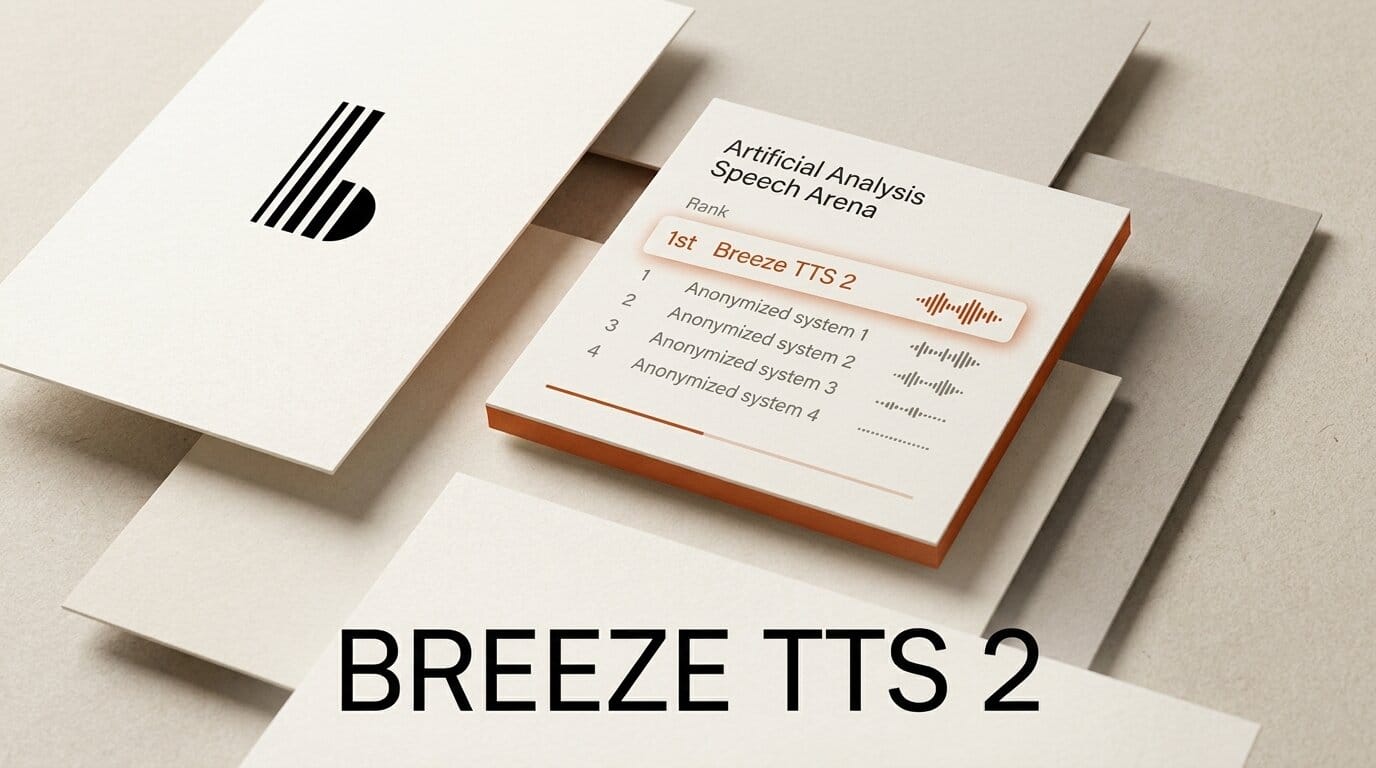
BreezeBlue has open-sourced Breeze TTS 2, a text-to-speech model that now ranks first among open-weights systems on the Artificial Analysis Speech Arena. It generates natural English and Chinese speech from a single model, clones voices from a short reference, and streams audio with under 40 milliseconds to first sound.
Try It: Design a Voice From a Text Prompt
The weights and PyTorch inference code are on GitHub. On a Linux machine with a CUDA GPU and roughly 8 GB of VRAM, clone the repo and run the inference script to generate speech locally. Beyond straight cloning, Breeze TTS 2 does voice design: describe a voice in plain language and it produces one with no reference audio, then lets you steer tone, emotion, and pace. Inline events like "(laugh)" render as real vocal expressions, so a narrator track can carry emotion without post-editing.
Why It Matters for Creators
Open-weights voice has been closing the gap with proprietary services, and Breeze TTS 2 pushes it further by topping the Artificial Analysis TTS leaderboard for open models while running on a single consumer-class GPU. For anyone producing audiobooks, video narration, or game dialogue, a local model means no per-character fees and full control over the voice. It sits alongside other local options we have covered, like on-device TTS voice cloning, and raises the quality bar for the open tier.
Key Details
Languages: English and Chinese from one model, with inline vocal events in both.
License: Code under Apache 2.0; weights under the BreezeBlue Research and Non-Commercial License, so commercial use needs written authorization.
Latency: Under 40 ms time to first audio and a 0.32 real-time factor for streaming.
Hardware: About 7.7 GB of GPU memory for standard inference, 14.4 GB for the faster optimized path.
Ranking: First among open-weights models on the Artificial Analysis Speech Arena, ahead of Fish Audio S2 Pro by 90 Elo.
What to Do Next
Check the non-commercial license against your use case before building it into a paid product. For personal projects, prototypes, and research, clone the repo and test voice design against your current TTS tool on a script that needs emotional range, where the inline events and steering matter most.