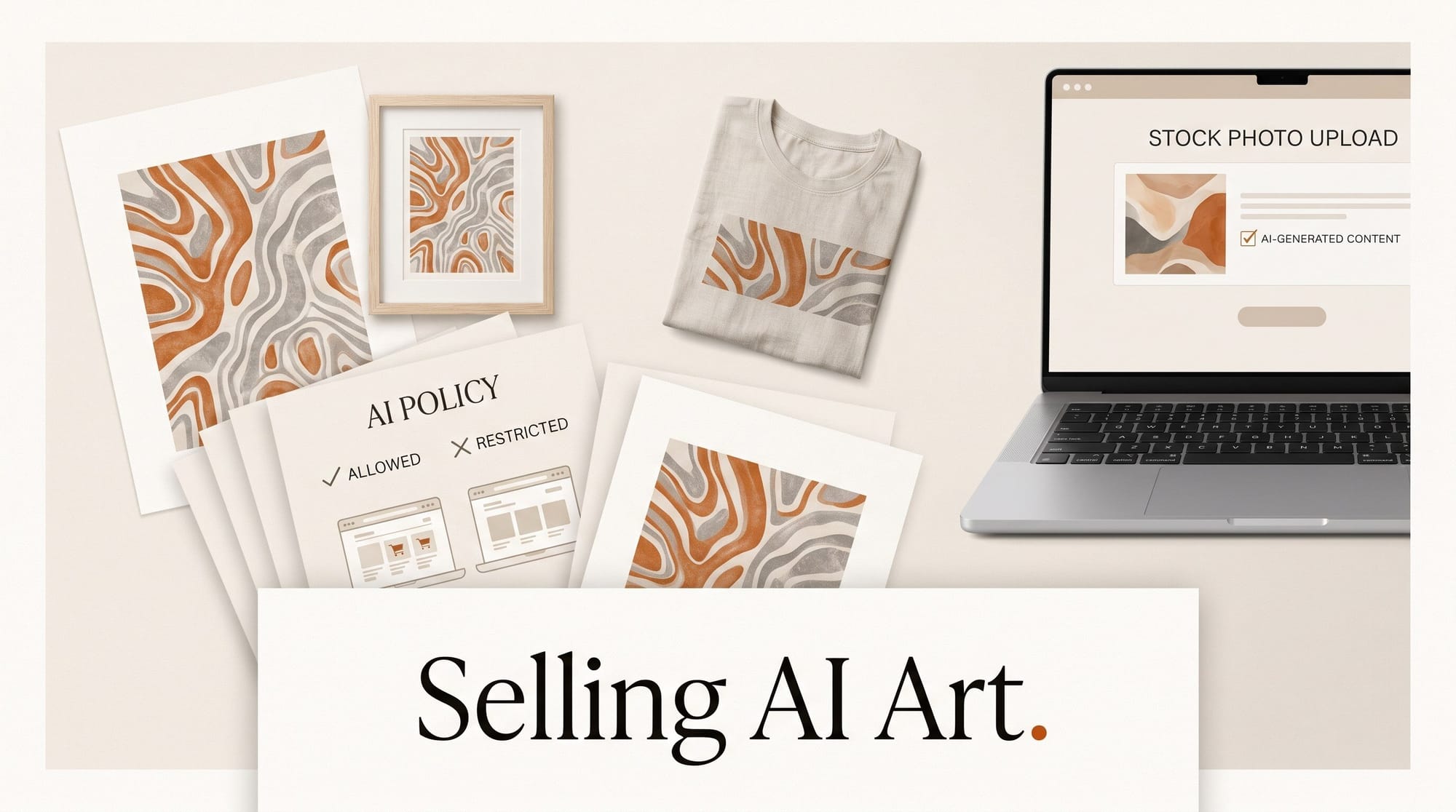
You can sell AI-generated images in 2026, but most of the big stock libraries will not take them. Shutterstock, Getty Images, iStock, Alamy and Pond5 refuse AI uploads outright. Adobe Stock, Dreamstime, 123RF and Freepik's contributor program accept them if you label them. Etsy, Zazzle and Amazon KDP allow AI work with disclosure, while Society6 does not take AI art from new artists. A paid plan on your image generator gives you the right to sell what it makes. Whether you can actually sell it depends on the store, and on whether copyright lets you stop someone copying it.
This analysis comes from the contributor guidelines, seller policies and terms pages of 14 platforms and four AI image tools, read on October 26, 2026. It is not legal advice. These rules change often, so check the linked page before you upload a batch.
Background
When AI art started selling in 2022, the stock industry split. Getty Images said no. Adobe Stock said yes and set up a labelling system. Every other platform has since picked one side or the other, and the AI flood made each choice matter more. CineD reported that AI images were 47.85% of Adobe Stock's library on April 8, 2025. Contributors then saw new upload limits and more "similar content" rejections.
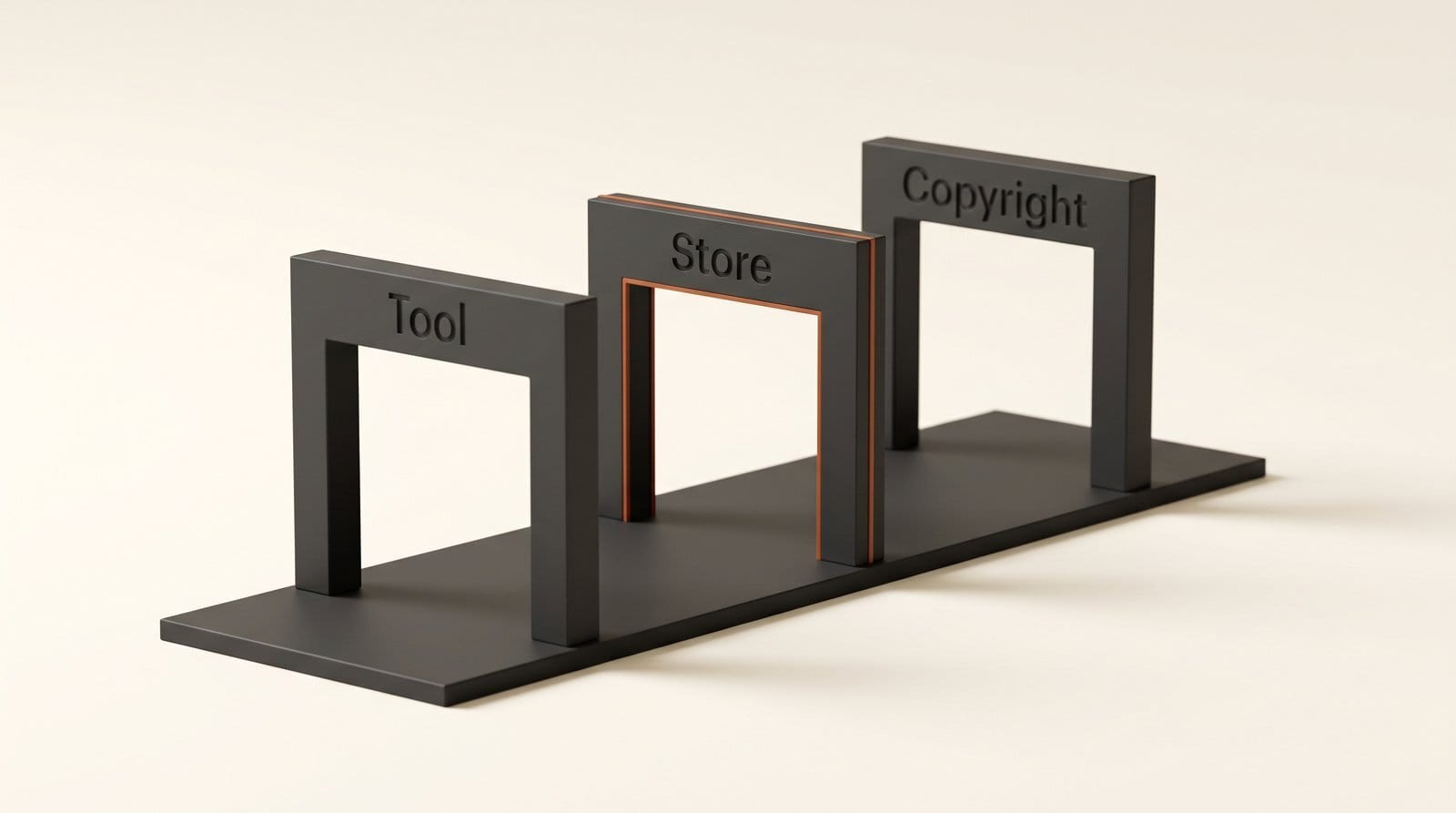
Three separate checks decide whether an AI image can earn you money:
- Your tool's terms. Do you own the output, and may you use it commercially?
- The store's rules. Will the place you want to sell it accept it?
- Copyright. If someone copies your design, can you stop them?
Most creators check the first and assume the other two follow. They don't. Each one has its own answer, and the store is where most uploads fail.
Deep Analysis
Your license lets you sell; the store decides where
The major image tools all give you broad rights to what they make:
- OpenAI. Its terms of use say you "own the Output" and transfer OpenAI's rights in it to you.
- Google. Google says it won't claim ownership of what you generate.
- Midjourney. Its commercial-use page says you own your images on any paid plan. A company that grosses more than $1,000,000 a year needs the Pro or Mega plan.
- Adobe Firefly. Adobe calls its Firefly models "commercially safe" because they are trained on licensed Adobe Stock and public domain content.
Owning an image does not mean every store will take it. Shutterstock's contributor policy is one line: "Shutterstock does not accept AI-generated content from our contributors." Alamy's contributor page says "we don't accept any AI-generated images on our platform." Its quality checks also flag photos edited with Generative Fill. Getty Images told contributors it "does not accept files created using AI generative models," as ProVideo Coalition reported. Pond5, which belongs to Shutterstock, has the same rule.
None of this is about quality. These libraries sell authenticity to news and brand buyers, and an AI image is the one thing they cannot vouch for.
Where AI images are welcome, the label is the price of entry
The libraries that accept AI work all ask for an AI label, and each has its own extra rules.
Adobe Stock is the biggest. Its generative AI guidelines ask for four things:
- Tick the "Created using generative AI tools" box.
- Upload images that look camera-made as photos and everything else as illustrations.
- Keep artist names, real people, fictional characters and real news events out of your prompts, titles and keywords.
- Upload no more than about three variations of the same idea.
Adobe also says it cannot tell you whether your AI tool's license allows the upload. Checking that is your job. AI images earn the same royalties as other work: 33% for photos, vectors and illustrations and 35% for video, on Adobe's royalty page.
The others each add their own twist:
- 123RF. Its AI guidelines say to upload to the "Ai Generated Images" category ONLY. AI content in any other category is rejected.
- Dreamstime. It wants AI use stated in the description and the AI category picked. Its AI page bans AI-generated people, real or invented, which rules out most lifestyle images.
- Freepik. Its contributor program (now part of Magnific) requires an AI tag on anything made fully or partly with AI.
One shortcut has also closed. Wirestock used to take your files and resubmit them to the big libraries for you. Its current terms, effective January 20, 2026, say it "will not license or otherwise provide to the content marketplaces any New Content you submit." Older uploads stay on the libraries, but new uploads no longer reach them. Upload to each library yourself.
Shops judge your role, not your tool
Print-on-demand and marketplace shops care less about which tool you used and more about whether a person did the creative work.
Etsy allows AI art. Since 2024, AI-made items belong in its "Designed by" category, and you have to say in the listing that AI was used. Selling prompt packs is banned, as TechCrunch reported. In October 2026 Etsy tightened the rules again. Patterns and recipes cannot be made with AI, and at least one photo of an item should be unaltered and against a real background, according to PR Daily. Etsy's message to buyers: "AI should support our sellers' creativity and craftsmanship, not replace them."
The other shops split:
- Society6 says no. Its artist application asks for "Original work that's all yours" and adds "No AI-generated art, or stock photos."
- Zazzle says yes. Its creator team asks for the tag "generativecontent" on listings that use AI.
- Redbubble, TeePublic and Amazon Merch on Demand have no written AI policy that we could find. Ask their support teams before you upload a catalog.
Amazon KDP, for books, is the clearest. Its content guidelines say "AI-generated images include cover and interior images and artwork," and you must tell Amazon about them when you publish. If you made the work yourself and only used AI to edit or improve it, you don't need to disclose that. So a cover you generated must be disclosed. A cover you painted and cleaned up with AI does not.
Selling is allowed; protecting it is not
The third check is the one creators find out about last. The US Copyright Office's January 2025 report on copyrightability says copyright "does not extend to purely AI-generated material" and that "prompts do not alone provide sufficient control." On March 2, 2026, the Supreme Court declined to hear Thaler v. Perlmutter. That left the rule that a human has to be the author in place, Mayer Brown notes.
For a seller, this means a design made from a prompt alone can be sold, and probably copied by anyone. What you can protect is your own contribution: the selection, the arrangement and the edits you make to the output. A t-shirt design you redrew, recolored and combined with your own lettering stands on firmer ground than a raw generation. We cover the full copyright picture in our AI copyright and licensing guide.
Detection is getting better too. Google says every image made or edited in the Gemini apps carries an invisible SynthID watermark. Leaving off an AI label is a bigger risk than it was two years ago.
Impact on Creators
| Platform | Takes AI work? | What it asks for |
|---|---|---|
| Adobe Stock | Yes | AI checkbox, no artist or real-person names, about 3 variations max; 33% image royalty |
| Dreamstime | Yes, limited | AI category and description, no AI people |
| 123RF | Yes, limited | AI category only, no real people, places or brands |
| Freepik (Magnific) | Yes | AI tag on anything fully or partly AI-made |
| Wirestock | Yes | AI flag at upload; new files no longer sent to other libraries |
| Shutterstock, Pond5 | No | Contributor AI uploads refused |
| Getty Images, iStock | No | Contributor AI uploads refused |
| Alamy | No | Refused; Generative Fill edits can fail checks |
| Etsy | Yes, limited | Disclose AI, "Designed by" category; no prompt packs, AI patterns or recipes |
| Zazzle | Yes | "generativecontent" tag |
| Society6 | No | New artists: no AI-generated art |
| Amazon KDP | Yes | Disclose AI-generated covers and interior art |
If you make stock images, Adobe Stock is the one big library open to you. Plan on labelling every file and uploading fewer, better variations, because the "similar content" filter punishes volume. Dreamstime and 123RF are smaller extras with stricter subject rules.
If you sell prints, shirts and mugs, Etsy and Zazzle take AI designs with a disclosure. Society6 doesn't. Your work in the image is also what makes it protectable, so redraw, combine and finish your designs instead of uploading raw generations.
If you sell physical products on Etsy, AI product photos are fine for lifestyle shots, but keep one real, unaltered photo in every listing. Our AI product photo workflow starts from a real photo of the item, which fits that rule.
If you publish books, disclose AI covers and illustrations at upload. The checkbox costs nothing, and leaving it unticked breaks KDP's content guidelines.
Key Takeaways
- A paid plan on your image tool lets you use the output commercially, but it does not get you into any particular store.
- Five of the ten stock libraries checked refuse AI uploads: Shutterstock, Getty Images, iStock, Alamy and Pond5.
- Adobe Stock is the largest library that takes AI work. It pays 33% on images and asks for a label on every file.
- Etsy and Zazzle allow AI designs with disclosure. Society6 does not take AI art from new artists.
- Prompt-only images are sellable but probably not copyrightable. Your edits and arrangement are what you can protect.
What to Watch
The next change is likely to come from the platforms that accept AI. Adobe Stock already limits volume, and Etsy's October 2026 update shows a marketplace pulling back on AI items that buyers complain about, such as patterns that don't work. Expect more category rules, stricter photo rules and automatic AI detection rather than outright bans. The refusing libraries are unlikely to change their minds, since their whole pitch to buyers is that their images are real. Shutterstock already sells its own licensed AI generator to customers, as we covered in June, and that is the only AI it wants in its library.
The other open question is whether courts or Congress ever give prompt-heavy work some protection. For now, the safest business plan treats AI as a starting point and your own finishing work as the part you can actually own.
FAQ
Can I sell AI-generated art legally?
Yes, if your image tool's terms give you commercial rights and the store you sell on allows AI work. ChatGPT, Gemini, Adobe Firefly and Midjourney on a paid plan all let you use the output commercially. The image must also not copy someone else's protected work, a trademark or a real person's likeness without permission.
Which stock sites accept AI-generated images?
Adobe Stock, Dreamstime, 123RF and Freepik's contributor program accept labelled AI images, each with its own rules. Shutterstock, Getty Images, iStock, Alamy and Pond5 do not accept AI uploads from contributors.
Can I sell AI art on Etsy?
Yes. AI-made designs go in Etsy's "Designed by" category, and you must say in the listing that AI was used. You cannot sell prompt packs, and since October 2026 patterns and recipes cannot be AI-made. Listings should include at least one unaltered photo of the real item.
Do I own the copyright to my AI images?
Not to the parts the AI made from a prompt alone. The US Copyright Office says purely AI-generated material is not protected, and the Supreme Court declined to revisit that in March 2026. Your own selection, arrangement and edits can be protected, so finish your designs by hand where it matters.
Do I have to label AI images when I sell them?
On most platforms that accept them, yes. Adobe Stock has a checkbox, 123RF and Dreamstime have AI categories, Freepik and Zazzle use tags, and Etsy and Amazon KDP ask you to disclose AI use. Images made in the Gemini apps also carry an invisible SynthID watermark, so leaving the label off is risky.