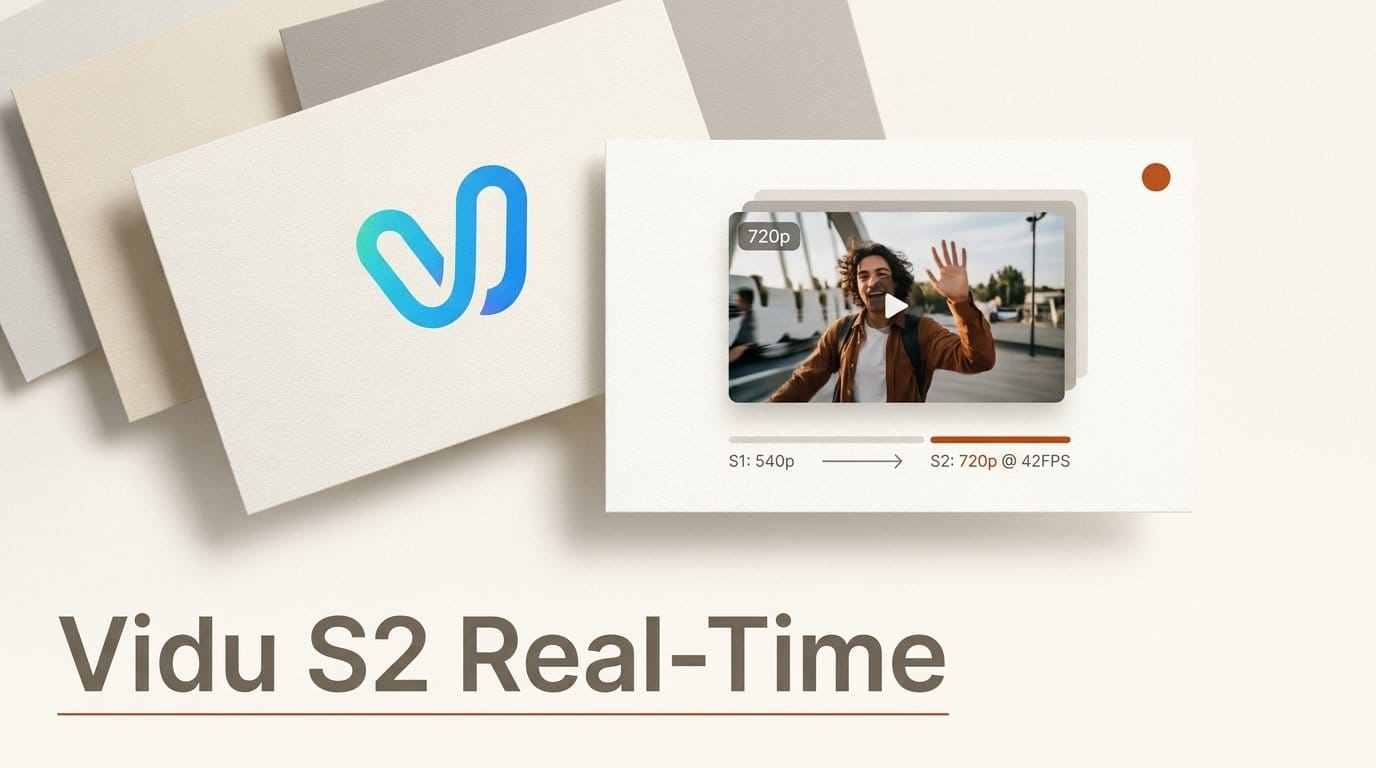
ShengShu Technology announced Vidu S2 on 15 September 2026, a pair of real-time video models that push interactive generation from 540p to 720p. The technical report, submitted to arXiv on 10 September by 35 authors led by Jintao Zhang, claims Vidu S2 "outperforms all baselines." That claim is true. It is also the least useful sentence in the release, because the margin ranges from 1.9% to roughly half, depending on which task you point it at.
Read the benchmark tables and a different product emerges from the one the press release describes. On general video editing, Vidu S2 beats the incumbent by a rounding error. On garment work, it cuts the previous best error nearly in half. If you are deciding whether to move a pipeline onto it this month, that gap is the entire decision.
What ShengShu actually shipped
Vidu S2 is two models, not one. Vidu S2-Avatar is a real-time interactive digital-character model: you upload a character image and drive it with text or voice, and it returns a live stream with facial expressions, poses, and full-body movement including dancing. Vidu S2-Editing edits an incoming video stream in real time across four named tasks: style transfer, outfit change, subject replacement, and background replacement.
Both run today in a browser at the Vidu Stream demo, and both are exposed through an API platform. The headline capability that S1 did not have is the dynamic reference: you can introduce a new reference image while the character is mid-sentence, and the character interacts with the new content without restarting the stream. ShengShu also says it explored real-time spatial video for VR headsets, which the paper frames as a feasibility study rather than a shipped feature.
Under the hood, the paper's central contribution is a training method called Self-Replay Forcing. After the student model performs a long autoregressive rollout, the entire generated trajectory is re-noised and replayed in a single gradient-enabled causal pass, so that, in the authors' words, "gradients can propagate across block boundaries during the replay pass without backpropagating through the original rollout." Two supporting components do the rest of the work: a vision-language model agent that writes prompts describing identity, expression, and pose while "retaining details that the user's instruction does not ask to change," and a one-step super-resolution refiner operating directly in latent space to restore 720p detail.
The 720p headline has a frame-rate footnote
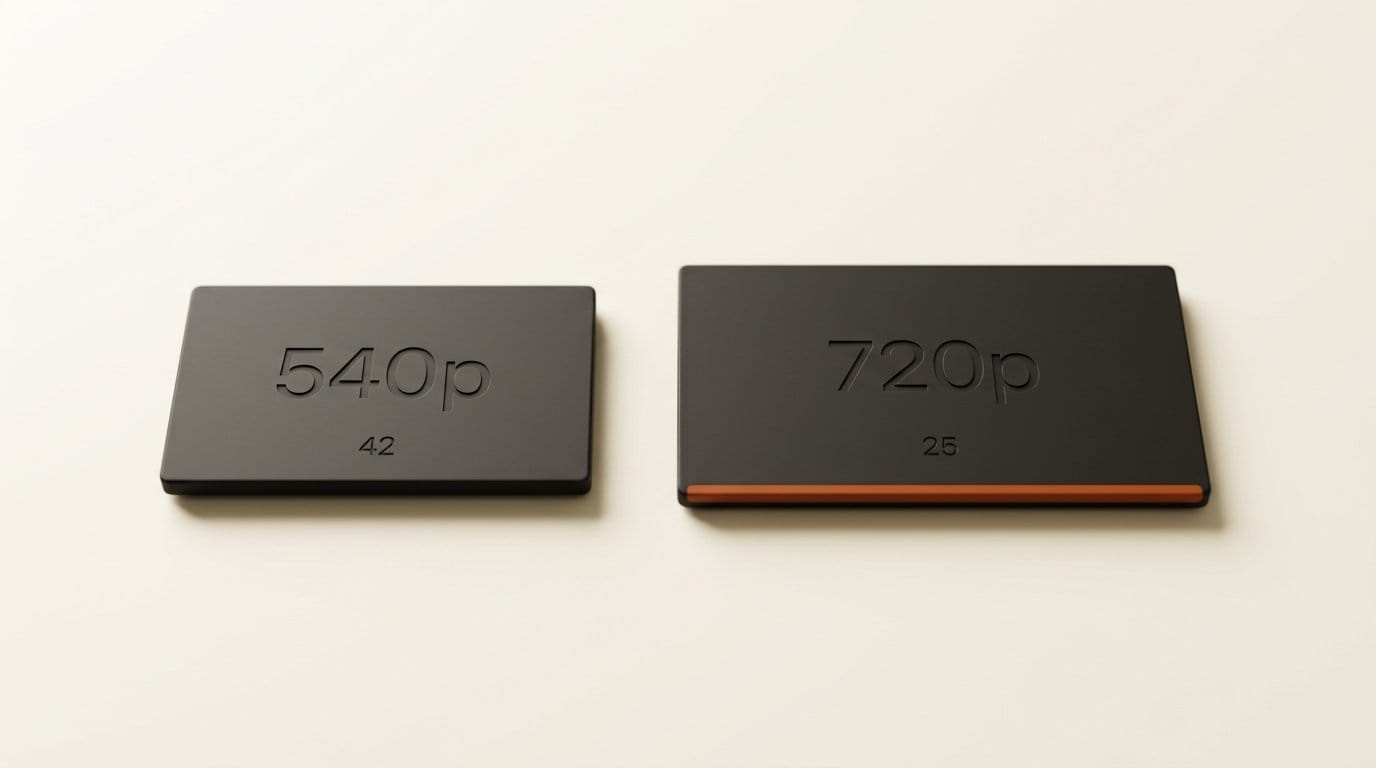
Every summary of this launch leads with 540p to 720p. The number that goes with it is in the project's GitHub README, not the press release: Vidu S2 generates 720p at 25 to 42 FPS. The Vidu S1 paper and the same README put S1 at 540p at up to 42 FPS.
| Spec | Vidu S1 | Vidu S2 |
|---|---|---|
| Real-time output resolution | 540p | 720p |
| Frame rate | Up to 42 FPS | 25 to 42 FPS |
| Pixels per frame (16:9) | 518,400 | 921,600 |
| Reference image | Fixed at session start | Swappable mid-stream |
| Large movement (dancing) | Limited | Supported |
S2 renders 1.78 times the pixels per frame, and the cost shows up as a frame-rate floor rather than a ceiling. S1's 42 FPS was a maximum; S2 quotes a range whose bottom end, 25 FPS, sits just above cinema's 24 and well below the 30 to 60 FPS that interactive avatars need to avoid visible stutter on a live call. Neither ShengShu nor the paper specifies the GPU behind those numbers, so you cannot tell whether 25 FPS is the consumer-hardware case or the complex-motion case. For an avatar that is expected to dance, that distinction is the one worth testing before you commit.
Where Vidu S2 actually beats the field
The paper benchmarks the two models separately, and the results are far more uneven than "outperforms all baselines" suggests. Vidu S2-Avatar takes the best score on all nine StreamAV-Bench metrics against 14 baselines including Self-Forcing, LongLive, SWIFT, IAMFlow, and Live Avatar, posting 0.998 subject consistency and 0.993 background consistency. That is a clean sweep, and it is the strongest result in the report.
The editing model is where the spread opens up. Reported results put S2-Editing at 3.74 overall on Sparkle-Bench, against 3.67 for Decart Lucy 2.5 and 3.57 for Kiwi-Edit. On the joint OpenVE and RefVIE evaluation it scores 4.26, which the report puts 0.34 ahead of Bernini-R 14B. On the ViViD virtual try-on benchmark it records a VFID score of 9.9515 against 19.5131 for CatV2TON and 21.8032 for the ViViD baseline, and because VFID is an error measure, lower is better.
| Benchmark | Vidu S2 | Best baseline | Margin |
|---|---|---|---|
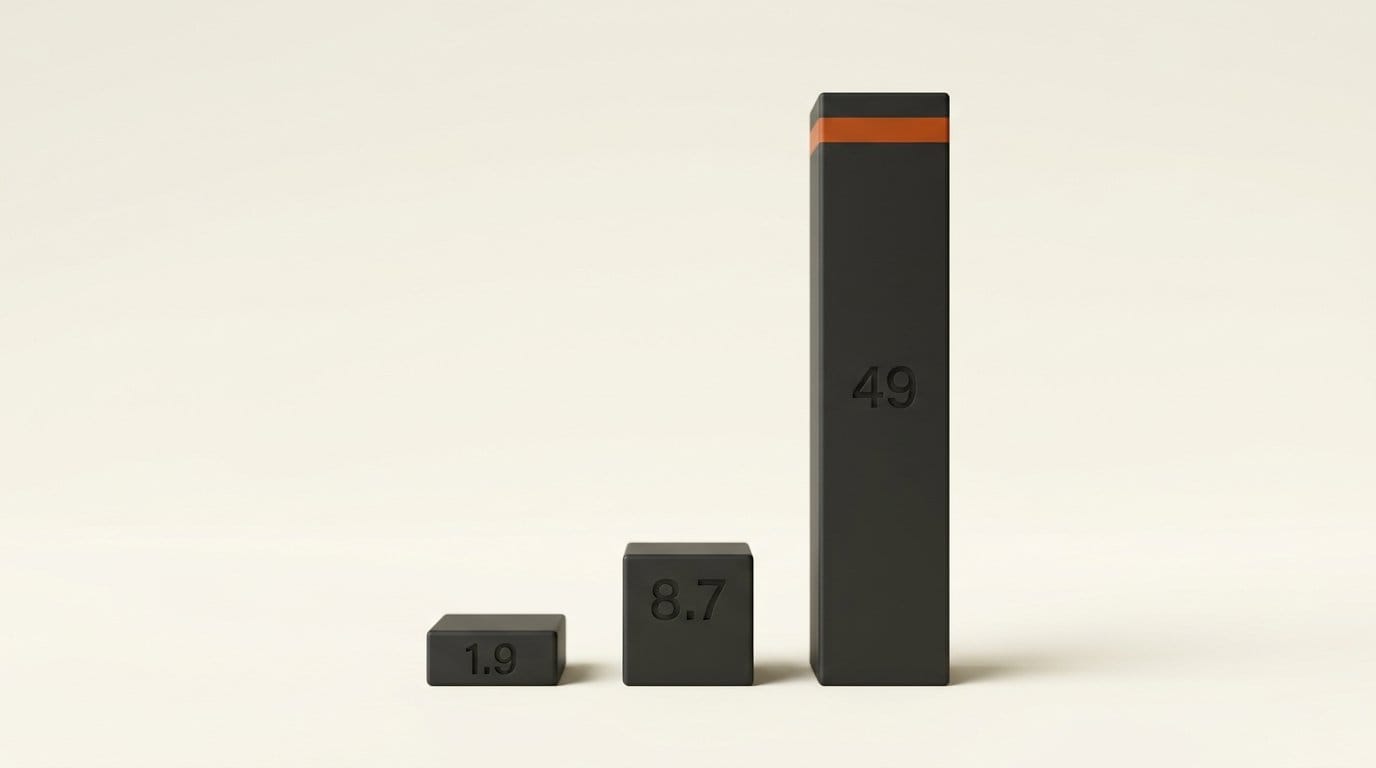
| Sparkle-Bench (overall) | 3.74 | 3.67 (Decart Lucy 2.5) | +1.9% |
| OpenVE + RefVIE (joint) | 4.26 | 3.92 (Bernini-R 14B) | +8.7% |
| ViViD try-on (VFID, lower better) | 9.9515 | 19.5131 (CatV2TON) | 49% lower error |
| StreamAV-Bench (avatar) | Best on 9 of 9 | 14 baselines | Clean sweep |
The pattern is consistent: the more specialised the task, the wider Vidu S2's lead. On broad editing quality it is one-fiftieth of a point ahead of a model that has been in production since July. On a narrow garment-transfer benchmark it roughly halves the error of the previous leader. That is not a criticism of the model, it is a targeting instruction. If your work is general-purpose stream editing, Vidu S2 is a marginal upgrade you can evaluate at leisure. If your work is clothing, catalogue, or fashion video, it is the biggest single jump the category has posted this year, and it belongs at the top of your test list alongside the still-image try-on models you are probably already running.
The repository is documentation, not weights
Vidu S2 has the surface features of an open release: an arXiv paper with a full method section, a public GitHub repository under the ShengShu organisation, and 44 commits on the main branch. None of that includes model weights. The repo is a documentation shell that points at the hosted demo, the API docs, and the two papers. No licence is stated for anything in it.
This matters because of where creators look first. A repository named Vidu-S with a real paper attached reads as runnable, and it is not. There is no local inference path, no quantised build, no ComfyUI node, and nothing to fine-tune. Every route to Vidu S2 runs through ShengShu's servers. That places it on the closed-hosted side of the line, with the hosted live-video platforms, rather than alongside the open video editors it benchmarks itself against, two of which are open-weights models you can run yourself.
The number nobody published
For a real-time streaming model, cost per minute is the whole economic question, and it is the one figure absent from every surface ShengShu published. The press release does not price it. The product page does not price it. The API documentation portal renders its content client-side and exposes no rate card to a plain fetch. The only published contact route for access questions is an email address.
Treat any per-minute comparison against Vidu S2 as unverified until ShengShu posts a rate card. A model that streams continuously bills very differently from one that renders a clip and stops, and a 720p stream at 42 FPS is not the same unit of work as the same stream at 25 FPS. Until the pricing page exists, the honest position is that Vidu S2's benchmark wins are documented and its economics are not.
How to evaluate it this week
The demo is open in a browser, so a real test costs an afternoon rather than an integration. Work through it in this order:
- Open the Vidu Stream demo and start an S2-Avatar session with a character image from your own library, not a sample. Identity drift on your assets is what you are measuring.
- Talk to it for a full three minutes without restarting. Long-horizon stability is the specific claim Self-Replay Forcing is meant to deliver, and short clips will not surface the failure.
- Swap the reference image mid-sentence. This is the one capability S1 does not have, so it is the only part of the upgrade you cannot evaluate on the older model.
- Ask for sustained large motion, dancing or a full turn, and watch the frame rate rather than the fidelity. If the stream drops toward the 25 FPS floor under motion, that tells you which end of the quoted range your use case lives in.
- Run S2-Editing on a garment clip and on a general style-transfer clip. Compare both against your current tool. The benchmark spread predicts you will see a large gap on the first and almost none on the second.
- Email ShengShu for the rate card before you scope anything production-shaped.
Frequently asked questions
Is Vidu S2 available to use right now?
Yes. Both models are live in a browser demo at vidu.com/vidu-stream, and an API platform is published. ShengShu has not stated whether API access requires approval, and no waitlist is mentioned on the product page.
Can I download Vidu S2 weights or run it locally?
No. The ShengShu GitHub repository contains documentation and links only, with no weights, no inference code, and no stated licence. Every path to the model goes through ShengShu's hosted service.
What does Vidu S2 cost?
ShengShu has not published pricing on the press release, the product page, or in any fetchable form on the API documentation portal. Cost per streaming minute is currently unknown, which makes head-to-head economic comparisons against other real-time models impossible to verify.
How much better is Vidu S2 than Vidu S1?
Real-time output resolution rises from 540p to 720p, roughly 1.78 times the pixels per frame, and the model gains mid-stream reference swapping plus support for large movements such as dancing. The trade is frame rate: S1 quoted up to 42 FPS, while S2 quotes a 25 to 42 FPS range at the higher resolution.
Does Vidu S2 really beat every competing model?
It leads every benchmark reported in the paper, but the margins are uneven. It sweeps all nine StreamAV-Bench avatar metrics against 14 baselines, leads Sparkle-Bench by 1.9% over Decart Lucy 2.5, leads the joint OpenVE and RefVIE evaluation by 8.7% over Bernini-R 14B, and cuts ViViD try-on error by about half against CatV2TON.
What is Self-Replay Forcing?
It is the training method behind the model's long-session stability. The student model generates a long rollout, the full trajectory is then re-noised and replayed in one gradient-enabled causal pass, which lets gradients cross block boundaries without backpropagating through the original rollout.
Which creators should adopt it first?
Anyone producing clothing, catalogue, or fashion video, where the try-on margin is largest. Teams doing general-purpose real-time stream editing will find the quality difference against their current tool close to noise, and can evaluate on a normal cycle.