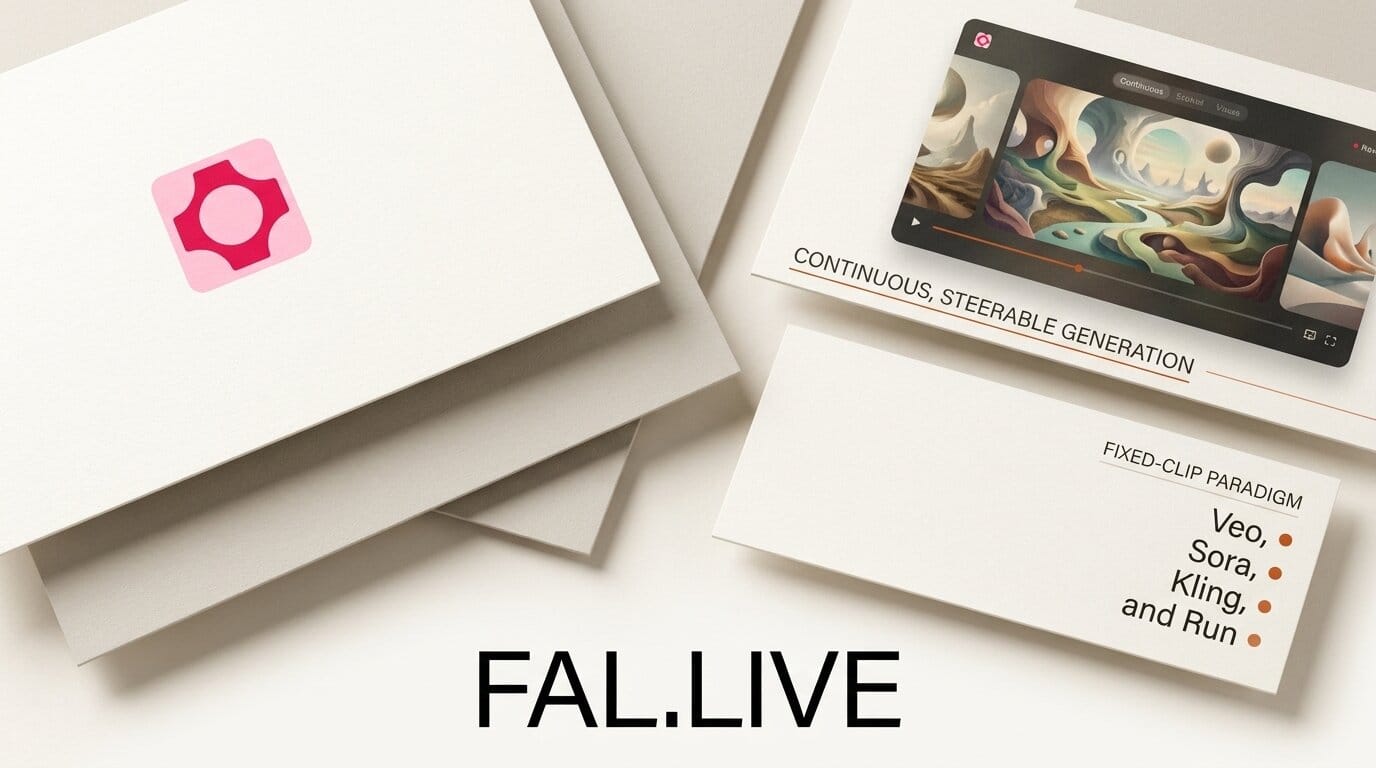
For three years the frontier of AI video has been a race to make one clip better: sharper, longer, more controllable. fal just changed the question. With fal.live, an infinite interactive livestream where the audience types what happens next and the picture never stops, the axis of competition is no longer clip quality. It is whether the video can keep going, hold its memory, and answer to you while it runs.
Background
The dominant paradigm in generative video is the fixed clip. You write a prompt, a diffusion model renders a self-contained segment of a few seconds, and then it stops. Veo, Sora, Kling, and Runway all work this way. The output is a file. You wait for it, you watch it, and if you want something different you go back to the prompt box and render again from scratch. Every generation is an island with no memory of the last one.
fal.live breaks that mold. It runs on H3 Max Director, described by fal as an autoregressive and natively continuous version of its H3 Max video model. Autoregressive means the model generates the next moment conditioned on everything that came before, the same principle that lets a language model produce an endless stream of coherent text rather than one fixed paragraph. Applied to video, it produces a stream instead of a clip. You open a browser, pick a channel such as Anime, Sitcom, or Chaos, and the scene generates on and on, folding your typed direction into whatever is already on screen.
Two properties make this possible. First, the model holds up to two minutes of context, so a new scene ties back to what came before instead of resetting on every segment. Second, generation runs faster than real time. The base H3 Max renders 768p five-second clips in about three seconds, reported at up to 50 times faster than the original endpoint. When a model can produce five seconds of video in three seconds, the segments render faster than they play, and the picture never has to pause. That is the mechanical basis of a livestream that has no end.
Deep Analysis
Continuous vs fixed-clip generation
The difference between fal.live and a tool like Sora is not a feature gap, it is a difference in kind. A fixed-clip model answers a bounded question: given this prompt, produce these five seconds. A continuous model answers an open-ended one: given everything so far and whatever the viewer just asked for, produce the next moment, and keep doing that indefinitely. The first is a render job. The second is a running process.
Persistent context is what makes the running process coherent rather than a slideshow of unrelated shots. With up to two minutes of memory, a character introduced early can still be on screen a minute later, a setting can persist, and a story beat can pay off. Fixed-clip tools have no equivalent. Stitching several Kling or Runway clips into a longer sequence means each generation starts blind, and continuity of character, lighting, and camera is something the creator fights for manually, prompt by prompt. On fal.live continuity is the default state of the system, not a post-production chore.
This maps closely onto the shift already underway in real-time interactive world models, where a model generates an explorable environment frame by frame in response to input. We covered that direction in our look at real-time interactive video world models. fal.live sits in the same family: video as a live, stateful, steerable process rather than a finished artifact.
Latency becomes the battleground
Once video generates faster than it plays, latency stops being a nuisance and becomes the product. In the fixed-clip world, generation speed is a convenience metric. Waiting thirty seconds or two minutes for a render is mildly annoying, but it does not change what the tool is. In the continuous world, speed is existential. If the model cannot generate the next segment before the current one finishes playing, the stream stalls and the illusion collapses. Faster-than-real-time generation is the price of admission, not a bonus.
That reframes the competitive landscape. The leading fixed-clip models compete on fidelity, resolution, prompt adherence, and maximum clip length. fal.live competes on a different axis entirely: sustained throughput and low enough latency to stay ahead of playback. The table below sets out the qualitative contrast.
| Tool | Generation model | Output length | Interactivity | Latency profile |
|---|---|---|---|---|
| fal.live (H3 Max Director) | Autoregressive, natively continuous | Infinite stream, up to two minutes of context | Steer live while it plays | Faster than real time |
| Veo | Diffusion, fixed clip | Short fixed clip | Prompt then render | Batch render, not interactive |
| Sora | Diffusion, fixed clip | Short fixed clip | Prompt then render | Batch render, not interactive |
| Kling | Diffusion, fixed clip | Short fixed clip, extendable | Prompt then render | Batch render, not interactive |
| Runway | Diffusion, fixed clip | Short fixed clip | Prompt then render | Batch render, not interactive |
The point of the table is not that fal.live is better on every row. Fixed-clip models still lead on raw per-frame fidelity, and for a polished thirty-second product film that quality gap matters. The point is that fal.live is not on the same axis. It trades some fidelity for continuity, statefulness, and interactivity, and in doing so it opens a use case the others cannot touch: video you inhabit and direct in the moment rather than commission and receive.
Steering vs prompting
Prompting is a request. You describe a finished thing, submit it, and receive an output you then judge as a whole. The feedback loop is slow and discrete: prompt, wait, evaluate, re-prompt. Steering is continuous. On fal.live you type a direction and watch the scene bend toward it in seconds, then type again based on what you see, then again. The creator is inside the loop while the video is being made, not standing outside it waiting for a delivery.
This is a genuinely different creative posture. Prompting rewards planning and precise specification up front, because a bad prompt costs a full render cycle. Steering rewards improvisation and reaction, because course correction is cheap and immediate. It is closer to playing an instrument, DJing, or driving than to writing a brief. The skill that matters shifts from writing the perfect prompt to reading the stream and nudging it in real time. fal.live also lets audiences vote on what happens next, which turns direction into a shared, crowd-driven act rather than a solo one. For technical context on how continuous generation breaks the fixed-clip barrier, fal's launch was covered in detail by the Latent Space AINews writeup.
Impact on Creators
For creators, the most immediate change is that video becomes a performance medium, not only a production one. A finished clip is something you make and then distribute. A steerable stream is something you can perform live, in front of an audience, reacting to a chat, the way a streamer plays a game or a VJ mixes visuals at a venue. The output and the event become the same thing. That collapses the gap between creation and broadcast that has defined every previous generative video tool.
It also lowers a different barrier. Fixed-clip tools reward users who can specify precisely and iterate patiently through render queues. Steering rewards taste and reaction speed, which are more evenly distributed and more fun to exercise in public. A creator with a strong sense of comedic timing can run a Sitcom channel and land jokes by feel. Someone with a sense of visual rhythm can VJ a Chaos channel to music. The tool meets improvisational skill rather than demanding technical prompt discipline.
There are real constraints to plan around. Two minutes of context is a meaningful memory, but it is still a horizon: direct a stream long enough and early details will fall out of the window. Continuous autoregressive generation can also drift, accumulating small errors over time in a way a single short clip does not. And the fidelity trade means fal.live is not the tool for a hero shot that needs to be perfect frame by frame. The practical pattern that emerges is a division of labor: fixed-clip models for polished, bounded deliverables, and continuous streaming for live, reactive, long-form experiences. Creators who understand which axis a project sits on will pick the right tool instead of forcing one to do the other's job. If you already use fal's free H3 Max model for short clips, fal.live shows where that same speed leads when it is pointed at a stream instead of a file.
Key Takeaways
- fal.live is an infinite, interactive AI livestream that the audience directs in real time, powered by the autoregressive, natively continuous H3 Max Director model.
- The core shift is continuous generation versus the fixed-clip paradigm of Veo, Sora, Kling, and Runway. A stream with memory replaces a file with none.
- Persistent context of up to two minutes gives the stream coherence across scenes, something fixed-clip tools cannot match without manual stitching.
- Faster-than-real-time generation makes latency the new axis of competition. If the model cannot stay ahead of playback, the stream stalls.
- Steering replaces prompting: a live improvisational loop instead of a slow prompt, wait, evaluate cycle. The valuable skill moves from precise specification to real-time reaction.
- Fixed-clip models still win on per-frame fidelity for bounded deliverables. fal.live wins on continuity, interactivity, and live performance. They are different tools for different jobs.
What to Watch
The obvious next step is live avatars: a persistent, steerable on-screen presenter that reacts to a chat in real time, which turns the same technology into a synthetic streamer or a live customer-facing agent. From there the line to game-like generative worlds is short, because an autoregressive video model that already conditions the next moment on viewer input is one design step away from a playable environment rather than a watchable one. That is the bridge between fal.live and the interactive world models we tracked earlier this year.
Interactive advertising is the commercial pull. A brand stream that viewers can steer, personalize, and vote on is a fundamentally new ad format, one that is watched and touched rather than skipped. Live VJing and event visuals are the near-term creative outlet, because they need exactly what fal.live provides: continuous, reactive imagery driven by a human operator in the moment. Each of these depends on the same two curves getting better, longer context and lower latency, and both are engineering problems with obvious headroom rather than open research questions.
The deeper thing to watch is whether the industry reorients around this axis at all. For three years the scoreboard has measured clip fidelity and length, and by those measures the fixed-clip leaders are still ahead. fal.live is a bet that the more interesting frontier is not a better clip but a video you can hold a conversation with, one that remembers, responds, and never stops. If that bet is right, the models that win the next phase will not be the ones with the sharpest single frame. They will be the ones that can keep the stream alive and keep it listening.