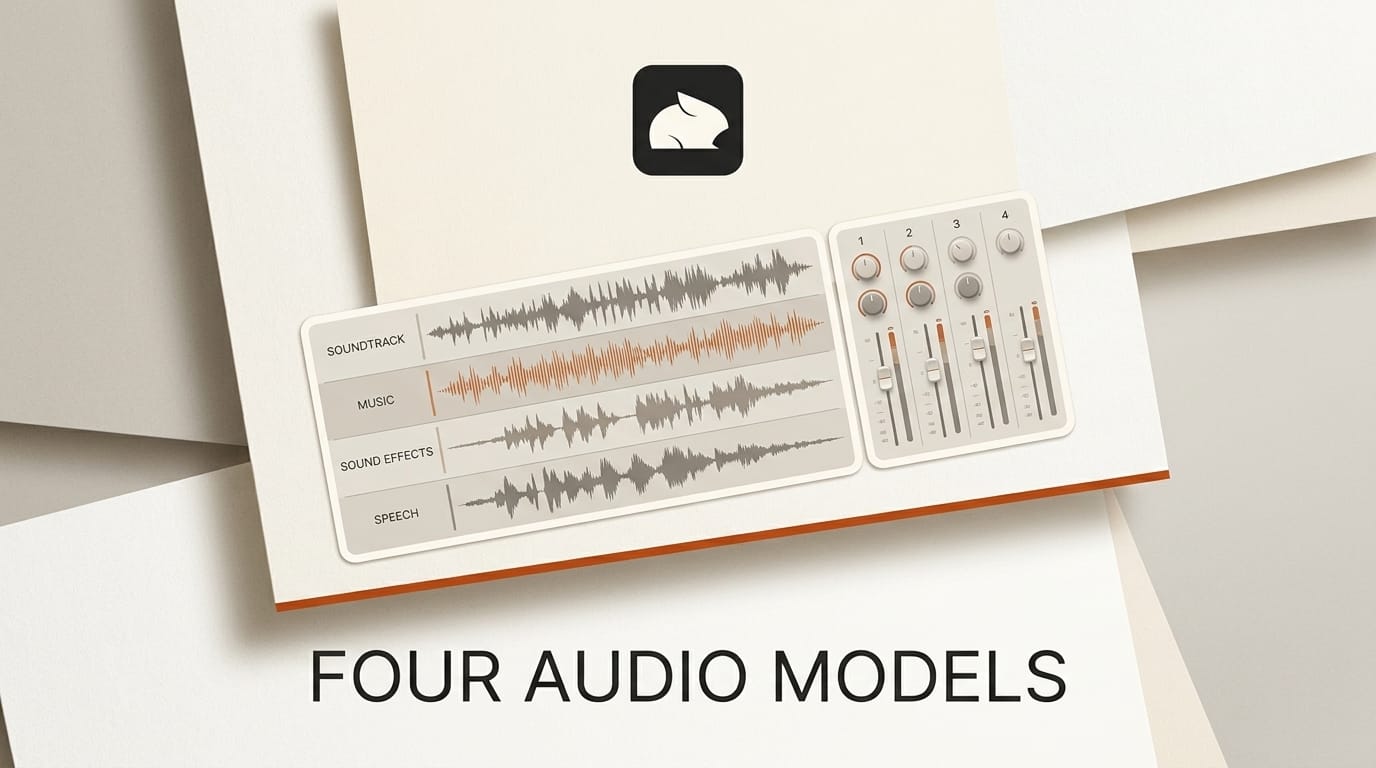
Pika released Pika Audio on August 13, 2026: four audio models covering soundtrack, music, sound effects and speech, priced at up to 20 times less than comparable models. For anyone who has been paying per second for AI audio, the pricing is the headline.
The more interesting detail is the shape of the lineup. Pika did not ship one general audio model. It shipped four narrow ones, and the split tells you something about where AI audio has actually landed.
What the Four Models Do
The announcement covers each one, and they map cleanly onto separate jobs.
Pika Soundtrack takes video and produces synchronised music, speech, ambience and motion-aware sound effects. Motion-aware is the operative word: the model is reading the footage rather than generating audio to a duration.
Pika Music turns prompts, lyrics, voices and reference tracks into complete songs. Reference track input is the notable part, because matching a feel is far more useful in practice than describing one in words.
Pika SFX turns written direction into clean, prompt-faithful sound effects. Prompt-faithful is doing real work in that sentence. Sound effects are a domain where approximately right is useless: you need the specific door, not a door.
Pika Speech turns text into expressive speech using preset voices or a clone of your own. This is the slice with the most entrenched competition, where ElevenLabs has been the default for a while, so pricing pressure here is where the claim gets tested first.
All four are reachable programmatically through the Pika API, which matters if you intend to wire audio into a batch pipeline rather than generate by hand.

Why Splitting Them Matters
A single model that does music, speech and effects sounds better on a spec sheet and is usually worse at all three. These are genuinely different problems. Music needs long-range structure. Speech needs prosody and intelligibility. Sound effects need transient accuracy and tight timing. Optimising one tends to cost you the others.
Splitting also means you pay for the job you are doing. If you need forty sound effects, you are not paying music-model rates for them, which is part of how the pricing gets where it does.
Soundtrack is the one worth watching, because generating video-synced audio in a single pass is the same problem ComfyUI's H3 Sync Sound Challenge is currently pushing on from the open source side. Two credible attempts at the same hard problem in one week is a signal about where video AI is heading.

What Cheap Audio Actually Changes
Price changes behaviour more than capability does, and this is the part worth thinking through.
At high per-generation cost you commit early. You pick a direction, generate once, and live with it because iterating is expensive. That is a bad way to work on anything creative, and it is especially bad for audio, where you often cannot tell whether a cue works until you hear it against the picture.
At a twentieth of the cost you generate ten soundtrack options and audition them. That is the actual workflow change: audio moves from a thing you commission once to a thing you iterate on, which is how it has always worked with human composers and sound designers on any decent budget.
For song generation specifically the incumbent comparison is Suno, and the reference-track input is the feature most likely to decide which one you reach for. The second change is coverage. Most short-form video published today has either library music or nothing, because bespoke audio was not worth it. Cheap generation moves the floor.
If you work in open weights instead, our coverage of MiniMax Music 3 covers the self-hosted equivalent for the music slice specifically.

What to Check Before You Commit
Three things, and the first two are the ones that cause real problems rather than mild annoyance.
Licensing is the first question with any generated audio you intend to publish, and it is more consequential than with images. Music rights are enforced aggressively and platform content ID systems act automatically. Read the terms on commercial use and confirm what you own before a client project depends on it.
Voice cloning is the second. Pika Speech supports cloning your own voice, which is straightforward when the voice is yours and a legal problem when it is not. Get written consent for any voice that belongs to someone else, and keep it.
The third is that "up to 20 times cheaper" is a ceiling, not a rate. Compare the specific model you will use against what you pay now for the specific job you do, not against the best case in a launch post.
Key Takeaways
1. Four models, not one: Soundtrack (video to synced audio), Music (songs, including from reference tracks), SFX, and Speech with voice cloning.
2. Splitting by job is the right call technically, because music, speech and effects optimise for different things.
3. The pricing claim is up to 20 times cheaper than comparable models. Treat that as a ceiling and check your specific use.
4. The real change is iteration. Cheap audio means auditioning options instead of committing to the first generation.
What to Watch
Whether Soundtrack holds up on real footage is the question that matters. Motion-aware sound effects are easy to demo on clean, well-lit, single-subject video and hard on the messy footage most people actually cut. Try it on your own worst clip before you believe the reel.
The other thing to watch is whether this pricing pulls the rest of the market down. Audio has stayed expensive relative to image generation for a while. If a credible provider undercuts by this margin and the quality holds, that gap closes quickly.
Frequently Asked Questions
What is Pika Audio?
A set of four audio models released August 13, 2026: Pika Soundtrack, Pika Music, Pika SFX and Pika Speech, covering video-synced audio, song generation, sound effects and text to speech.
How much cheaper is it?
Pika describes the models as up to 20 times cheaper than comparable audio models. That is an upper bound across the range, so compare the specific model you plan to use against your current cost.
Can it generate audio that matches my video?
That is what Pika Soundtrack is for. It produces synchronised music, speech, ambience and motion-aware sound effects from the footage itself rather than generating to a fixed duration.
Can I clone my own voice?
Yes, Pika Speech supports preset voices or a clone of your own. Only clone a voice you own or have written permission to use.
Can I use the output commercially?
Check the current terms before committing. Music rights in particular are enforced aggressively and platform content systems act automatically, so confirm commercial usage rights before a paid project depends on it.
Is there an open source alternative?
For music specifically, MiniMax Music 3 ships open weights and runs in ComfyUI. There is no direct open equivalent to the video-synced Soundtrack model yet.
Deep dive by Creative AI News.
Subscribe for free to get the weekly digest.