StepFun released Step Code v0.1.0 on 22 September 2026, an MIT-licensed terminal coding agent that reads your code, edits it, runs tests and ships, and its launch claim is "80.9% on Terminal-Bench 2.1". That figure is 72 of 89 tasks, run once, on a model StepFun has not named, and it is not on the official leaderboard. Translated back into tasks, StepFun's own chart puts Step Code two tasks ahead of Codex and three ahead of Claude Code. This piece works through what that number can and cannot tell you, and who should install the tool anyway.
Background
Step Code is a fork. The repository's license status file says it "is derived from the MIT-licensed Pi" project, the open coding harness by Mario Zechner, and the LICENSE file still opens with his 2025 copyright. StepFun's binaries were built at 03:59 UTC on 22 September and the launch thread on X went out at 16:23 UTC. By 24 September the installer's manifest already pointed at version 0.1.1.
Out of the box it talks to one provider. The README says the default entrypoint "exposes one built-in model provider: Step (StepFun)", and the code's default model is step-5-preview. On StepFun's pricing page that model costs $1.00 per million input tokens on a cache miss, $0.05 on a cache hit and $2.70 per million output tokens, with output counting reasoning as well as the answer. StepFun's model configuration docs go further than the README and describe API keys for other providers, cloud platforms and a models.json file for Ollama, vLLM and LM Studio. The two documents do not agree yet, which is normal for a 0.1 release and worth knowing before you plan around a local model.

The features are aimed squarely at people leaving another agent. It reads AGENTS.md and uses an existing CLAUDE.md as-is, loads Skills in the SKILL.md format, claims that "most Claude Code plugins are directly compatible", and on first launch imports MCP servers from ~/.claude.json and ~/.codex/config.toml. It has four permission modes (Ask, Read Only, Bypass, Autopilot), parallel subagents, a /goal command for long autonomous tasks, and StepPage, one-command static site publishing with rollback.
Deep Analysis
The chart is counted in tasks, not percentages
StepFun's second post spells out the fraction: "it passed 72/89 tasks (80.9%)". Every other number on its chart divides cleanly by 89 as well, which makes the gaps easy to read in whole tasks.
| Harness (StepFun's chart) | Score | Tasks passed of 89 | Gap to Step Code |
|---|---|---|---|
| Step Code | 80.9% | 72 | 0 |
| Dsh | 80.9% | 72 | 0 |
| Codex | 78.7% | 70 | 2 tasks |
| Claude Code | 77.5% | 69 | 3 tasks |
| Kimi Code | 74.2% | 66 | 6 tasks |
| Zcode | 71.9% | 64 | 8 tasks |
| Pi | 66.3% | 59 | 13 tasks |
| Opencode | 66.3% | 59 | 13 tasks |
One task on this benchmark is worth 1.1 points. A lead of two tasks over Codex is the kind of gap a single flaky test, a timeout or a different random seed can open or close. The same post says Step Code tied for the top pass rate "while using fewer tokens than the other tied leaders", and the chart bears that out narrowly: the only other leader is Dsh, plotted at a little over 3.5 million tokens per rollout against Step Code's roughly 3.2 million. The same chart also shows Codex at 78.7% on roughly 1.6 million tokens per rollout, about half of Step Code's usage for two fewer tasks. On efficiency alone, StepFun's own data favours Codex.

One pass against a five-trial rule
The official Terminal-Bench 2.1 submission rules say "you must run at least 5 trials per task". Every row on the official leaderboard is 445 trials, 89 tasks five times over, and each carries a standard error. StepFun's 72 of 89 reads as one pass per task, with no error bar. The leaderboard also has no Step Code or StepFun entry, and it could not have one yet: the maintainers write that "Community submissions are currently closed for Terminal-Bench 2.1. Only submissions run by the maintainers will be added."
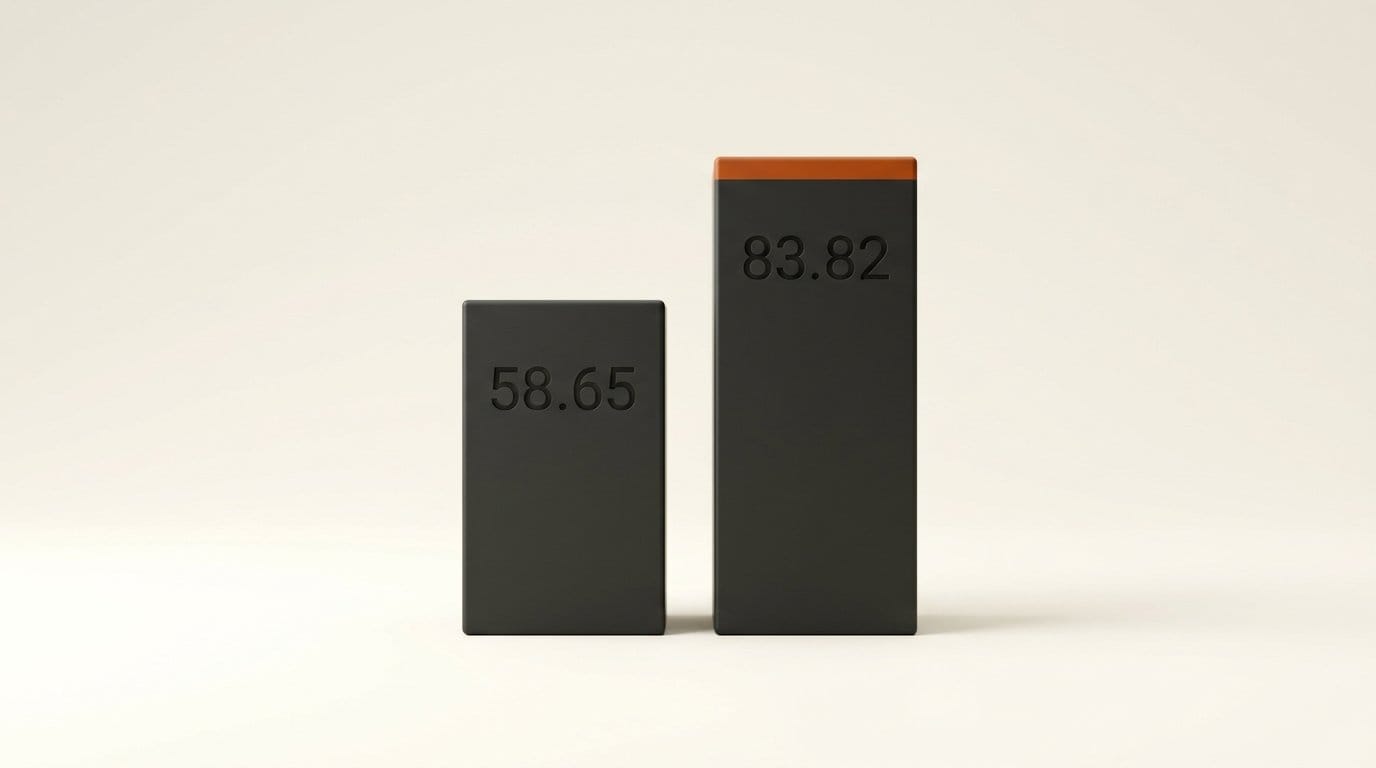
That also means StepFun's numbers for rival harnesses are not the official ones. StepFun charts Codex at 78.7% and Claude Code at 77.5%. The leaderboard's Codex rows run from 75.73% to 87.42% and its Claude Code rows from 58.65% to 83.82%, depending on which model sits underneath. Which models StepFun used for its rivals is not stated either.
The missing variable is the model, and it is the big one
The official leaderboard lets you measure how much a harness matters compared to a model, because some models appear under more than one harness. Fable 5 scores 83.82% in Claude Code and 80.45% in Terminus 2, a harness effect of 3.4 points. Claude Code with GLM-5.1 scores 58.65% and with Fable 5 scores 83.82%, a model effect of 25.2 points inside the same harness. On this benchmark, swapping the model moves the score about seven times more than swapping the harness.
So a harness score with no model attached cannot be ranked against anything. A KuCoin news summary of the launch notes that the company did not disclose which underlying model was used in the benchmark. If the 72 tasks came from step-5-preview, that is a strong result for a model priced at $2.70 per million output tokens. If they came from a frontier model routed through the Step Code harness, it is a result about that model. The thread does not say which.
The fork gained 13 tasks over its parent
The most surprising row on StepFun's chart is its own ancestor. Pi, the project Step Code is forked from, scores 66.3%, which is 59 tasks. Step Code scores 72. A 13-task jump from a fork is large, and either it comes from genuine harness work (context handling, retries, subagent fan-out, the opt-in context projection setting a KuCoin summary mentions) or the two rows were not measured the same way. The chart hints at the second: Pi and Opencode are drawn with the orange "multirun r1" and "usage subset (est.)" markers, while every other harness is a "frozen chain" point, and none of those three terms is defined in the posts or the repository. If StepFun publishes the per-task traces on Harbor Hub, the question answers itself; until then, treat the gap as a hypothesis worth testing on your own repo, not a finding.
The chart also includes a harness labelled "Dsh" tied with Step Code at 80.9%. The KuCoin summary reads it as DeepSeek's harness, which we covered in DeepSeek Harness: Open Agent Framework, Everything a Plugin; StepFun does not expand the abbreviation.
Impact on Creators
If you build sites, tools or automations with Claude Code or Codex today, Step Code is the cheapest way to try a second opinion on the same project, because it picks up the configuration you already have. Your CLAUDE.md, your Skills and your MCP servers come across without editing, and the importer is written to read, not rewrite, those files. At $1.00 in and $2.70 out per million tokens, step-5-preview is also cheap enough to run on real tasks rather than toy ones, which is the only benchmark that settles the Pi question for your own work.

Three cautions from the repository, which had 41 open issues and pull requests on 24 September. Issue #191, opened that morning, reports that stdio MCP subprocesses "receive the full StepCode process environment", which means every MCP server you imported can see every API key exported in your shell. Until that is fixed, launch Step Code from a shell that holds only the keys it needs. Windows install is marked beta and the README recommends WSL. And the public repository ships only no-op telemetry, with a note that private observability code is kept out of it, so what the released binary reports is not something you can read in the source.
If you are choosing a harness for a team, not trying one for a weekend, the official leaderboard is the better guide, and it currently says the model you pick matters more than any harness on it. Our Cognition SWE-2 vs Fable 5.1 comparison walks through the same trap from the model side.
Key Takeaways
- Step Code's 80.9% is 72 of 89 Terminal-Bench 2.1 tasks, two more than StepFun's Codex run and three more than its Claude Code run.
- It is one pass per task against an official rule of at least five, with no error bar and no leaderboard entry, because community submissions for 2.1 are closed.
- StepFun's own chart shows Codex at 78.7% on about half the tokens per rollout, so the efficiency lead is over one rival, not the field.
- StepFun has not named the model behind the score, and on the official board the model moves results about seven times more than the harness does.
- The tool itself is useful now: it imports Claude Code and Codex MCP config, reads CLAUDE.md and AGENTS.md, and defaults to a model at $2.70 per million output tokens.
- Run it from a shell with minimal secrets until the MCP environment issue is closed.
What to Watch
The single most useful thing StepFun could publish is the model and the trial count behind the 72 tasks. If the answer is step-5-preview across five trials with a standard error near the official board's typical one point, Step Code becomes a genuinely cheap contender. If the answer is a frontier model, the efficiency claim (fewer tokens than the tied leaders) is still interesting, and should be tested head to head on the same model.
Also watch the provider question. The README says Step is the only built-in provider while the docs describe Anthropic, OpenAI, Gemini and local endpoints through models.json. When those line up, you will be able to run the Pi-versus-Step comparison yourself on one model, which is the test that would tell you whether the 13-task gain belongs to the harness. With 0.1.1 out two days after launch, that answer may not take long.
Frequently Asked Questions
What is Step Code?
Step Code is StepFun's open-source terminal coding agent, released as v0.1.0 on 22 September 2026 under the MIT license. It is derived from the Pi coding harness, supports MCP servers, Agent Skills, subagents and four permission modes, and defaults to StepFun's step-5-preview model.
Is Step Code's 80.9% Terminal-Bench 2.1 score official?
No. It is self-reported by StepFun from one pass over the 89 tasks. The official leaderboard requires at least five trials per task, currently accepts only maintainer-run submissions for 2.1, and has no Step Code entry.
Which model did Step Code use for 80.9%?
StepFun has not said. The launch posts give the pass count and token use but not the model or reasoning settings, which matters because the model changes Terminal-Bench scores far more than the harness does.
Does Step Code work with my Claude Code setup?
Largely yes. It uses an existing CLAUDE.md as-is, loads SKILL.md Skills, imports MCP servers from ~/.claude.json and ~/.codex/config.toml, and says most Claude Code plugins are directly compatible. An open issue reports that plugin .mcp.json declarations are ignored at runtime.
How much does Step Code cost to run?
The CLI is free and MIT-licensed. The default step-5-preview model is billed at $1.00 per million input tokens on a cache miss, $0.05 on a cache hit and $2.70 per million output tokens, with reasoning counted as output.