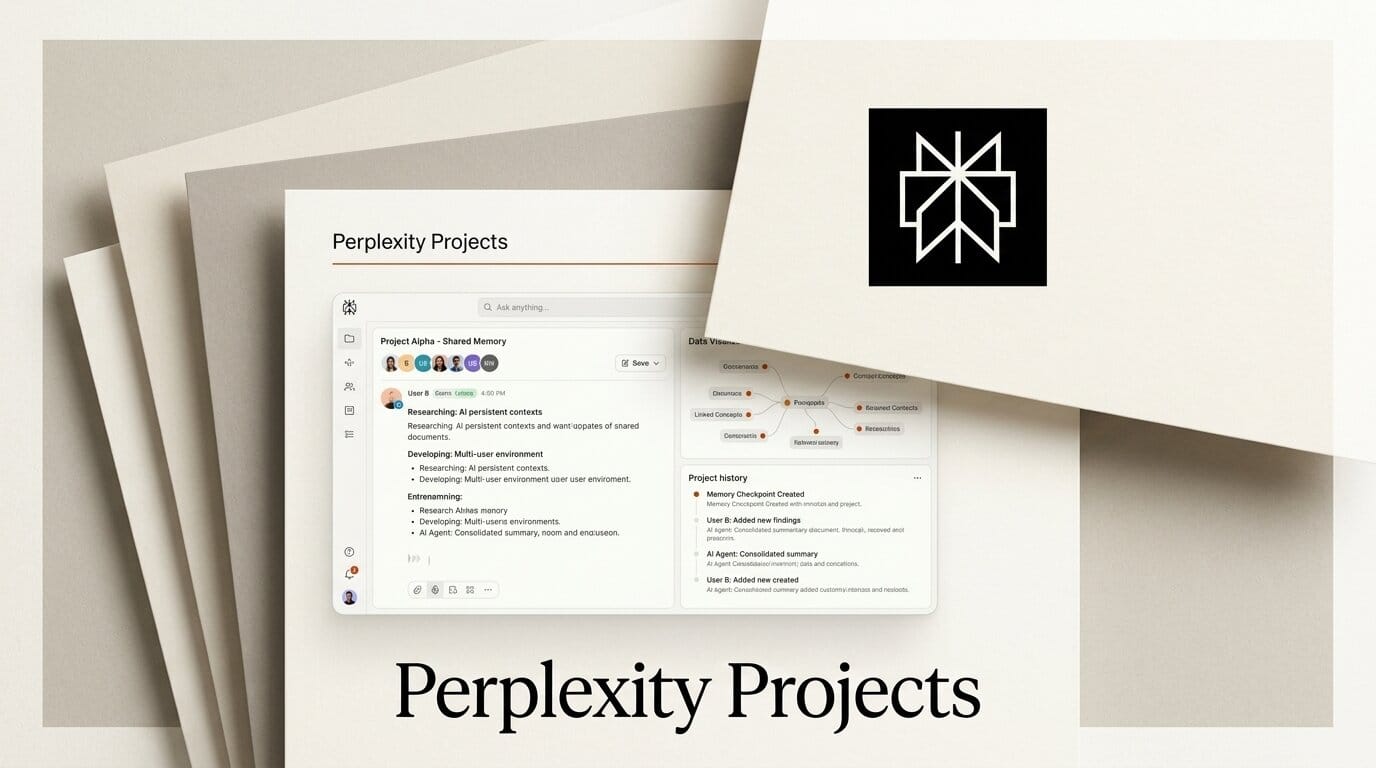
On July 30, 2026, Perplexity rolled out Projects, an evolution of its old Spaces feature that turns Perplexity Computer into a shared, multiplayer workspace for people and AI agents. Each Project bundles a persistent file system, a memory layer called Brain, and long-running agent sessions into one hub, and it is available to all users, not just paid tiers. The pitch is blunt: instead of starting every agent task from a blank slate, your next task starts with full context from the last one, and your teammates work from the same files.
For anyone building something over days rather than minutes, a website, a research report, a content pipeline, a codebase, that continuity is the whole game. This is the same product line as the Perplexity Personal Computer that landed on Windows, now with a collaboration layer bolted on top.
What Perplexity Projects Actually Is
Projects replaces Spaces, which were mostly organized collections of threads and files. A Project is more active. It is a hub for long-running, ongoing work inside Computer, with three things stitched together: a shared file system that both humans and agents read and write, a persistent Brain that remembers decisions and sources across tasks, and agent sessions that can run for hours and be resumed later.
The multiplayer part matters. When a team collaborates in a Project, every member works from the same files, context, and skills, while each person's private memory and connected accounts stay scoped to them. So a shared brand-guidelines folder and a shared research trail live in the Project, but your personal Gmail connector does not leak to the whole team. That split, shared work context versus private credentials, is what makes it usable for real teams rather than a single power user.
The SPACE Runtime Underneath
Projects sits on top of infrastructure Perplexity has been building quietly all year. In June 2026 the company deployed SPACE, its Sandboxed Platform for Agentic Code Execution, and it now powers 100% of Computer sessions. SPACE is what lets an agent execute code, edit files, and grind through multi-step tasks that span hours, days, or even months without falling over.
The technical details explain why long-running work is now practical. Every task runs in a disposable Firecracker microVM with its own guest kernel, isolating untrusted code from the host and from other users. The system supports pausing, resuming, suspension, restoration, rollback, forking, and crash recovery, with rolling snapshots that preserve both live memory and files. Built on btrfs with copy-on-write cloning, SPACE cut median sandbox creation from 185ms to 60ms and dropped 90th-percentile latency from 447ms to 89ms. In plain terms: an agent can pick a task back up tomorrow exactly where it stopped, and you can fork a working session to try a risky change without destroying the original.

Brain: The Persistent Memory Layer
The second pillar is Brain, Perplexity's shared memory system. Rather than living inside one product, Brain is a connective layer underneath Search, Computer, and potentially the Comet browser. It organizes what you know as categorized topics with underlying context, plus a navigable graph of connections between topics that looks a lot like an Obsidian-style knowledge graph. Retrieval is topic-based, so only the relevant slice of memory loads for a given task instead of dumping everything into the prompt.
Perplexity's own numbers claim Brain improves answer correctness by 25%, recall by 16%, and runs 13% cheaper per task, because the agent starts with full context of your projects, decisions, and sources instead of from scratch. Cheaper and more accurate at the same time is unusual, and it comes from not re-deriving context you already established.
Projects vs ChatGPT Work vs Claude Cowork

Projects lands in a crowded fight. OpenAI shipped ChatGPT Work on July 9, 2026, an agent that takes an outcome, plans the steps, and works for hours across your connected apps to ship finished spreadsheets, slides, docs, and web apps. Anthropic's Claude Cowork, by contrast, lives inside the desktop app and touches your local file system, mapping out steps and running parallel sub-agents on the files already on your machine. The rough split across the category is an agent that lives in your browser and reaches the web versus one that lives on your desktop and reaches your disk. Perplexity Projects stakes out a third position: a cloud workspace where the files, the memory, and the agents are all shared and multiplayer.
| Dimension | Perplexity Projects | ChatGPT Work | Claude Cowork |
|---|---|---|---|
| Where it runs | Cloud (Computer / SPACE microVMs) | Cloud, across connected apps | Local desktop app |
| Shared file system | Yes, humans and agents on the same files | Connected app files | Your local folders |
| Persistent memory | Brain, cross-product, topic graph | Task and connector context | Project-scoped Cowork memory |
| Multiplayer teams | Yes, private credentials stay scoped | Single-user focused | Single-user focused |
| Availability | All users | Paid work tiers | Claude desktop users |

A Real Workflow: Building With Projects
Here is how a builder actually uses this in an afternoon. Say you are producing a launch page and a supporting research brief for a new product.
- Create a Project and drop your brand assets, past copy, and a spec doc into its shared file system.
- Ask the agent to research competitors. Because Brain remembers the sources and decisions, you never re-explain the product on later tasks.
- Have the agent draft the landing page as real files in the Project. Because SPACE persists the session, you can walk away and resume the exact state later.
- Fork the session to try a bolder design variant without touching the original, then compare.
- Invite a teammate. They open the same Project, see the same files and context, and edit alongside the agent while their own connected accounts stay private.
The unlock is not any single generation. It is that the context, the files, and the running work survive between sessions and across people. That is the difference between a chatbot and a workspace.
Why It Matters for Creators and Builders
Most AI tools still treat every request as a fresh conversation. For a quick answer that is fine. For anything you build over a week, it is a tax you pay again and again, re-uploading files, re-stating goals, re-establishing what you already decided. Projects, SPACE, and Brain together attack that tax directly. Persistent files mean your work has a home. Persistent memory means the agent stops forgetting. Persistent sessions mean long jobs actually finish. And making it multiplayer, on the free tier, is an aggressive move against ChatGPT Work and Cowork, both of which lean toward single users on paid plans. If Perplexity's correctness and cost claims hold up in real use, Projects is one of the clearer signals yet that the agent-as-workspace, not agent-as-chat, is where creative and build tooling is heading.
Frequently asked questions
Is Perplexity Projects free?
Yes. Perplexity says Projects is available to all users, not just paid tiers. Heavier agent usage and premium models may still fall under existing plan limits, but the workspace itself is not paywalled.
How is Projects different from the old Spaces?
Spaces were mostly organized collections of threads and files. Projects add a shared file system that agents read and write, persistent Brain memory across tasks, and long-running resumable agent sessions, turning a folder into an active workspace.
What is Brain and how does it help?
Brain is Perplexity's cross-product memory layer. It stores your context as a topic graph and loads only the relevant slice per task. Perplexity claims it lifts answer correctness by 25%, recall by 16%, and cuts cost per task by 13%.
Can my team collaborate in one Project?
Yes. Every member works from the same files, context, and skills, while personal memory and connected accounts stay scoped to each individual, so shared work does not expose private credentials.
How does it compare to ChatGPT Work and Claude Cowork?
ChatGPT Work is a browser-side agent that works across connected apps. Claude Cowork is a desktop agent that touches your local files. Perplexity Projects is a cloud, multiplayer workspace where files, memory, and agents are shared across a team.
What powers the long-running agent tasks?
SPACE, Perplexity's sandbox runtime, runs each task in a disposable Firecracker microVM with snapshots, forking, and crash recovery, so sessions can pause and resume across hours or days without losing state.