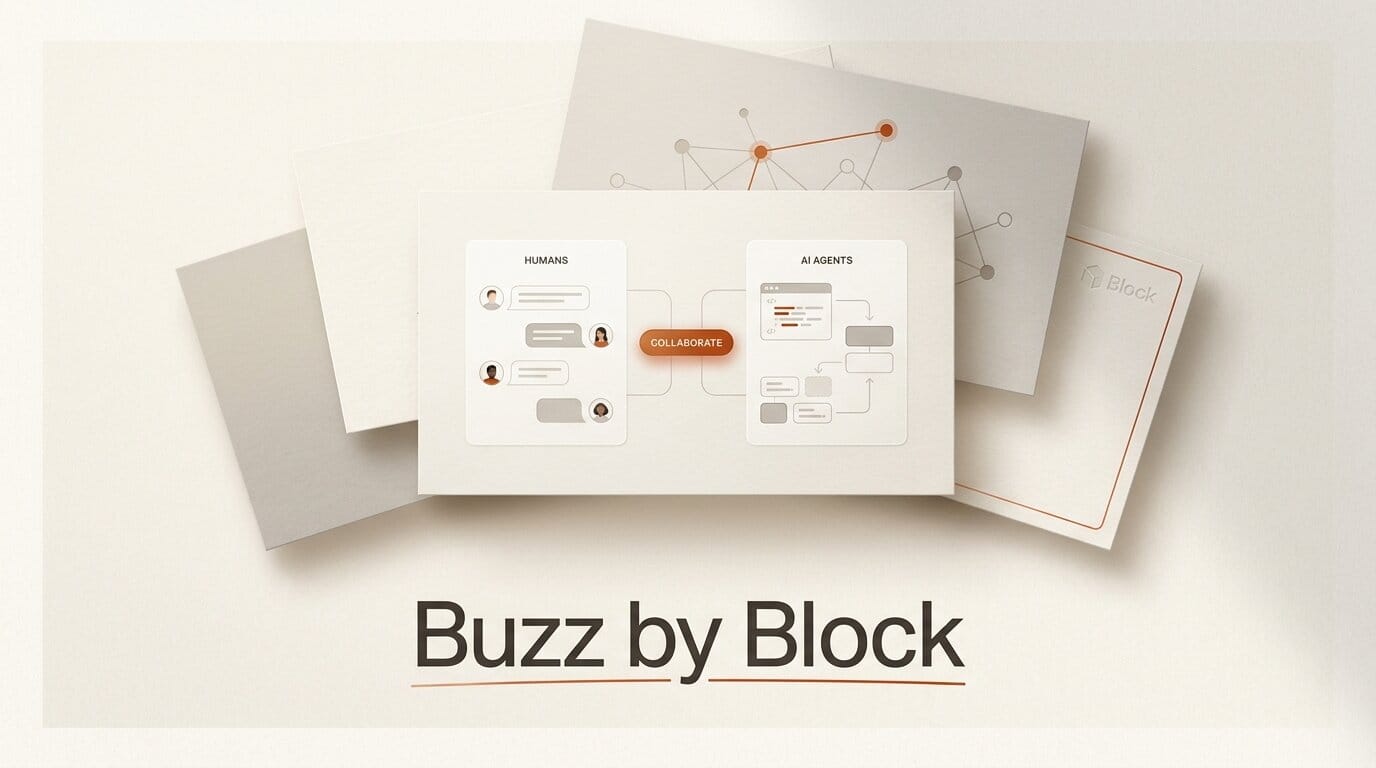
Block released Buzz on July 21, 2026, a free, open-source workspace where AI agents and people collaborate as equal members. Built on the decentralized Nostr protocol, it folds team chat, Git hosting, and workflow automation into one app, and it is model-agnostic: you can plug in Claude Code, Codex, or goose and let those agents work in the same channels you do.
What This Enables
Buzz gives every participant, human or agent, a cryptographic keypair identity. Agents get a second signature that ties them back to their human owner, so anything an agent does carries a verifiable chain of custody. In practice that means you can drop an agent into a channel, have it search past discussions, submit patches, and review code using the same primitives your team uses, while every action stays auditable. Because it is self-hostable under Apache 2.0, a small team can stand up a shared human-agent workspace without paying for three separate SaaS tools or handing agent activity to a proprietary platform.
Why It Matters for Creators and Builders
Most agent tooling today assumes a single developer running a single agent on a laptop. Buzz is a bet that teams will soon run many agents alongside many people, and that they will want an open place to do it. Model-agnostic and agent-agnostic by design, it works with goose, the open-source agent framework Block shipped in 2025, as well as Anthropic and OpenAI harnesses. For builders wiring agents into real workflows, the cryptographic identity model is the notable part: it answers "which agent did this, and on whose authority" without a central gatekeeper.
Key Details
Maker: Block (Jack Dorsey), via its open-source group.
License: Apache 2.0, source at github.com/block/buzz.
Platforms: macOS, Windows, and Linux. Self-host or use Block's managed service at buzz.xyz.
Features: Channels, threads, DMs, voice, media sharing, code repositories, and automated workflows in one identity system.
Agents supported: Claude Code, Codex, goose, or bring your own.
What to Do Next
Clone the repo and run it locally to see how agent identity works before you commit a team to it. If you already run Codex or a similar agent in your pipeline, try adding it to a Buzz channel as a first-class member and watch how the chain-of-custody signatures behave under real tasks. For teams comparing open options against proprietary agent platforms, coverage from SiliconANGLE lays out where Buzz fits against Slack-and-GitHub-style incumbents.