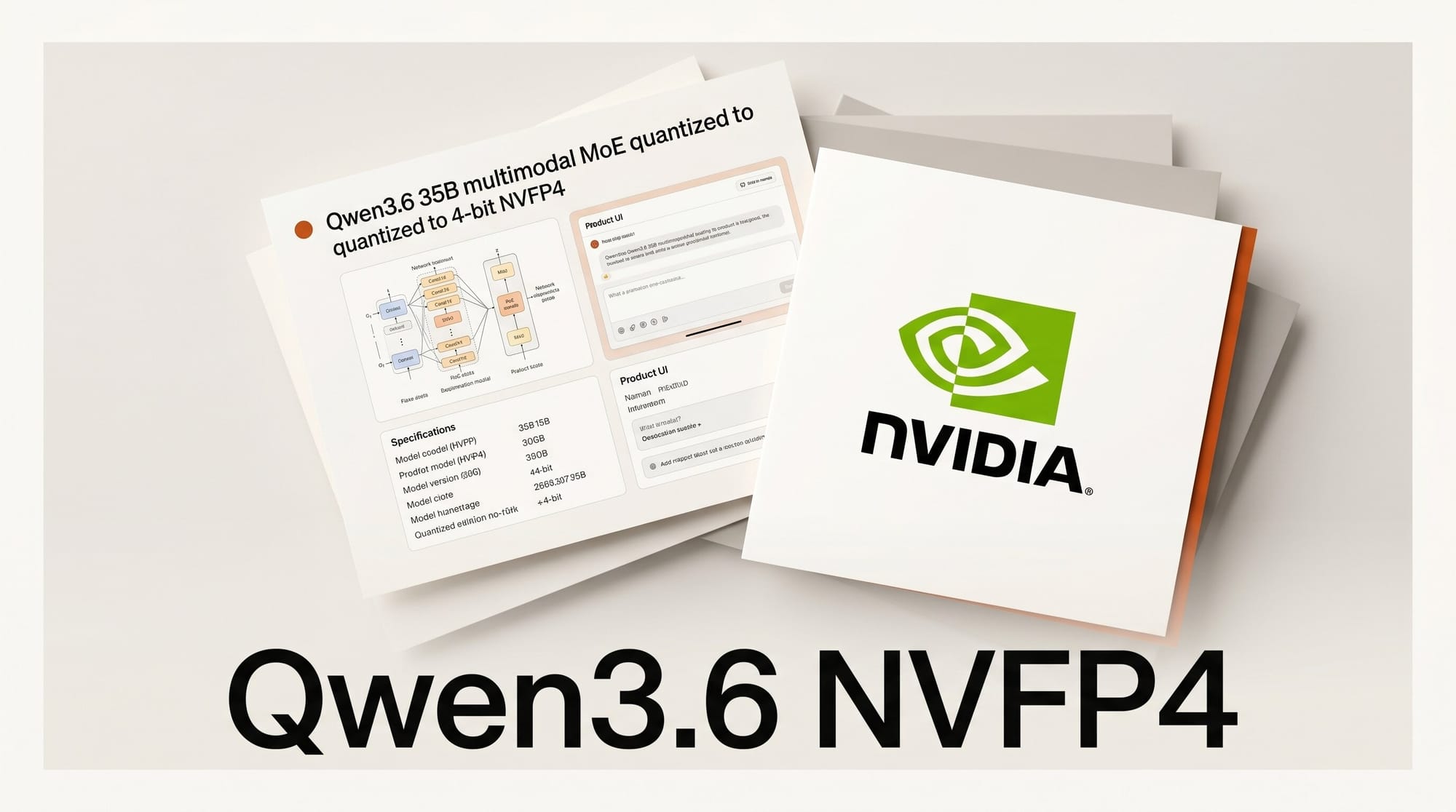
NVIDIA has shipped an NVFP4 quantized build of Alibaba's Qwen3.6-35B-A3B, a 35B-parameter multimodal Mixture-of-Experts model with 3B activated parameters and 262K context. The May 28, 2026 release uses NVIDIA's Model Optimizer to compress weights and activations from 16-bit down to a new 4-bit floating-point format, cutting disk and GPU memory roughly 3x with less than 1% accuracy loss across eight standard benchmarks.
How to integrate this
If you already serve Qwen models on a Hopper or Blackwell GPU, the swap is mechanical. Pull the NVFP4 checkpoint, point vLLM at it with the modelopt quantization flag, and the model loads in roughly a third of the VRAM the BF16 version needed. A workstation with a single 80 GB Hopper card that previously could not fit the full 262K context window for Qwen3.6-35B-A3B can now serve it comfortably, and consumer Blackwell cards (the RTX 50 series) become a viable target for multimodal coding agents that previously required datacenter hardware. The release notes ship a working vllm serve command and the model speaks an OpenAI-compatible API, so existing client code that targets the BF16 endpoint keeps working without changes.
Why It Matters
Quantization usually forces a tradeoff between memory footprint and output quality, and 4-bit formats have historically been the cliff edge where reasoning models start to break. The NVFP4 numbers on this release land differently. MMLU Pro drops from 85.6 to 85.0, GPQA Diamond from 84.9 to 84.8, AIME 2025 from 89.2 to 88.8, and on three multimodal and instruction-following benchmarks (IFBench, MMMU Pro, AA-LCR) the quantized model matches or slightly beats the BF16 baseline. For agentic coding workloads where Qwen3.6-35B-A3B already posts a 73.4 on SWE-bench Verified, a near-lossless 3x compression collapses the cost of running the model locally and changes which teams can self-host a frontier-tier MoE.
Key Details
The base Qwen3.6-35B-A3B model is Apache 2.0, ships with a vision encoder for images and video, and operates in thinking mode by default. Its MoE layout is 256 experts with 8 routed and 1 shared expert active per forward pass, and the architecture interleaves Gated DeltaNet blocks with gated attention. The NVFP4 derivative is also Apache 2.0 and quantizes only the linear operators inside the transformer and MoE blocks, leaving embedding, normalization, and routing layers in their original precision. NVIDIA used nvidia-modelopt v0.44.0 for the post-training quantization sweep. The published deployment path is vLLM on Linux with NVIDIA Hopper or Blackwell GPUs, and the 262K context length carries over unchanged from the base model.
What to Do Next
Decide whether you need the multimodal head. Teams running text-only coding agents can serve the smaller dense Qwen3 family at lower cost; the NVFP4 build is worth the switch when you want image or video input in the same model, when you need the full 262K context for repo-level prompts, or when you are GPU-constrained and the 3x memory reduction unblocks a deployment you could not previously fit. Pull the checkpoint from Hugging Face, run the vLLM command on a Hopper or Blackwell box, and benchmark against your current setup on the agentic-coding tasks you actually serve before swapping production traffic.