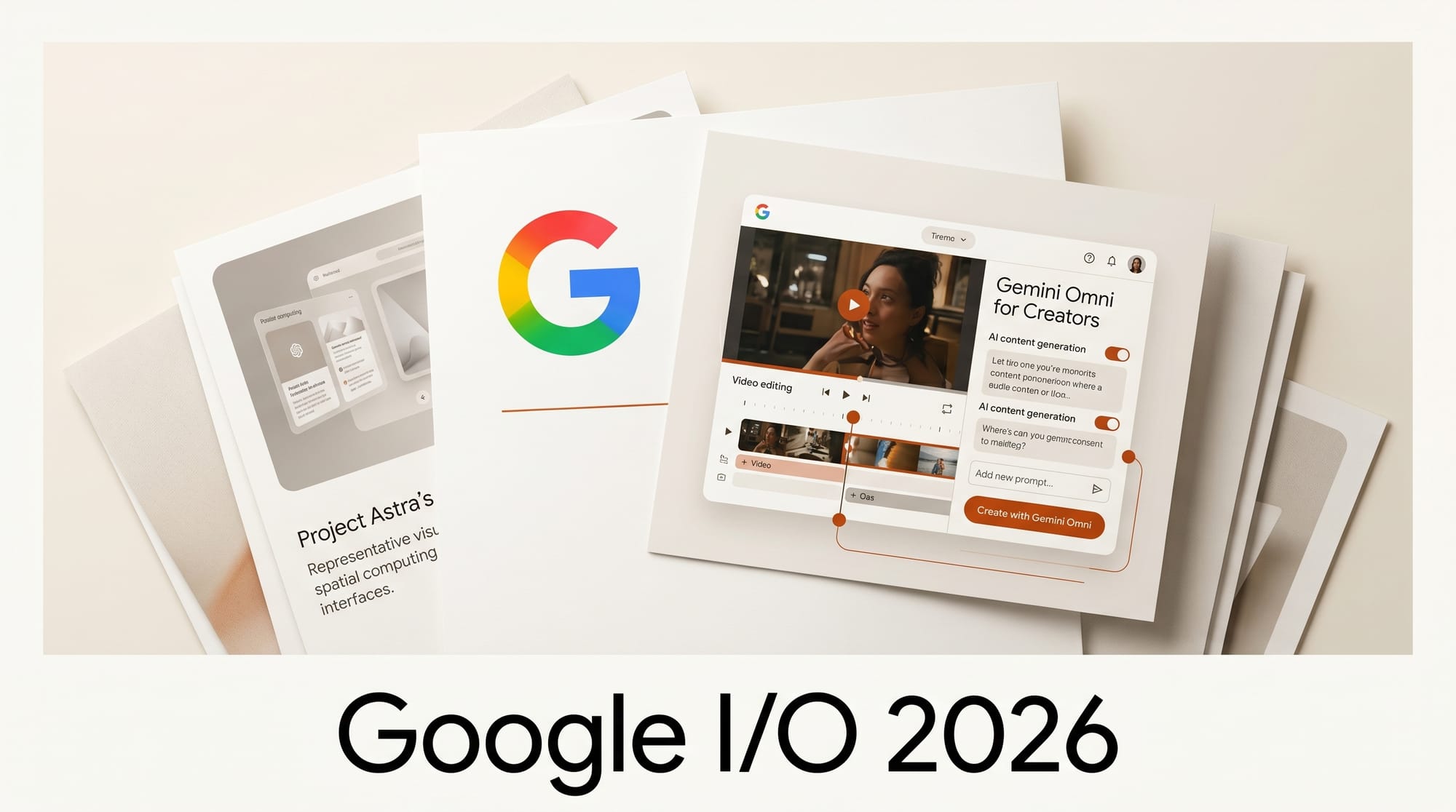
Google I/O 2026 opens on May 19 at 10am PT with the main keynote, followed by the Developer Keynote at 1:30pm PT. The event runs May 19-20 at Shoreline Amphitheatre in Mountain View, with sessions livestreamed at io.google/2026. With five days to go, here is what creators working in image generation, video, audio, and AI-assisted design workflows should watch most closely.
What Is Already Confirmed
Several tools in the Gemini creative ecosystem launched earlier in 2026 and will likely be showcased, or expanded, at the keynote:
- Imagen 4 family: Three tiers (Imagen 4, Imagen 4 Fast, Imagen 4 Ultra) are generally available in the Gemini API and Vertex AI. Ultra supports up to 2K resolution with improved photorealism and multi-subject scene handling.
- Lyria 3 Pro: Google's music generation model produces full tracks up to three minutes long with structural controls for intros, verses, choruses, and bridges. Available in Gemini, Vertex AI, Google Vids, and ProducerAI. Details on Google's Lyria 3 Pro announcement.
- Veo 3.1 and Veo 3.1 Lite: Both models are in production on Vertex AI. The Lite variant cuts costs for high-volume batch video creation. Google's Veo 3.1 Lite and upscaling launch post published May 11 also introduced a standalone video upscaling capability.
- Google Flow: A unified creative workspace relaunched in February 2026 that consolidates Whisk and ImageFX into one interface for image generation and editing.
These are in production use today. The keynote is expected to expand their capabilities, announce next-generation successors, and introduce tighter integration across the Gemini ecosystem.
What Creators Are Watching: Veo 4
Veo 4 is the most anticipated announcement for video creators at I/O 2026. Google has not confirmed the name or release date, but consistent leaks and analyst reporting point to a May 19 preview. Android Authority's I/O 2026 expectations guide places Veo 4 as a primary announcement alongside Gemini 4.
The expected feature set for Veo 4 includes:
- Extended generation length: Up to 20-30 seconds of continuous video, compared to the 10-second limit in Veo 3.1
- Native 4K output: No upscaling step required
- Character consistency: ID-embedding with 3-5 reference images lets the same character appear across separate shots without visual drift
- Multi-layer audio generation: Separate tracks for dialogue, ambient sound, and sound effects, generated in one pass
- Cinematic camera controls: Support for professional terminology: dolly-in, whip pan, rack focus, orbital drone shots
Character consistency is the capability that matters most for practical use. Creating multi-scene video narratives in Veo 3 today requires significant post-production work to maintain visual continuity across shots. A reference-image system changes the production math for short-form video and client work.
Gemini 4: From Response to Action
Google DeepMind CEO Demis Hassabis confirmed in January 2026 that the team is "focusing on Gemini 4 this year." The model is expected to shift from responsive AI (answering questions and generating content on request) toward proactive AI that plans and executes multi-step workflows without prompting for each step.

Key expectations for Gemini 4:
- Context window expansion: From 1M tokens (Gemini 3 Pro) to 2M tokens
- Native image and video generation: Rather than routing to Imagen or Veo separately, Gemini 4 may handle multimodal output within the same model
- Agentic capabilities: Triggering and completing multi-step workflows from a single high-level instruction
For creators, the agentic shift is more significant than the context window increase. A model that can plan and execute a five-step design workflow from one brief changes how creative software gets used. For more on using the current Gemini ecosystem for creative work, see Gemini for Creative Work: 2026 Workflow Guide.
The Gemini Omni Leak
On May 2, a UI string referencing "Powered by Omni" appeared inside the Gemini app. The leak was analyzed by WaveSpeed and Testing Catalog, both pointing to a new model or model family. Three interpretations are circulating: Omni is a new brand name for Veo 4, it is a separate Gemini-trained video model, or it is a unified architecture that handles image and video generation from a single prompt.
The third interpretation is the most consequential. A model that generates both static images and video without switching tools or APIs would consolidate the current workflow where creators move between Imagen for stills and Veo for motion. Whether Omni is a name, a model, or a product tier, Google will clarify it on May 19.
Project Astra: AI Agents for Creative Workflows
Project Astra debuted as a research demonstration at Google I/O 2025, showing a multimodal AI agent that processes live video, audio, and text with near-zero latency. At I/O 2026, the expectation is a move from demo to developer preview. Astra sees through the device camera, understands screen content, speaks, takes actions, and can call Google Search, Maps, and Lens.
For creative professionals, the practical use case is an agent that reviews work in progress (looking at the actual screen) and provides contextual feedback or executes revisions without copy-pasting between tools. The May 19 Developer Keynote includes a confirmed session titled "Agent-first workflows from prompt to production," which points to concrete tooling announcements for agentic creative pipelines.
Creator Impact by Discipline
| Discipline | What to Watch | Why It Matters |
|---|---|---|
| Video editors | Veo 4 character consistency, multi-layer audio | Multi-scene video without post-production continuity fixes |
| Graphic designers | Imagen 4 Ultra expansion, Omni unified model | 2K+ image output in Gemini, possible image-to-video in one prompt |
| Music producers | Lyria 3 Pro integration with Veo 4, possible Lyria 4 preview | Synchronized audio-video generation in one workflow |
| Developers | Project Astra developer preview, Gemini 4 API timeline | Multimodal agentic pipelines for creative tools |
| 3D artists | Omni model video output, Veo 4 cinematic camera controls | Cinematic motion generation from 3D stills |
How to Watch Google I/O 2026
The keynote streams live at io.google/2026 starting May 19 at 10am PT (1pm ET). The Developer Keynote follows at 1:30pm PT. Sessions on "What's new in Google AI" and "Agent-first workflows from prompt to production" run at 3:30pm PT. All sessions are available on replay immediately after broadcast.
This publication will post deep-dive coverage for each major creative AI announcement starting May 19 at noon ET. For a guide to the current Gemini Flash tier, see Gemini 3.1 Flash-Lite Is Now GA: What Creators Need to Know.
Is Veo 4 officially confirmed for Google I/O 2026?
Google has not officially confirmed Veo 4 by name. The announcement is expected based on consistent signals: leaked UI strings, roadmap alignment, analyst reporting, and the pattern of major model announcements at I/O. The most likely scenario is a preview on May 19 with broader availability in late May or June 2026.
What is the Gemini Omni model leak?
A UI string "Powered by Omni" appeared in the Gemini app on May 2, 2026. WaveSpeed and Testing Catalog both analyzed the string. The leading theory is that Omni is either a new brand name for Veo 4 or a unified model that handles image and video generation together. Google has not commented publicly. Expect a full explanation at the May 19 keynote.
Is Lyria 3 Pro already released?
Yes. Lyria 3 Pro launched earlier in 2026 and is currently available in Gemini, Vertex AI, Google AI Studio, Google Vids, and ProducerAI. It generates full music tracks up to three minutes long with structural controls and uses SynthID watermarking. I/O 2026 may introduce expanded capabilities or a Lyria 4 preview, particularly around synchronized audio-video workflows with Veo 4.
Will Gemini 4 be available to all users right after I/O?
Based on past releases, a preview is more likely than full general availability at I/O. Google typically announces models at the keynote and rolls them out in tiers over the following weeks. Expect API access for developers first, then a Gemini Advanced preview, before broader rollout in late 2026.
What is Project Astra and when does it launch publicly?
Project Astra is a multimodal AI agent from Google DeepMind that processes live video, audio, and text in real time with near-zero latency. It debuted as a research demo at I/O 2025. The expected I/O 2026 announcement is a transition to developer preview, built on Gemini 2.5 Pro. Broader public access is expected later in 2026 after developer testing.
What if I miss the Google I/O 2026 keynote live?
All sessions are recorded and available on replay immediately at io.google/2026. The Google for Developers YouTube channel will also carry the replay. Creative AI News will publish a summary of every major creative tool announcement within two hours of the keynote ending on May 19.