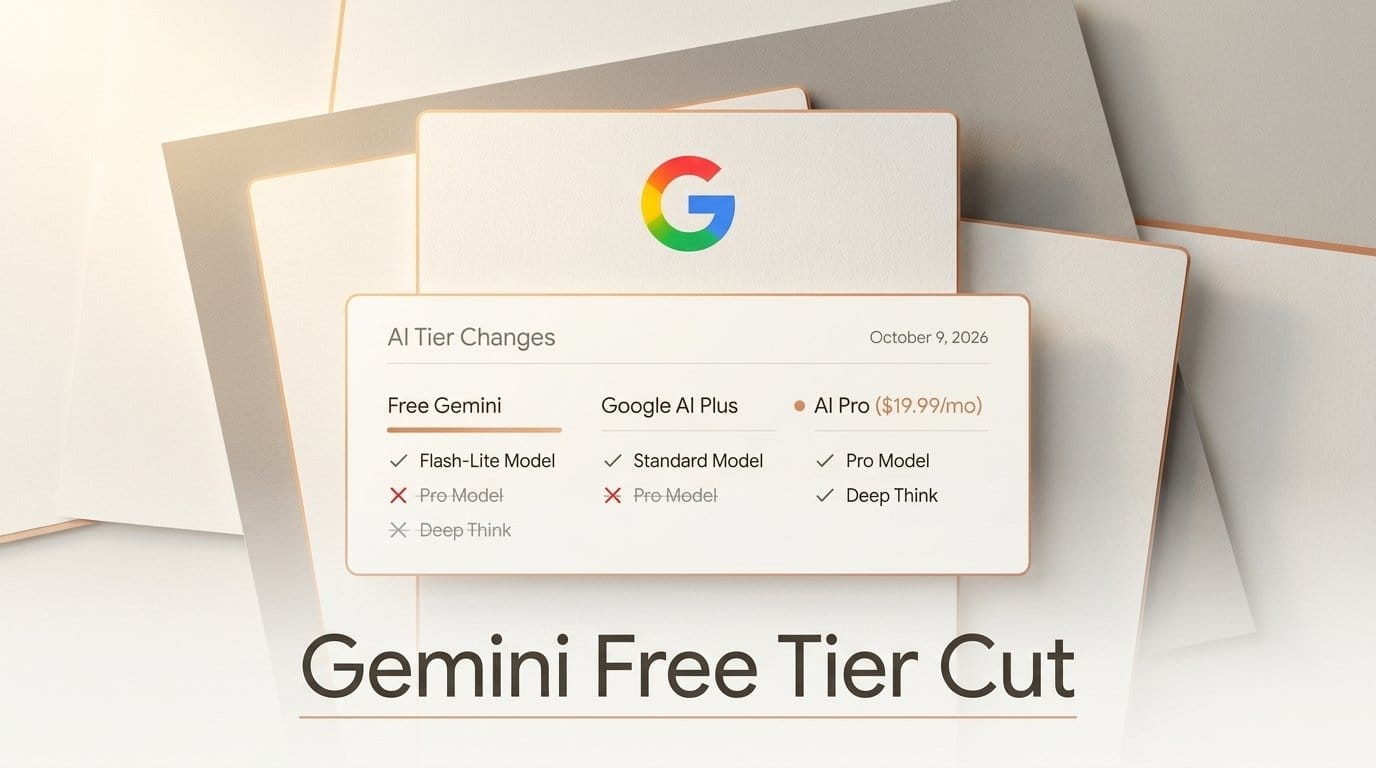
Starting October 9, 2026, the free Gemini app will only run Flash-Lite, Google's smallest model. Google's help page on the October changes shows a new model table: no plan gets Flash-Lite only, AI Plus gets Flash-Lite and Flash, and only AI Pro and AI Ultra keep Pro. 9to5Google spotted the update on October 3, and AI Plus subscribers are told they will get an email saying when the change reaches them.
Until now, Google's own Gemini limits page listed Flash-Lite, Flash and Pro as available on every plan, free included, with the difference made up in usage limits. That approach ends next week. This piece lays out what each tier keeps, what creators on the free and $4.99 plans actually lose, and the cheapest ways to keep using Flash or Pro in your own work.
What Google changed, and when
The new page is titled "Changes to Gemini model access and limits". It says the changes apply to Gemini Apps used with a personal Google account, starting in October 2026, and take effect on October 9 for people without an AI subscription. It covers the Gemini app on the web and on mobile, not the Gemini API or Google AI Studio, which have their own pricing.
Three things change at once:
- Model access is now gated by plan. Free users get Flash-Lite. AI Plus gets Flash-Lite and Flash. AI Pro and AI Ultra get all three.
- Deep Think moves down a tier. The current limits page says Deep Think is "AI Ultra only". The October page says AI Pro and AI Ultra subscribers get the Deep Think option.
- Effort levels arrive. Every available model gets a low, medium or high effort setting. Google says higher effort gives "more thorough answers" but "will also use more of your limit".
According to The Decoder's write-up on October 4, the free tier currently gives access to 3.6 Flash and varying access to 3.1 Pro, so the October 9 change is a real cut for free users, not a relabel.
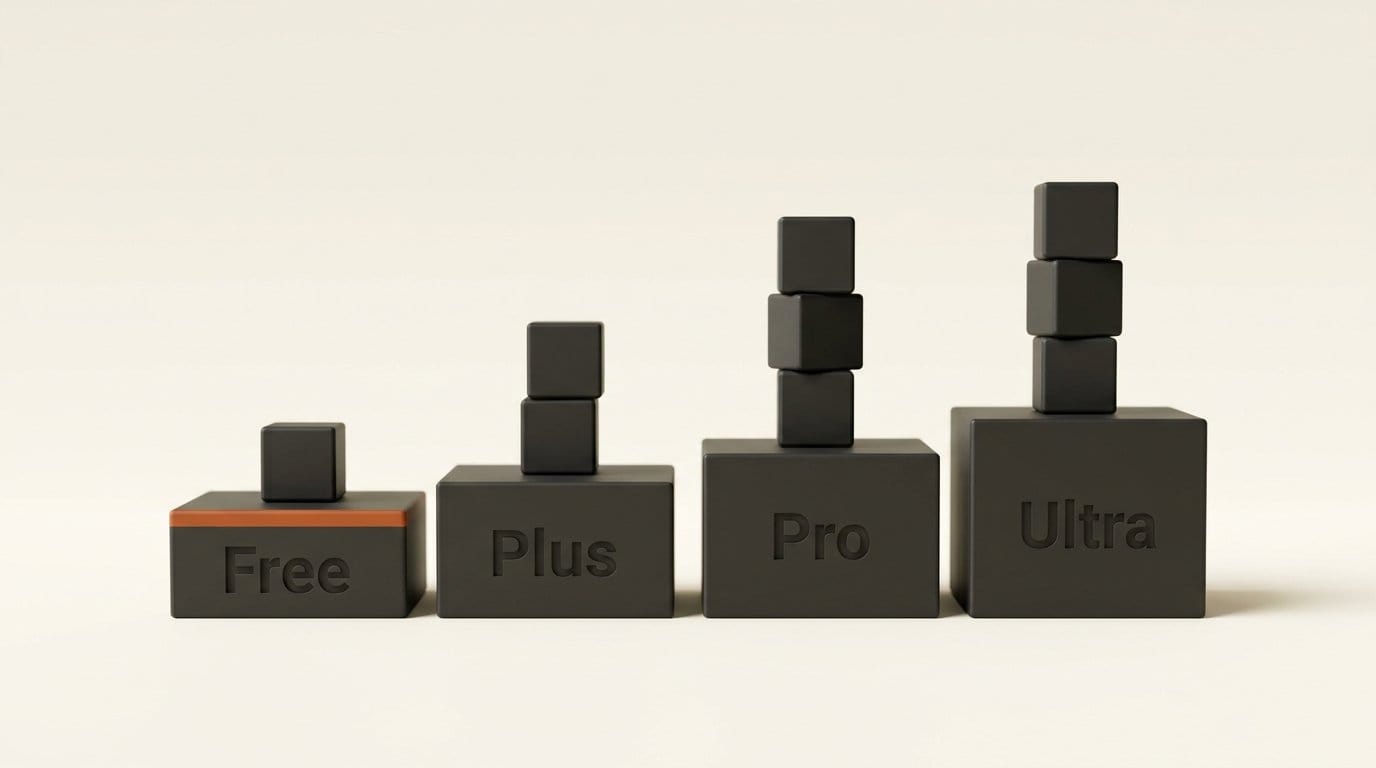
The four tiers side by side
The table combines Google's October model table with the usage multipliers and context windows from its current limits page. Prices are the US list prices reported by The Decoder; check your own region in the Google One app before you decide.
| Plan | Price (US) | Models after Oct 9 | Usage limit | Context window | Deep Think |
|---|---|---|---|---|---|
| No plan | Free | Flash-Lite | Standard | 32k tokens | No |
| AI Plus | $4.99/month | Flash-Lite, Flash | 2x standard | 128k tokens | No |
| AI Pro | $19.99/month | Flash-Lite, Flash, Pro | 4x standard | 1 million tokens | Yes (new) |
| AI Ultra | $99.99 or $199.99/month | Flash-Lite, Flash, Pro | 5x or 20x AI Pro | 1 million tokens | Yes |
The usage column has not changed. Gemini Apps still use compute-based limits that refresh every 5 hours until you hit a weekly cap, and Google counts the complexity of the prompt, the features used and the length of the chat. Media generation, Deep Research, the Pro model and extended thinking all draw down the limit faster.
What free users lose, and what they keep
The October page changes the model table and nothing else. Google's feature table, as it reads on October 4, still lists these for users without a plan: Canvas, Gems, Storybook, Connected Apps, Audio Overviews, slide generation, Deep Research, music generation and image generation with Nano Banana 2. Video generation, "Redo images with Nano Banana Pro" and scheduled actions were already paid-only.
So the loss for a free creator is the chat model behind those features. Flash-Lite is described by Google as "an efficient workhorse model designed for speed", suited to summarization and brainstorming. Flash is "a more powerful model that balances speed and reasoning". If you use the free app to draft scripts, outline long articles, debug code or reason over an uploaded document, from October 9 that work runs on the smaller model, inside a 32k-token context window.
Google has not said whether the features listed above will route to Flash-Lite too, or keep a larger model behind the scenes. Treat that as unknown until the feature table changes or Google says so.
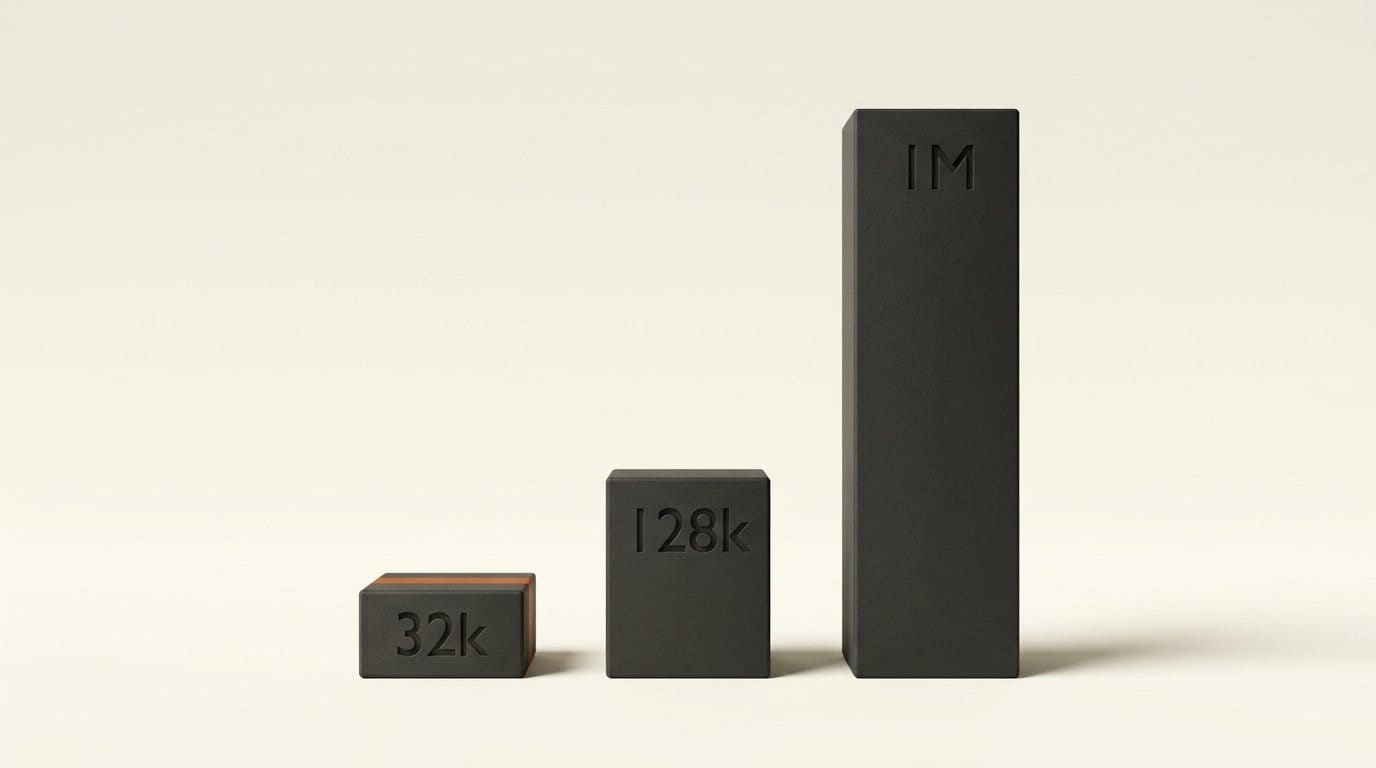
The $4.99 plan loses Pro
AI Plus is the tier with the biggest change. When Google cut AI Plus to $4.99 in June, the plan included Gemini 3 Pro, Nano Banana Pro image generation, Deep Research and video generation. After the October change, Plus keeps Flash-Lite and Flash but drops Pro. Google says Plus subscribers "should receive an email that explains when these changes will take effect", so the date may differ from October 9.
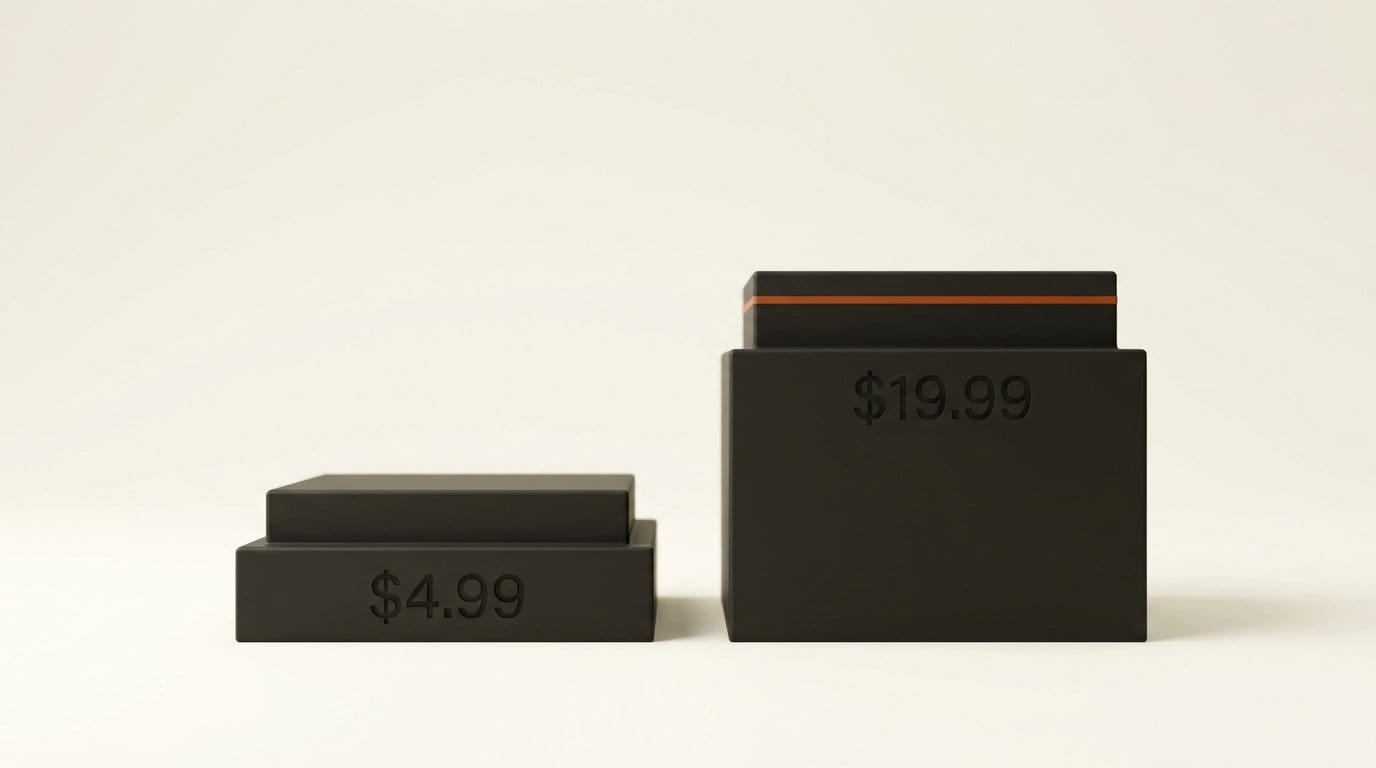
The Decoder's headline frames it bluntly: $5 subscribers are locked out of Pro. In practice the gap between $4.99 and $19.99 now covers three things: the Pro model, a 1 million token context window instead of 128k, and Deep Think. If Pro was the reason you subscribed to Plus, the plan you were paying for is gone on the day your email names.
Why Google is doing this now
Google has not given a reason on the help page. Two pieces of context are worth knowing. First, this reverses the direction of travel from May, when Google eased its compute-based limits nine days after introducing them and made Flash-Lite prompts free of quota for paid users. Second, the change lands days after Google announced Gemini 4 Argon on September 30, a frontier model that is not yet available in the consumer app.
The Decoder reads the tiering as a setup for a pricier model to run. That is an interpretation, not something Google has stated. What is on the record is the shape: a free tier on the cheapest model, a cheap tier on the middle model, and the top model behind $19.99. The Decoder notes that the setup mirrors OpenAI's freemium model for ChatGPT.
How to pick your plan before October 9
Run this check once, before the change reaches your account:
- List what you actually use Gemini for. Open your recent chats and sort them into quick tasks (captions, rewrites, summaries), reasoning tasks (scripts, code, long documents) and media (images, music, video).
- Test your quick tasks on Flash-Lite now. Pick Flash-Lite in the model menu and rerun three real prompts. If the output is good enough, the free tier still works for that job.
- Check your document sizes. The free tier reads 32k tokens and AI Plus reads 128k. A long PDF, a full script or a codebase needs AI Pro's 1 million token window.
- Decide whether you need Pro or just Flash. If your reasoning tasks run fine on Flash, AI Plus at $4.99 covers them. If you rely on Pro or want Deep Think, AI Pro at $19.99 is now the minimum.
- Move repeatable work to the API. If you run the same prompt many times, the Gemini API is a better home than the app (next section).
The cheapest way back to Flash
The October change applies to Gemini Apps. The Gemini API pricing page still lists a free tier for Gemini 3.8 Flash, 3.7 Flash and 3.6 Flash, with input and output marked "free of charge". The catch is in the same table: on the free tier, "Used to improve our products" reads Yes, so do not send client work or anything private through it.
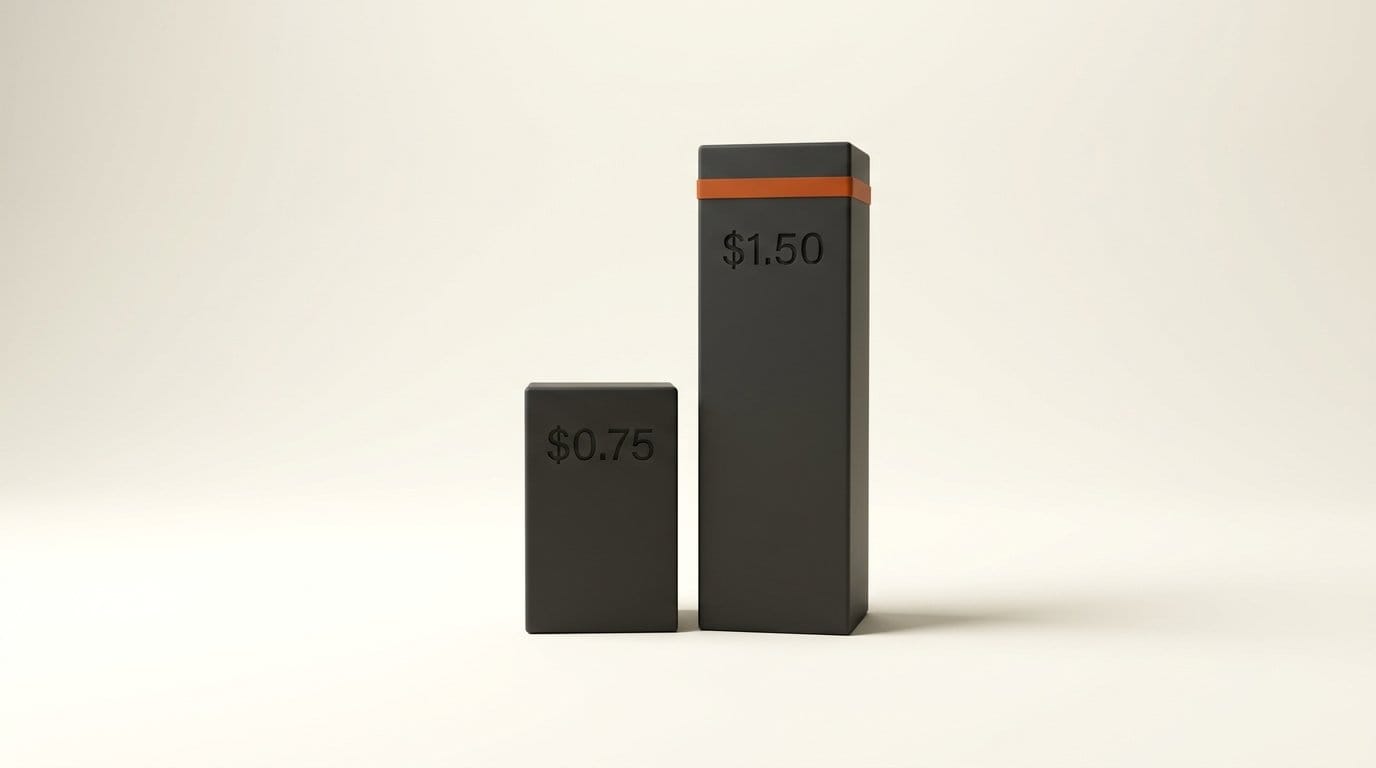
On the paid tier, Gemini 3.8 Flash costs $0.75 per million input tokens and $3.75 per million output through December 31, 2026, doubling to $1.50 and $7.50 from January 1, 2027. A Tier 1 account only needs an active billing account. For a creator running captions, alt text or metadata in bulk, a few dollars of API usage a month can replace an app subscription. Pro is a different story: Gemini 3.1 Pro Preview has no free API tier and costs $2 per million input tokens and $12 output for prompts up to 200k tokens. We covered the Flash pricing trade-offs in our Gemini 3.6 Flash deep dive.
What to watch next
Three open questions decide how much this costs you. Whether the free feature table changes next, especially image generation with Nano Banana 2 and Deep Research. When AI Plus subscribers get their email, and whether the date differs by country. And how much quota the new high effort setting burns, which Google has not quantified. We will update this page when Google publishes any of the three.
Frequently asked questions
When does the Gemini free tier change?
On October 9, 2026, for users without a Google AI subscription. From that date the free Gemini app offers Flash-Lite only. AI Plus subscribers get an email with their own date.
Which Gemini models do free users get after October 9?
Only Flash-Lite. Flash requires AI Plus or higher, and Pro requires AI Pro or AI Ultra, according to Google's "Changes to Gemini model access and limits" help page.
Does Google AI Plus still include Gemini Pro?
No. After the change, AI Plus includes Flash-Lite and Flash. Pro is limited to AI Pro ($19.99 a month in the US) and AI Ultra.
Can free users still generate images in Gemini?
Google's feature table on October 4 still lists image generation with Nano Banana 2 and music generation for users without a plan. The October change only touches chat model access, so those features stay listed for now. Video generation was already paid-only.
Who gets Deep Think now?
AI Pro and AI Ultra subscribers. Before this change, Google's limits page listed Deep Think as AI Ultra only, and it requires the Pro model.
Is the Gemini API free tier affected?
Google's help page covers Gemini Apps, not the API. The Gemini API pricing page still lists free-tier access to Gemini 3.8, 3.7 and 3.6 Flash, but free-tier data is used to improve Google's products.
What are Gemini effort levels?
A new low, medium or high setting for each model in the Gemini app. Higher effort gives more thorough answers and uses more of your usage limit.