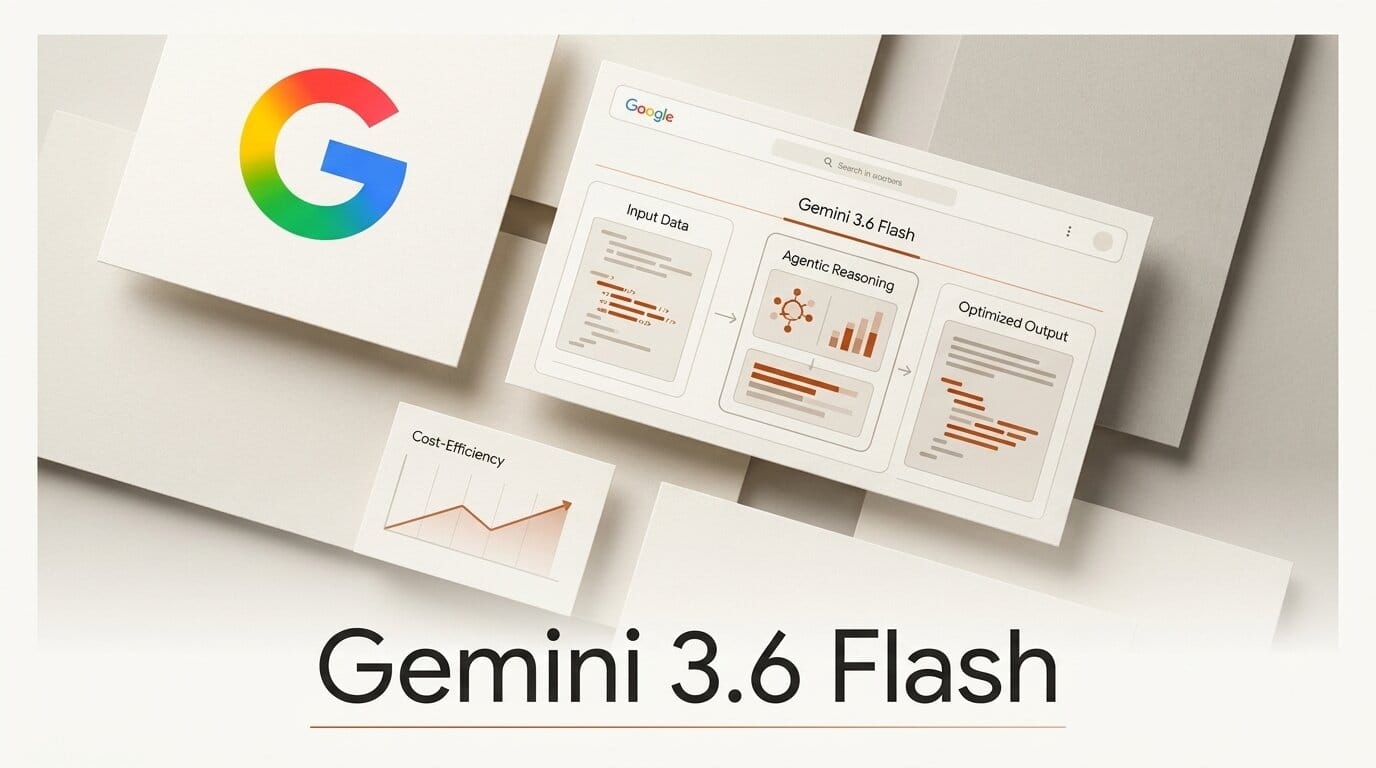
Google shipped Gemini 3.6 Flash on July 21, 2026, and the headline is not a new benchmark crown. It is the bill. The new workhorse model costs $1.50 per million input tokens and $7.50 per million output, down from $9 on the output side for Gemini 3.5 Flash, and it burns 17 percent fewer output tokens to reach the same answer. Alongside it, Google launched Gemini 3.5 Flash-Lite, a cheaper high-throughput tier, and teased that pre-training for Gemini 4 has already begun. For builders wiring models into agents, apps, and content pipelines, this is the release that changes the math.
What Google Shipped
The July 21 announcement covered three models. Gemini 3.6 Flash is the mid-tier workhorse, positioned for production agents that need reliability at low latency. Gemini 3.5 Flash-Lite is the fastest and cheapest of the family, built for high-volume, latency-sensitive work. Gemini 3.5 Flash Cyber is a security-tuned variant available only through Google's CodeMender pilot for governments and trusted partners, so it does not factor into most creator workflows.
Both Flash and Flash-Lite are generally available today, not previews. You can reach them through the Gemini app, Google Search, Google AI Studio, Android Studio, Google Antigravity, and the Gemini Enterprise platform, as 9to5Google confirmed at launch. Notably absent is Gemini 3.5 Pro, which Google says is still testing with partners. This mirrors the pattern from the reported Gemini 3.5 Pro timeline earlier this month: Google is shipping the cheaper, faster tiers first and holding the flagship back until it is ready.

The Pricing and Efficiency Story
The real news is cost. Gemini 3.5 Flash charged $9 per million output tokens. Gemini 3.6 Flash charges $7.50, a straight 17 percent cut on the most expensive side of the ledger. Then the model layers a second saving on top: it produces roughly 17 percent fewer output tokens to complete the same task, because Google tuned it to stop over-explaining and over-editing. Both rates are live on the Gemini API pricing page. Stack the two together and a typical agent run can land meaningfully cheaper than the same run on 3.5 Flash, without a quality drop.
That compounding matters most for anyone running a model in a loop. An agent that plans, calls tools, reads results, and revises can emit tens of thousands of output tokens per session. A 17 percent price cut multiplied by 17 percent fewer tokens is the difference between an experiment you shut off at the end of the day and a background automation you leave running. The knowledge cutoff also moved forward from January 2025 to March 2026, so the model is less likely to hallucinate around recent tools and APIs.
Coding and Agent Benchmarks
Gemini 3.6 Flash posts clear gains over its predecessor on the benchmarks builders actually care about. On DeepSWE, a software-engineering agent test, it scores 49 percent versus 37 percent for 3.5 Flash. On MLE Bench it jumps to 63.9 percent from 49.7 percent. Computer use, measured on OSWorld-Verified, climbs to 83 percent from 78.4 percent, and knowledge-work quality on GDPval-AA reaches 1421. OfficeChai's benchmark breakdown notes the model even edges out Gemini 3.1 Pro on several of these tasks, which is unusual for a Flash-tier release.
Here is how the family lines up on the numbers that drive tool selection:
| Spec | Gemini 3.6 Flash | Gemini 3.5 Flash | Gemini 3.5 Flash-Lite |
|---|---|---|---|
| Input price / 1M | $1.50 | $1.50 | $0.30 |
| Output price / 1M | $7.50 | $9.00 | $2.50 |
| DeepSWE (agentic coding) | 49% | 37% | Improved, not disclosed |
| OSWorld-Verified (computer use) | 83.0% | 78.4% | Not disclosed |
| Throughput | Standard | Standard | ~350 tokens/sec |
| Knowledge cutoff | March 2026 | January 2025 | March 2026 |

Gemini 3.5 Flash-Lite: The Speed Tier
Flash-Lite is the quieter but arguably more useful launch for high-volume builders. At $0.30 per million input and $2.50 per million output, it is five times cheaper on input than 3.6 Flash, and it streams around 350 output tokens per second. Google reports 54 percent on Terminal-Bench 2.1 and a large jump over the prior 3.1 Flash-Lite in agentic workflows. For tasks like classification, extraction, routing between other models, or generating the first draft that a bigger model later refines, Flash-Lite is the tier you reach for when you are calling the API thousands of times an hour.
You can test both models side by side in Google AI Studio before committing any code. The practical pattern is a two-model pipeline: Flash-Lite handles the cheap, high-frequency steps, and 3.6 Flash steps in for the reasoning-heavy edits where quality pays for itself.
How It Compares to GPT-5.6 and Claude Haiku
Gemini 3.6 Flash lands in the middle of a crowded budget tier. OpenAI's GPT-5.6 Luna, the cheapest of its Sol, Terra, and Luna lineup, runs $1 per million input and $6 per million output. Claude Haiku 4.5 sits at $1 input and $5 output. On raw price, both undercut Gemini 3.6 Flash slightly, but Google's answer is the token-efficiency gain plus the agent and computer-use benchmarks, where 3.6 Flash is strong for its class.
The strategic read is that the flagship race and the workhorse race have split. Coding leaderboards are still contested at the top by models like those in our Grok 4.5 vs Opus 4.8 vs GPT-5.6 comparison, but the volume battle is being fought a tier down, on cost per completed task. Gemini 3.6 Flash is Google's move in that fight, and the pricing shows it.

What This Means for Builders
If you already run an agent or automation on Gemini 3.5 Flash, the migration is close to free money. Swap the model identifier to 3.6 Flash, rerun your evaluation set, and you should see lower cost and better code with no prompt changes. Because the model emits fewer tokens by default, watch for places where you previously padded prompts to force verbosity, and trim them.
If you are building something new, structure it as two tiers from the start. Route high-frequency, low-stakes calls to Gemini 3.5 Flash-Lite at $0.30 input, and reserve 3.6 Flash for the steps that need reliable reasoning or code. Prototype the whole flow in Google AI Studio first, measure cost per task on a realistic sample, and only then wire it into production. With Gemini 4 pre-training already underway, this Flash generation is the stable, cheap foundation to build on for the next few months.
Frequently asked questions
Is Gemini 3.6 Flash available now?
Yes. Gemini 3.6 Flash and Gemini 3.5 Flash-Lite went generally available on July 21, 2026. You can use them through the Gemini app, Google Search, Google AI Studio, Android Studio, Google Antigravity, and Gemini Enterprise. Gemini 3.5 Flash Cyber is limited to the CodeMender pilot.
How much does Gemini 3.6 Flash cost?
It is priced at $1.50 per million input tokens and $7.50 per million output tokens. That output price is a 17 percent reduction from Gemini 3.5 Flash, which charged $9 per million output. The model also uses about 17 percent fewer output tokens per task.
What is new versus Gemini 3.5 Flash?
Lower output pricing, 17 percent fewer output tokens per task, stronger agentic coding (49 percent on DeepSWE versus 37 percent), better computer use (83 percent on OSWorld-Verified versus 78.4 percent), and a newer knowledge cutoff of March 2026 instead of January 2025.
What is Gemini 3.5 Flash-Lite for?
Flash-Lite is the high-throughput, low-latency tier at $0.30 per million input and $2.50 per million output, streaming roughly 350 tokens per second. It suits classification, extraction, routing, and high-volume first drafts where you call the API frequently and cost per call dominates.
How does it compare to GPT-5.6 and Claude Haiku?
On price, GPT-5.6 Luna ($1 input, $6 output) and Claude Haiku 4.5 ($1 input, $5 output) are slightly cheaper. Gemini 3.6 Flash counters with strong agent and computer-use benchmarks for its class and its token-efficiency savings, which can close the gap on real workloads.
Should I upgrade my existing Gemini 3.5 Flash agent?
In most cases yes. Change the model identifier to 3.6 Flash and rerun your evaluation set. Expect lower cost and better code without prompt changes, and trim any prompt padding you added to force verbosity, since the new model is less verbose by design.