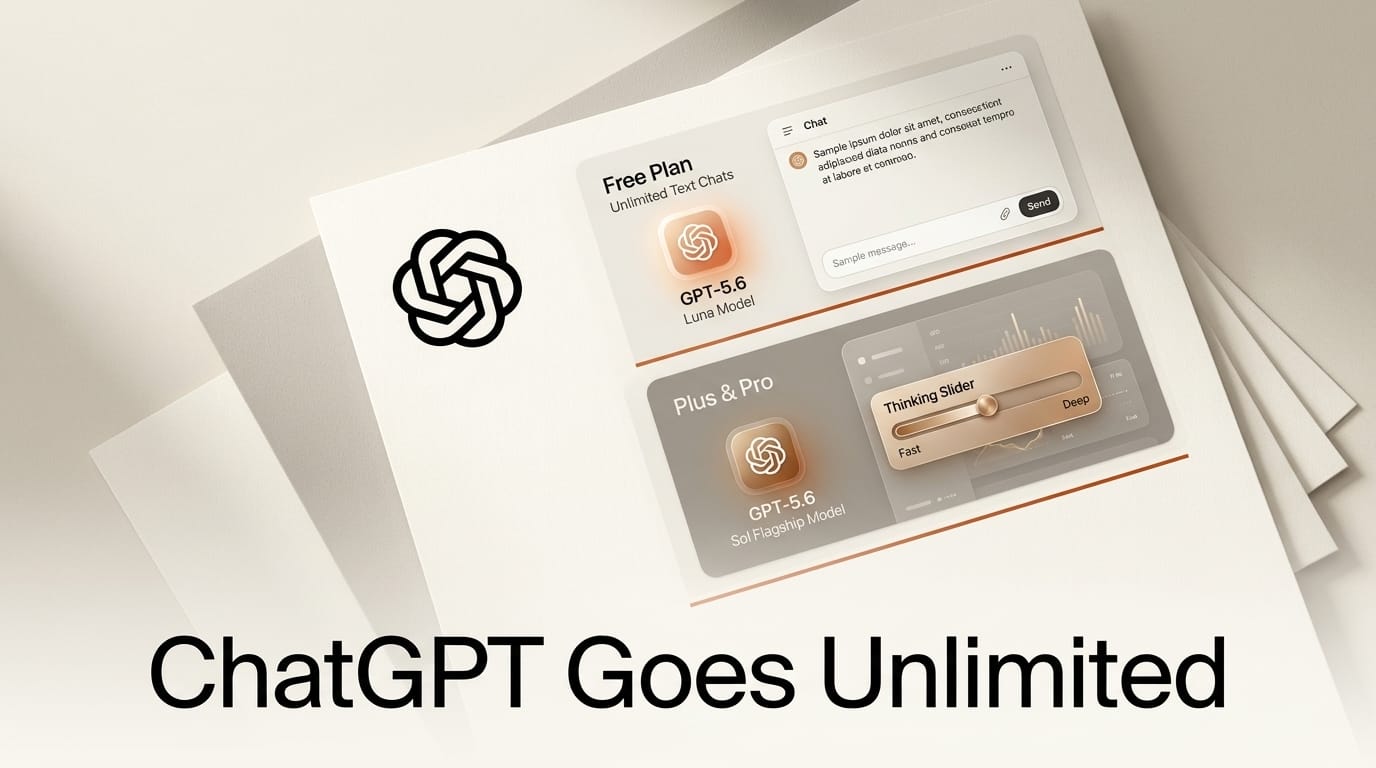
OpenAI announced on August 6, 2026 that free ChatGPT users now get unlimited text chats and are being moved to a smarter default model, GPT-5.6 Luna, while Plus and Pro subscribers gain the upgraded GPT-5.6 Sol model and a new thinking slider that controls how hard the model reasons. According to TechCrunch, the unlimited text chats begin rolling out this week with a full rollout next week, and OpenAI says GPT-5.6 Luna makes 62% fewer factual errors than the older GPT-5.5-Instant, with GPT-5.6 Sol landing 68% fewer. For the creators, writers, and builders who lean on ChatGPT daily, this is one of the most consequential free-tier upgrades OpenAI has shipped, and it changes the math on when you actually need a paid plan.
What OpenAI Changed for Free and Paid Users
The update splits cleanly across two audiences. Free and Go users get unlimited text conversations plus a new "Think" button that pushes complex questions into a slower, more careful reasoning pass. Their default model quietly shifts from GPT-5.5 to GPT-5.6 Luna, OpenAI's fastest and cheapest tier. Plus and Pro subscribers get GPT-5.6 Sol, the flagship, available today, along with a thinking slider that lets you dial reasoning depth up or down per query. As Startup Fortune notes, upgrading every free account to a better default is a competitive move as much as a product one, arriving as ChatGPT crosses one billion weekly users.
One important caveat: "unlimited" applies to text chats only. Limits still apply to file uploads, image understanding, voice, and image generation on the free tier. So the change is huge for people who mostly type, and more modest for people who lean on multimodal features.

Free, Go, Plus, and Pro: What Each Tier Gets Now
Here is how the four tiers compare after the August 6 update. The model names come from OpenAI's GPT-5.6 family, which spans Sol (flagship), Terra (mid), and Luna (fastest and cheapest), detailed in this GPT-5.6 model and pricing breakdown.
| Tier | Default text model | Text chat limit | Reasoning control | Still limited |
|---|---|---|---|---|
| Free | GPT-5.6 Luna | Unlimited | "Think" button | Files, images, voice, image gen |
| Go | GPT-5.6 Luna | Unlimited | "Think" button | Files, images, voice, image gen |
| Plus | GPT-5.6 Sol | High | Thinking slider (low to high) | Higher caps on media |
| Pro | GPT-5.6 Sol | Highest | Thinking slider (max reasoning) | Near-unlimited |
The practical takeaway: the gap between free and paid is no longer about how many messages you can send. It is about model quality (Luna versus Sol), how much reasoning control you get (a single button versus a slider), and multimodal headroom.
GPT-5.6 Luna vs Sol: Speed, Accuracy, and the Thinking Slider
GPT-5.6 shipped as a family on July 9, 2026, structured as a three-tier lineup with programmatic tool calling in the Responses API, as covered by MarkTechPost. Luna is tuned for speed and low cost, which is exactly why it makes sense as the new free default: OpenAI can serve it to a billion people without melting its GPUs. Sol is the accuracy-first flagship, and the 68% reduction in factual errors is the headline reason to want it.
The thinking slider is the sleeper feature. Instead of guessing which mode to use, Plus and Pro users can now scale reasoning to the task: keep it low for quick rewrites and brainstorming, push it high for logic, code, or research where a wrong answer is expensive. Free users get a simpler version of the same idea through the "Think" button. For broader OpenAI coverage and context on the rollout, The Verge maintains an ongoing OpenAI section. If you want the enterprise and API side of the same models, we covered GPT-5.6 Sol, Terra, and Luna landing on Amazon Bedrock when the family first became available to developers.

Why It Matters for Creators and Builders
For anyone whose workflow is text-heavy, this removes the single biggest source of friction on the free tier: hitting a cap mid-project. Newsletter writers drafting dozens of variations, developers pasting stack traces all day, and researchers running long question chains no longer need to ration messages. OpenAI has publicly floated unlimited standard-intelligence access for free accounts before, as Engadget reported during the GPT-5 era, and this is that promise arriving in practice, subject to abuse thresholds.
It also compresses the value proposition of competitors. A free tier that is both unlimited and running a genuinely capable model raises the bar for every other assistant a creator might otherwise reach for. The remaining reasons to pay are model quality, reasoning control, and multimodal volume, not raw message count.
What This Enables: Putting Unlimited Chats to Work
Here is a concrete workflow that only becomes practical once text chats are unlimited and the default model is smarter:
- Draft in bulk. Generate 10 to 15 headline or hook variations in a single session without watching a message counter. Luna is fast enough that iteration feels instant.
- Branch, do not restart. When a thread gets long, open a fresh chat for each sub-idea instead of overloading one conversation. Unlimited chats make this free.
- Escalate with "Think." When you hit a genuinely hard problem (structuring an argument, debugging logic, planning a launch), tap the "Think" button so the model reasons before answering.
- Verify everything. Fewer factual errors is not zero. Treat GPT-5.6 output as a fast first draft, then fact-check names, numbers, and links against primary sources.
- Reserve Sol for high-stakes work. If you are on Plus or Pro, push the thinking slider up for the one task per day where accuracy actually matters, and keep it low everywhere else to stay fast.
What to Do Next
Open ChatGPT and check which model you are on. Free and Go users should see GPT-5.6 Luna as the default within the next week as the rollout completes; if you still see GPT-5.5, give it a few days. Plus and Pro users can switch to GPT-5.6 Sol today and start experimenting with the thinking slider on your hardest recurring task. If your work is media-heavy rather than text-heavy, weigh whether the paid multimodal headroom still justifies the subscription, since the unlimited change does not lift image, voice, or file caps on free accounts. For a deeper look at how the same models serve developers, revisit our breakdown of the GPT-5.6 family on Amazon Bedrock.
Frequently Asked Questions
Is ChatGPT really unlimited for free users now?
Text chats are unlimited, subject to abuse thresholds. Files, images, voice, and image generation still have limits on the free and Go tiers. The unlimited change applies specifically to typed conversations.
What is GPT-5.6 Luna?
Luna is the fastest and most affordable model in OpenAI's GPT-5.6 family, which also includes the flagship Sol and the mid-tier Terra. It is now the default model for free and Go users, replacing GPT-5.5, and OpenAI says it makes 62% fewer factual errors than GPT-5.5-Instant.
What is the difference between the "Think" button and the thinking slider?
The "Think" button, available to free users, pushes a single question into a slower, more careful reasoning pass. The thinking slider, available to Plus and Pro, lets you set reasoning depth on a scale so you can trade speed for accuracy on demand.
Do I need to pay to get GPT-5.6 Sol?
Yes. Sol, the flagship model, is available to Plus and Pro subscribers. Free and Go users get GPT-5.6 Luna, which is fast and capable but not the flagship tier.
When does the rollout finish?
OpenAI said unlimited text chats begin rolling out the week of August 6, 2026, with a full rollout the following week. If you do not see the change yet, it should reach your account within days.
Does unlimited mean there are no rate limits at all?
No. Access is unlimited for standard text chats but remains subject to abuse thresholds, so extreme automated or high-volume use can still be throttled. For normal human use, you should not hit a cap on text conversations.