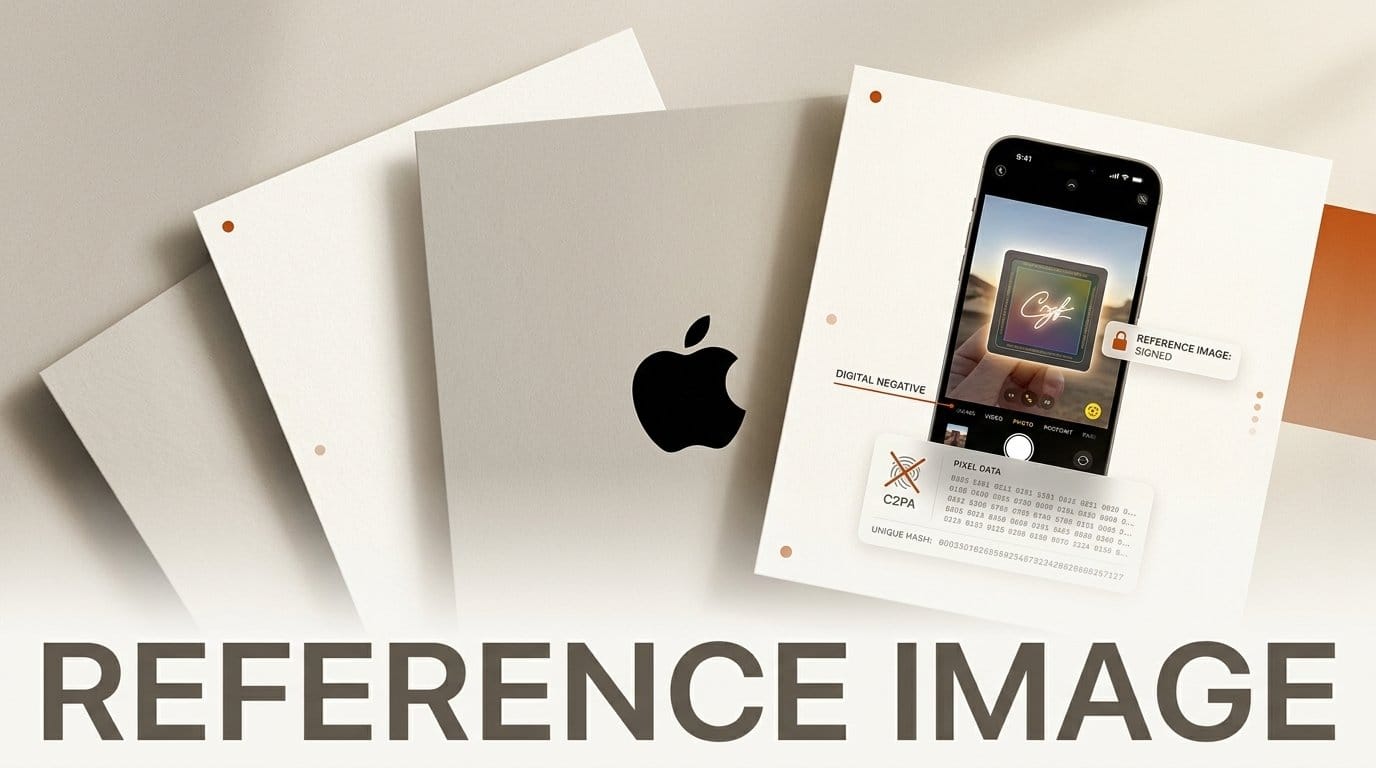
Apple announced Apple Reference Image on September 9, 2026, alongside the iPhone 18 Pro and iPhone 18 Pro Max. The pitch is one sentence long and unusually concrete: the new Main camera sensor "can sign every pixel it sees," and the signed capture becomes an unalterable reference file you can hold up against the finished photo to see exactly what changed.
The feature is easy to summarize and easy to get wrong. Most coverage on launch day framed it as Apple joining the fight against AI-generated images. It is closer to the opposite: Apple built a parallel provenance system rather than adopting the industry standard that Adobe, Nikon, Canon, and Google's own Pixel line already ship. At the same time, Apple agreed to carry Google's SynthID watermark on the images Apple itself generates. Apple is now a standards refuser on the capture side and a standards adopter on the generation side, and that split is what actually matters to anyone whose work depends on proving a photo is real.
What Apple Actually Shipped
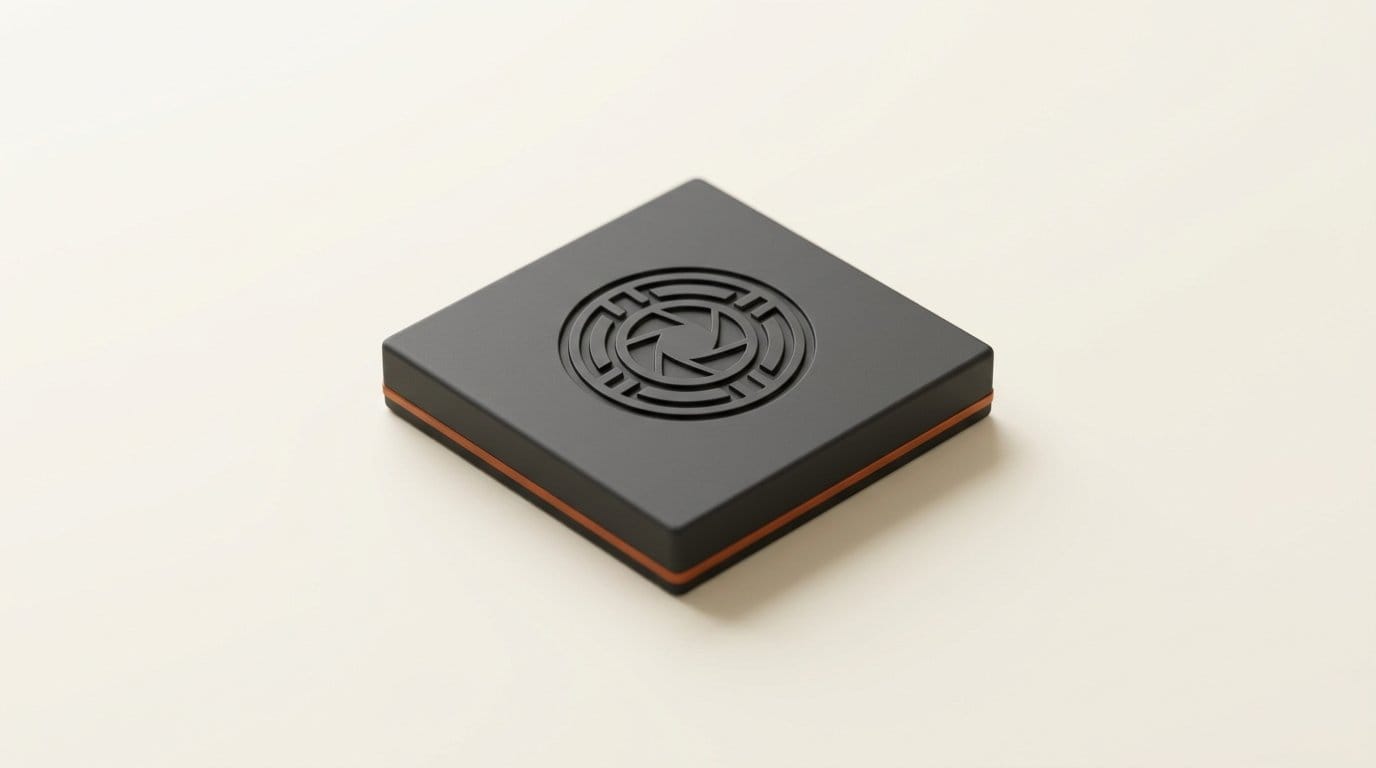
Reference Image is a capture mode, not a metadata field. Apple's description is specific about the pipeline: "When a photo is taken in the new Reference mode, the camera captures signed sensor data that Private Cloud Compute develops into an unalterable reference image." The word "develops" is doing real work there. The signed sensor data is not the deliverable. It is raw material that Apple's server-side compute turns into a viewable asset.
That asset then lives next to the photo. Apple says reference images "can be viewed in the Photos app alongside the main image, like a digital negative, to visually compare the two assets and determine if any edits were made." Verification is therefore a human act of comparison, not an automated cryptographic check that returns a pass or fail. You look at two images and you see the difference.
Third-party support arrives through APIs in iOS 27, iPadOS 27, and macOS 27, but read the scope carefully: Apple says those APIs let third-party apps "enable viewing of these reference images." Viewing, not capturing and not validating. A photo editor can show you the negative. Apple has not said that a wire service's ingest system can programmatically assert that a file is unmodified. As reported by TechCrunch, Apple positioned the feature as vital for photojournalists and photographers, which is precisely the audience that needs machine-checkable assertions rather than eyeballs.
Why Apple Skipped the Industry Standard
There is already a widely deployed answer to this problem. The Coalition for Content Provenance and Authenticity publishes the C2PA specification, and its consumer-facing implementation ships as Content Credentials: a signed manifest attached to the file that records what device captured it and what edits were applied afterward. Adobe, Nikon, and Canon build it into their products, and Google supports it on Pixel. Apple did not join.
The two designs answer different questions. Content Credentials answers "what is this file's history," and the answer travels inside the file. Reference Image answers "does this file match what the sensor saw," and the answer lives in a second asset you have to also possess. Neither is strictly better, but they are not interchangeable, and only one of them survives a trip through a CMS that strips metadata.
Apple has not published a technical rationale, so the honest read is that the company preferred a system it controls end to end, from a sensor it designs to a Private Cloud Compute tier it operates. That is a familiar Apple pattern. It is also the reason a photographer cannot treat Reference Image as a drop-in replacement for the provenance workflow a client may already require.
| System | What it proves | Where the proof lives | Backed by | Status |
|---|---|---|---|---|
| Apple Reference Image | The finished photo matches the signed sensor capture | A separate reference asset paired with the photo | Apple only | Ships September 18 on iPhone 18 Pro |
| C2PA Content Credentials | The file's capture and edit history | A signed manifest attached to the file | Adobe, Nikon, Canon, Google Pixel | Shipping across cameras and editors today |
| SynthID | That an image was AI-generated or AI-edited | An imperceptible watermark inside the pixels | Google, and now Apple as an adopter | Apple support in a software update later in 2026 |
| NVIDIA Synthetic Video Detector | That footage is probably AI-generated | Nowhere; it classifies after the fact | NVIDIA | Available now as a NIM microservice |
The fourth row is the one worth sitting with. It requires no cooperation from whoever made the file, which is exactly the case that provenance standards cannot cover.
The Regional Carve-Outs Most Coverage Missed
Apple's own release contains two limits that launch-day reporting either skipped or flattened. Quoting directly: "In China, Apple Reference Image will not be available at launch because of regulatory requirements. In the EU, Apple Reference Image capture will not be available at launch with iPhone 18 Pro models, but users with iOS 27, iPadOS 27, and macOS 27 will be able to develop and view reference images."
Those are two different restrictions and the difference is practical. China loses the feature. The EU loses capture only, while keeping the ability to develop and view reference images produced elsewhere. Several outlets, including 9to5Mac, reported flatly that the feature "will not be available in the European Union or China," which understates what EU users get and overstates what they lose.
For a working photographer the distinction decides whether the tool is usable. A European photojournalist cannot originate a reference image on an EU device at launch, but can receive, develop, and inspect one shot by a colleague elsewhere. A verification desk in Berlin can still do its job on incoming files. A staff shooter in Berlin cannot yet protect their own.

Detection Is Moving the Other Way
On the same day Apple announced capture-side provenance, NVIDIA announced the opposite bet. Its AI for Media expansion for IBC 2026 centers on a Synthetic Video Detector that classifies footage as authentic or generated with no marker, manifest, or cooperation required. NVIDIA puts it at 99.3% accuracy on text-to-video output and 97.7% on image-to-video, and it is available now as a hosted microservice, with Dalet, TwelveLabs, and Wowza wiring it into verification and compliance workflows.
Provenance and detection are complements, not competitors, and the split tells you something about where each is useful. Provenance protects content you control from the moment of capture. Detection is the only option for everything else, which is nearly all of the internet. A newsroom needs both, and neither Apple nor NVIDIA is offering the whole answer.
Apple's SynthID commitment sits in the same frame. By marking its own generated output with Google's watermark, Apple is making its AI images detectable by third parties rather than building a proprietary marker. It is a genuinely cooperative move, and it makes the refusal to adopt C2PA on the capture side look like a deliberate architectural choice rather than reflexive standards aversion.
What This Changes for Creators
Three consequences are already clear from the shipped details, and none of them require waiting for reviews.
First, Reference Image is opt-in per shot. It is a mode you select, not a property of every photo. If you shoot a breaking news frame in the standard camera mode, there is no reference image and nothing to compare against later. Provenance you have to remember to switch on protects the photos you expected to need it for, which is not the same set as the photos that turn out to matter.
Second, the proof is a second file. Any workflow that exports a flattened JPEG to a client, a CMS, or a social platform needs a story for how the reference asset travels alongside it. Apple has not described an export or interchange format, and until it does, the safe assumption is that the proof stays inside the Apple ecosystem. This is the exact failure mode that a metadata manifest like Content Credentials was designed to avoid, which is worth weighing before you tell a client you can prove provenance.
Third, if your clients or platforms already require Content Credentials, Reference Image does not satisfy that requirement. The two systems produce different artifacts and there is no announced bridge between them. Photographers working for outlets that standardized on C2PA now have a device that proves authenticity in a format their publisher's pipeline does not read. Our earlier analysis of how C2PA is being applied to AI-generated text covers why the manifest approach won adoption in the first place.
What to Do Next
If you shoot professionally on iPhone, plan a test before you promise a client anything. Pre-orders open September 12 and devices arrive September 18, so the first real question is answerable within about ten days: shoot a frame in Reference mode, run your normal edit, export the way you actually deliver, and see whether the reference asset survives the trip. That single test tells you more than any spec sheet.
If you already deliver into a Content Credentials workflow, do not change anything yet. Keep the pipeline you have and treat Reference Image as an additional check inside Photos rather than a replacement for the manifest your publisher reads. If you are in the EU, verify which half of the feature you have before you build a process on top of it, because capture and viewing are being shipped separately.
Frequently asked questions
What is Apple Reference Image?
It is a capture mode on iPhone 18 Pro and iPhone 18 Pro Max. The Main camera sensor signs the pixels it records, Private Cloud Compute develops that signed sensor data into an unalterable reference image, and you compare that reference against the finished photo in the Photos app to see whether the image was edited.
Is Apple Reference Image the same as C2PA Content Credentials?
No, and the two are not interoperable. Content Credentials attaches a signed manifest describing the file's capture and edit history to the file itself. Reference Image produces a separate asset that you visually compare against the photo. Apple has not joined the C2PA coalition, so a file carrying a reference image does not satisfy a workflow that requires Content Credentials.
Does it work in the EU and China?
Partly in the EU, not at all in China at launch. Apple says Reference Image will not be available in China at launch because of regulatory requirements. In the EU, capture is unavailable at launch, but users on iOS 27, iPadOS 27, and macOS 27 can still develop and view reference images that were captured elsewhere.
When does SynthID support arrive?
Apple says SynthID "will be available in a software update later this year and will be included for most edited images, depending on the edits applied." Images produced by Apple's own generation features, including Image Playground and the Extend and Spatial Reframing editing tools, will carry SynthID markers. Apple has not given a specific date.
Can other apps use reference images?
Only to display them, based on what Apple has announced. APIs in iOS 27, iPadOS 27, and macOS 27 let third-party apps enable viewing of reference images. Apple has not announced APIs that let other apps capture reference images or programmatically validate one, which is the capability an automated verification pipeline would need.
Does every photo get a reference image?
No. It applies to photos taken in Reference mode, which is a mode you choose at capture time. Photos shot in the standard camera mode have no reference image, and one cannot be created after the fact, because the proof depends on sensor data signed at the moment of capture.
What does it cost?
There is no separate charge, but it requires the new hardware. Reference Image depends on the new Main camera sensor in the iPhone 18 Pro line. iPhone 18 Pro starts at $1,199 and iPhone 18 Pro Max at $1,299, with pre-orders on September 12 and availability on September 18.