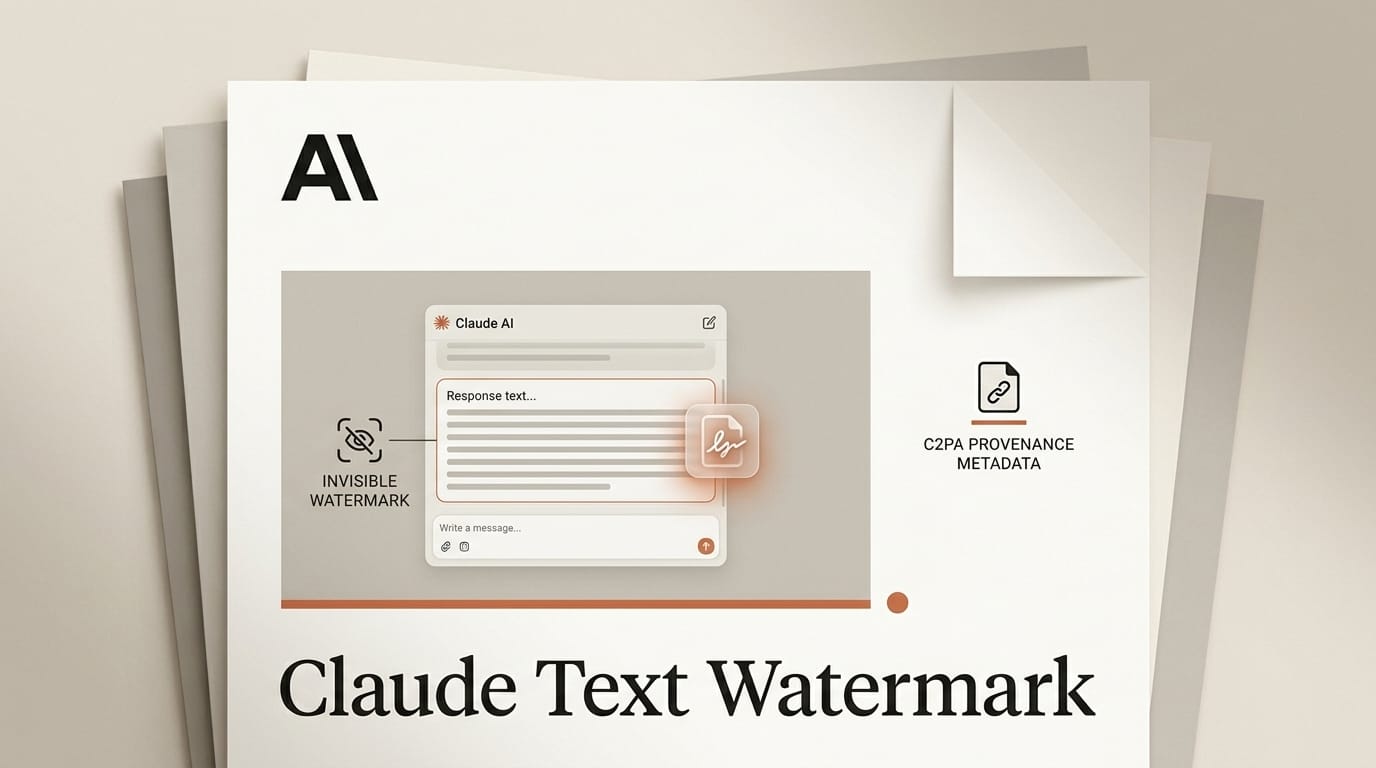
On August 11, 2026, Anthropic began embedding an imperceptible watermark directly into the text that Claude generates, and attaching signed C2PA provenance metadata to files it produces. The marking applies globally, to every user regardless of location, and spans the Claude Platform API, Claude.ai, Claude Code, Claude Cowork, and Claude Tag. Anthropic says the watermark does not change the meaning, quality, or readability of the output, and that it can persist through copying and pasting. The move is Anthropic's answer to the EU AI Act, whose transparency obligations for AI-generated content took effect on August 2, 2026.
For anyone who uses Claude to draft, edit, or generate content, this is a workflow change worth understanding. Below is what actually got announced, how the marking works, how it compares to what OpenAI and Google are doing, and the practical steps creators should take.
What Anthropic Announced
Anthropic signed the EU AI Act's Article 50(2) Code of Practice on the transparency of AI-generated content, then chose to apply the resulting marking worldwide rather than only inside the EU. As TechCrunch reported, the company will mark text output from its models and attach provenance metadata to supported files. New models launching on or after August 2, 2026 support marking at launch, and earlier models are being transitioned to add it.
The regulatory backdrop matters. Article 50 of the EU AI Act requires providers to mark synthetic content in a machine-readable way. Non-compliance can trigger fines of up to 15 million euros or 3 percent of global annual turnover, whichever is higher. By marking globally, Anthropic avoids maintaining two output pipelines and sidesteps the question of how to detect where a given API call originates.

How the Marking Actually Works
There are two distinct mechanisms, and creators should not confuse them.
Embedded text watermark. For plain text, Claude weaves an invisible signal into the words themselves. Anthropic says this signal survives copy and paste and does not alter readability. It has not yet published the detection method, promising a technical document and a detector that lets users and third parties verify a mark. Independent write-ups suggest the signal is a statistical bias in token selection rather than hidden Unicode characters, though Anthropic has not confirmed the exact approach.
Signed provenance metadata. For supported file types including .svg, .png, and .jpg, Claude attaches metadata following the C2PA open standard, the same content-credentials framework used across the imaging industry. This is a cryptographically signed record of AI involvement, not a hidden pixel pattern, so it can be stripped by re-encoding or a screenshot. Cloud partners such as AWS, Google Cloud, and Microsoft Foundry receive the embedded text watermark, while metadata support varies by platform.
How It Compares to OpenAI and Google
Anthropic is not first to text watermarking, but it is the most aggressive about applying it by default. Here is how the three major labs line up.
| Provider | Text marking | File / image marking | Applied by default? | Survives paraphrase? |
|---|---|---|---|---|
| Anthropic (Claude) | Invisible embedded watermark, all text | C2PA signed metadata on files | Yes, globally, from Aug 2, 2026 | No |
| Google (Gemini) | SynthID token-probability watermark | SynthID on images, audio, video | On Gemini surfaces | No |
| OpenAI (GPT) | Detector built but withheld for ~2 years | C2PA plus SynthID on images | Images yes, text no | No |
Google's SynthID takes a similar approach to Claude's text mark, nudging token probabilities during generation so a detector can later recognize the pattern. OpenAI has said text watermarking remains hard to deploy at scale, and it has sat on a reported 99.9 percent-accurate text detector without releasing it. On the image side, OpenAI already joined C2PA, which we covered in OpenAI's move to add SynthID and C2PA to verify AI images. The pattern across all three: image and file provenance is maturing fast, while text watermarking is fragile.
What This Means for Creators
If you use Claude to write blog posts, marketing copy, scripts, or code comments, your output now carries an invisible signal that says a Claude model processed it. That has three practical consequences.
First, a positive detection does not prove Claude authored the text. As The Decoder noted, people routinely paste their own writing into Claude to edit, translate, or reformat it, and the output picks up the mark anyway. The watermark proves processing, not authorship. Anyone treating a detected mark as proof of cheating or plagiarism will generate false positives.
Second, the mark is easy to remove. Heavy editing, running the text through another model, or simply rewriting a few sentences by hand strips the signal. This is a feature for creators who want clean provenance-free copy, and a weakness for anyone hoping watermarks would reliably flag AI content at scale.
Third, file provenance is stickier than text. If you export an image or SVG from Claude, the C2PA credential travels with the file until someone re-encodes or screenshots it. Platforms that read content credentials, including a growing set of social and stock-photo sites, may label your asset as AI-involved.
What to Do Next
You do not need to change how you prompt Claude, but a few habits are now worth adopting. If you are publishing under an AI-disclosure policy, the watermark is your friend: it gives you a defensible, standards-based way to show provenance. If you need provenance-free output, do a substantive human editing pass, since light touch-ups will not reliably clear the mark. When handing off Claude-generated images or SVGs to a client, check whether the destination platform reads C2PA and whether that labeling is acceptable. And do not build any workflow that treats watermark detection as proof of authorship, because the false-positive rate on edited or translated text makes that unreliable.
Frequently Asked Questions
Does the watermark change how Claude's text reads?
Anthropic says no. The embedded signal is designed to be imperceptible and to leave meaning, quality, and readability unchanged. Critics, including John Gruber in his Daring Fireball note, point out the tension between an invisible mark and unchanged output, and Anthropic has not yet published the technical details that would settle it.
Can I turn the watermark off?
No. Marking is applied by default across all Claude surfaces and cloud partners to satisfy the EU AI Act, and there is no documented opt-out. The practical way to remove it from text is to edit the output substantively.
Will the watermark survive if I paraphrase or edit heavily?
No. Anthropic acknowledges the mark may persist through some editing but that heavy editing, format changes, or rephrasing can strip it entirely. Copy and paste preserves it; rewriting does not.
Is this the same as the C2PA credentials on AI images?
Related but different. Text gets an invisible statistical watermark baked into word choice. Files such as .png, .jpg, and .svg get separate C2PA signed metadata, the same content-credentials standard OpenAI and Adobe use. The file metadata is cryptographic and removable by re-encoding; the text watermark is statistical.
Does a detected watermark prove Claude wrote something?
No. It proves Claude processed the text, which includes editing or translating a human's own writing. Using detection as proof of authorship or plagiarism will produce false positives.
How does this compare to Suno and other creative tools adding watermarks?
It is part of the same industry shift toward provenance. Music tools are doing it too, as we covered when Suno added watermarking and download limits to AI music. The common thread is regulation and platform pressure pushing every generative tool toward machine-readable provenance.