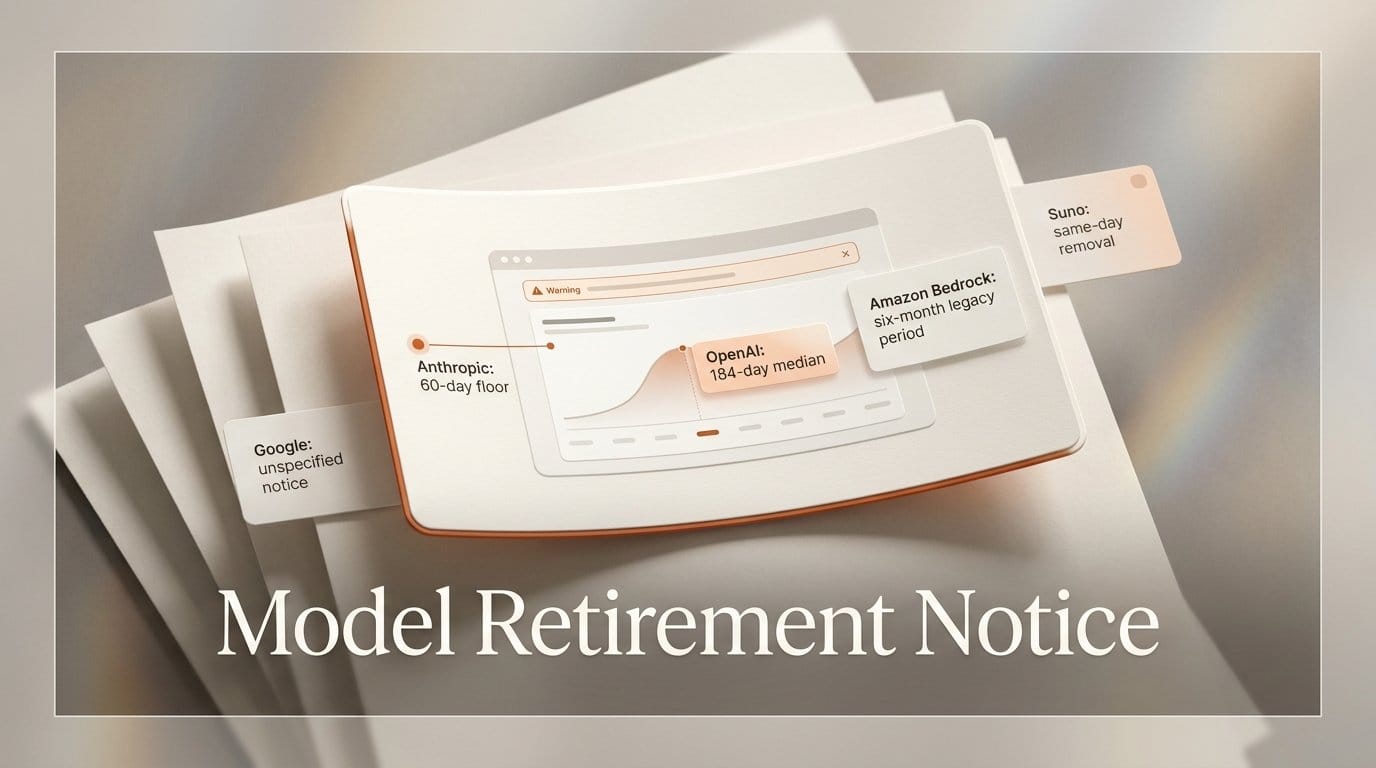
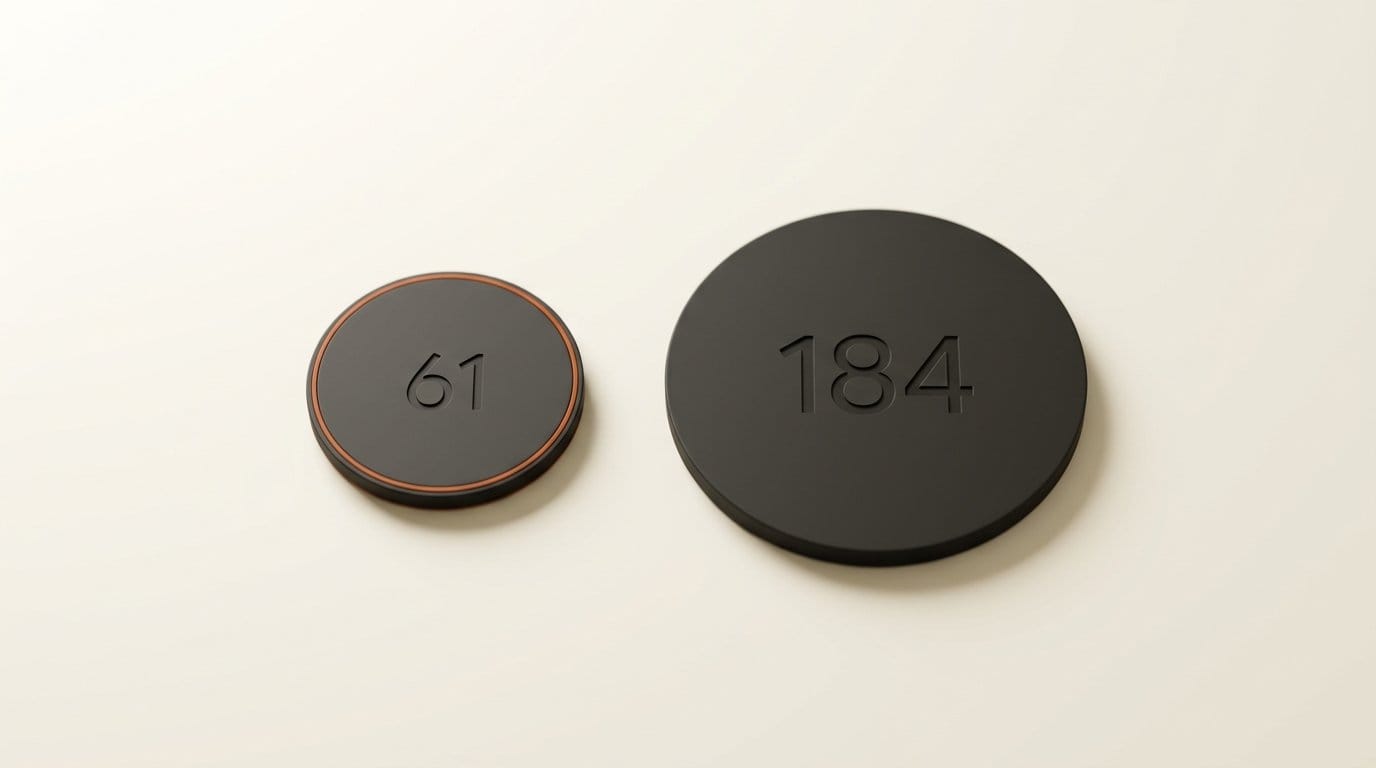
When Suno shipped v6 on September 9, 2026, every model before it left the picker the same day. No sunset window, no legacy toggle, no migration period. That is one end of a spectrum that creators rarely see written down. At the other end, Amazon Bedrock keeps most retiring models callable for six months after it tells you they are going away. In between sit Anthropic at a stated floor of 60 days, OpenAI at a measured median of 184, and Google, which publishes shutdown dates but calls them "the earliest possible dates" and commits to no number at all. The length of the warning you get is not a property of the model. It is a property of the platform you call it through.
Background: Retirement Became Routine in 2026
Model retirement used to be an occasional event. In 2026 it became scheduled maintenance. Anthropic has run nine separate deprecation announcements since September 2024 and retired Claude Opus 4.1 in August. OpenAI's deprecations page currently lists nine live entries, covering everything from gpt-3.5-turbo-0125 to the whole gpt-realtime and gpt-audio families. Google's Gemini API has retired image, video and embedding endpoints on separate schedules across two surfaces.
Consumer creative apps move faster still, because they have no API contract to honor. Suno's v6 launch replaced v4, v4.5, v5 and v5.5 at once, a consequence of moving to licensed training catalogues from Warner Music Group, BMG and participating Believe and TuneCore artists. Existing songs still play and still work as a base for covers, but nothing new can be generated on the old models. We covered the mechanics in Suno v6 Retires Every Older Model.
Deep Analysis: What the Notice Periods Actually Are
The useful question is not whether a model will be retired. It is how many days of warning you get, and whether that number is a promise or a courtesy. Four platforms publish enough to answer it.
Anthropic: at least 60 days, and almost exactly 60 days
Anthropic's model deprecations page states the commitment plainly: the company notifies customers with active deployments "providing at least 60 days' notice before model retirement for publicly released models." The page also publishes the deprecation date and the retirement date for every model it has ever retired, which makes the policy auditable.
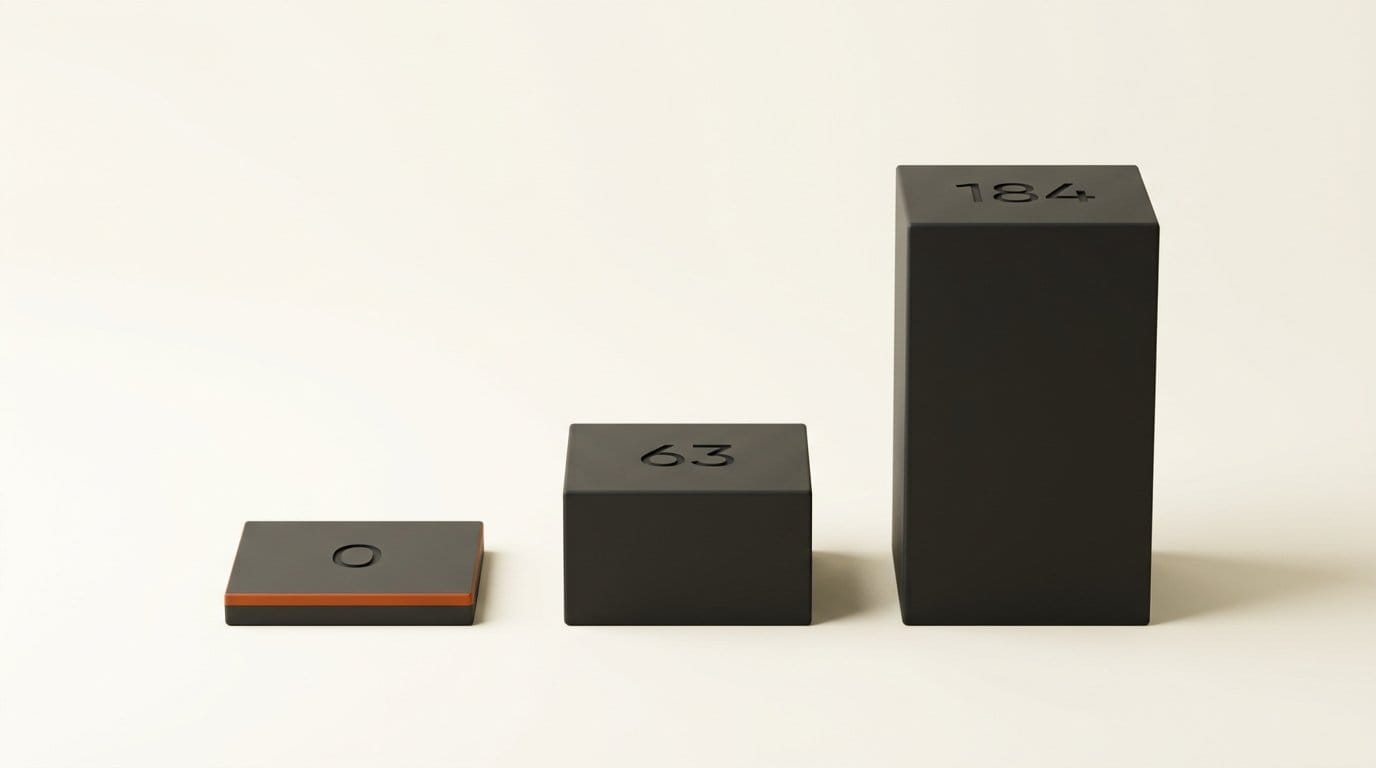
Across nine announcements the median gap is 63 days. The three made in 2026 land at 60, 61 and 62 days. Claude Haiku 3 was deprecated on February 19 and retired April 20, exactly 60 days. Claude Sonnet 4 and Opus 4 got 62 days. Claude Opus 4.1 got 61. Older announcements were more generous, with Claude Opus 3 receiving 189 days and the Claude 2 family 181, but the recent pattern is a floor being treated as a target. Plan for 60, not for the historical average.
OpenAI: 184 days, with one 20-day exception
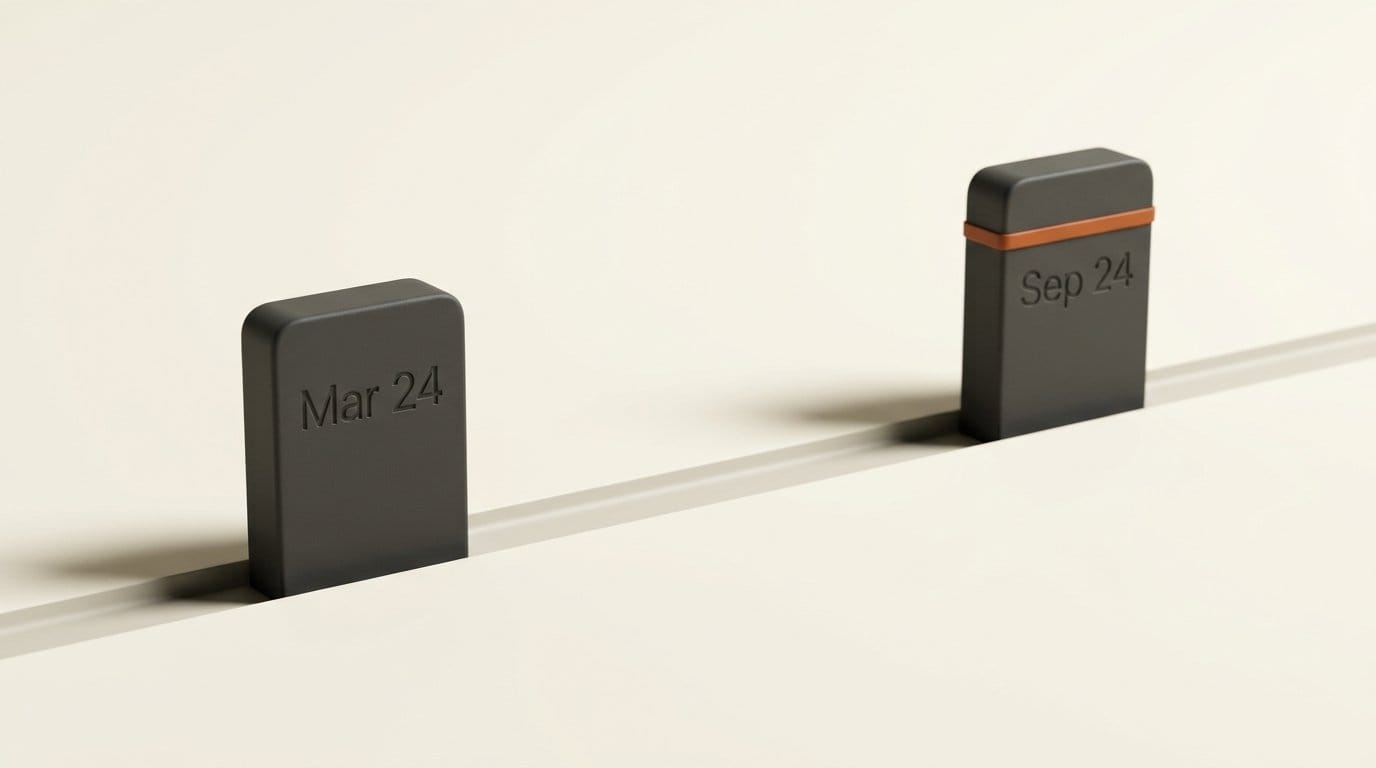
OpenAI publishes an announcement date alongside every shutdown date, which is the single most useful thing on any of these pages, because it makes the notice period computable rather than inferred. Eight of the nine current entries cluster tightly between 180 and 184 days. The Videos API and sora-2 were announced March 24 for a September 24 shutdown. The gpt-5, gpt-5-mini and o3 snapshots got 183 days. Whisper and the 4o transcription family got 184.
Then there is gpt-5.4-cyber, announced September 11 for an October 1 shutdown. Twenty days. It is a single outlier on a security-adjacent model rather than evidence of a policy change, but it is worth knowing that the page carries no stated minimum, so the 184-day norm is a pattern rather than a commitment.
Google: no number at all
Google's Gemini API deprecations page publishes shutdown dates without announcement dates, which makes the notice period impossible to measure from the documentation. It also qualifies the dates it does publish: "The shutdown dates listed in the table indicate the earliest possible dates on which a model might be retired. We will communicate the exact shutdown date to users with advance notice to ensure a smooth transition to a replacement model."
That is a commitment to give notice, with no quantity attached. It cuts both ways. A listed date can slip later, which is good. It also means the number in the table is not the number you can plan against. Several Gemini 3.x Flash models currently sit in the deprecation table with no shutdown date assigned at all. Creators running image pipelines felt this directly when the Gemini 3 Pro Image and 3.1 Flash Image preview endpoints closed on June 25, covered in our Gemini image API migration guide.
The same model, two clocks
The sharpest finding is that identical weights carry different expiry dates depending on the door you walk through. Amazon's Bedrock model lifecycle policy defines a Legacy period as the notice window before end of life, and states: "There are two Legacy periods: 6 months and 45 days. Most models have a 6-month Legacy period."
Both vendors confirm the divergence in their own documentation. Anthropic writes that partner-operated platforms including Amazon Bedrock and Google Cloud "set their own retirement schedules, so a model's lifecycle status and dates can differ." Amazon writes that lifecycle dates "are specific to Amazon Bedrock and may differ from dates published by model providers (such as Anthropic or Cohere)," and that for Bedrock usage "only the dates on the model card apply." The practical result is that Claude Opus 4.1 gave 61 days of warning on Anthropic's own API and roughly six months on Bedrock, a three-fold difference for the same model.
Bedrock adds a clause that matters more to creators than to enterprises: once the Legacy period begins, "existing customers may lose access after 15 days of inactivity." If a workflow is seasonal, or you step away from a project for three weeks, the six-month window can close early.
| Platform | Stated policy | Measured median notice | Shortest observed |
|---|---|---|---|
| Anthropic Claude API | "At least 60 days' notice" | 63 days across 9 retirements | 60 days (Claude Haiku 3) |
| OpenAI API | No minimum stated on the page | 184 days across 9 entries | 20 days (gpt-5.4-cyber) |
| Amazon Bedrock | 6 months or 45 days, set per model card | 6 months for most models | 45 days, plus a 15-day inactivity clause |
| Google Gemini API | "Earliest possible dates", exact date communicated later | Not measurable from docs | Not measurable from docs |
| Suno (consumer app) | None published | Same day | 0 days |
Impact on Creators
The asymmetry here is that vendors measure retirement in API calls and creators measure it in finished work. A model change does not just break a script. It moves the look, the voice or the timing of output that a client already approved.
Three consequences follow. First, style continuity is not covered by any of these policies. A replacement model is offered for every deprecation, but none of the pages promise that the replacement renders the same way. For a musician, an illustrator or an editor with a house look, "migrate to the recommended replacement" means re-establishing the look, not swapping a string.
Second, the notice clock starts when the vendor emails the account holder, not when you next open the project. Anthropic notifies customers "with active deployments," which is exactly the group Bedrock's 15-day inactivity clause can drop you out of. A project you return to after a quiet month is the one most likely to find the model gone.
Third, retirement is increasingly bundled with repricing, so the migration is rarely cost-neutral. DeepSeek retired V4-Pro alongside a price change, which we covered in DeepSeek V4.1-Flash Retires V4-Pro and Cuts Prices. Bedrock notes that continued access past end of life requires "a private arrangement between you and the provider," which is not a consumer-tier option.
What to Do Next
None of this is fixable by choosing a better vendor, because the vendor with the longest notice period is not necessarily the one with the model you need. It is fixable by treating model retirement as a scheduled risk rather than an interruption.
Start with an inventory. Write down every model ID your workflows actually call, including the ones buried in ComfyUI nodes, agent configs and render presets. Anthropic exposes this directly: the Usage page in the Claude Console exports a CSV broken down by API key and model, which turns "I think we are on Sonnet" into a fact.
Then pin versions rather than aliases. An auto-updating alias hands the vendor permission to change your output without a deprecation notice, because nothing is being retired when an alias moves. A dated snapshot ID gives you a deprecation entry to watch.
Next, keep a reference set. Ten to twenty prompts with their approved outputs, stored with the settings that produced them, is the cheapest insurance available. When a replacement model lands, you re-run the set and see the drift instead of discovering it in a client review. This is the step that converts a 60-day window from a scramble into a task.
Finally, know which of your workflows can run on weights you hold. Open models do not get retired out from under you, which is a genuine argument for keeping one local path for anything you need to reproduce years from now. Our local AI versus cloud AI decision guide covers where that trade is worth making.
Related deep dive: DALL-E 3 Shuts Down: GPT Image 1 Migration Guide, a worked example of migrating an image workflow on a published deadline.
Key Takeaways
- Notice length is set by the platform, not the model. Claude Opus 4.1 gave 61 days on Anthropic's API and roughly six months on Bedrock.
- Anthropic commits to a 60-day floor and its three 2026 retirements landed at 60, 61 and 62 days. Treat 60 as the planning number.
- OpenAI's measured median is 184 days, but the page states no minimum, and
gpt-5.4-cybergot 20. - Google publishes shutdown dates as "earliest possible dates" with no committed notice period, so its table is not a planning instrument.
- Consumer creative apps carry no lifecycle policy at all. Suno retired four model generations on launch day.
- A pinned version ID plus a stored reference set of prompts and approved outputs is the only defense that does not depend on a vendor promise.
What to Watch
The gap worth tracking is between preservation and availability. Anthropic has published commitments on model deprecation and preservation that promise to preserve the weights of all publicly released models "for, at minimum, the lifetime of Anthropic as a company," and to interview each model before retirement. Preserved weights are not the same as callable weights, and the company describes keeping select models publicly available after retirement as something it is "exploring" rather than something it has committed to. If that exploration turns into a product, it would be the first long-term support tier in the industry.
The second thing to watch is whether announcement dates become standard. OpenAI publishes them, Anthropic publishes them, Google does not. That single field is the difference between a lifecycle policy you can audit and one you have to trust. It costs a vendor nothing to add, which makes its absence informative.
The nearest concrete deadline is OpenAI's Videos API and sora-2 shutdown on September 24, 2026, listed with no replacement model. Anything still calling it has under two weeks, and unlike most entries on these pages, there is nothing to migrate to.
FAQ
How much notice do AI companies give before retiring a model?
It depends entirely on the platform. Anthropic commits to at least 60 days and its recent retirements have landed at 60 to 62 days. OpenAI's published record has a median of 184 days but no stated minimum. Amazon Bedrock gives most models a six-month Legacy period. Google's Gemini API commits to advance notice without specifying a length. Consumer apps such as Suno give none.
Why does the same model have different retirement dates on different platforms?
Because the platform, not the model developer, sets the schedule. Anthropic's documentation states that partner-operated platforms including Amazon Bedrock and Google Cloud set their own retirement schedules, and Amazon's documentation states that for Bedrock usage only the dates on its model card apply. Claude Opus 4.1 carried 61 days of notice on Anthropic's API and about six months on Bedrock.
Can I keep using a model after its retirement date?
Generally no. Requests to retired models fail. Amazon Bedrock notes one narrow exception, continued access "unless there is a private arrangement between you and the provider," which is an enterprise negotiation rather than a self-service option. The reliable alternative is running open weights you hold yourself.
Does a replacement model produce the same output?
No vendor promises that. Every deprecation entry names a recommended replacement, but the recommendation covers capability and pricing, not visual style, voice character or timing. This is why keeping a reference set of prompts and approved outputs matters more than the migration guide itself.
What is the safest way to protect a workflow from retirement?
Pin dated model snapshot IDs instead of auto-updating aliases so that any change arrives as a deprecation notice rather than a silent swap. Keep an inventory of every model ID your workflows call, audit it against each vendor's deprecations page on a set schedule, and maintain a stored reference set so you can measure drift when you are forced to move.