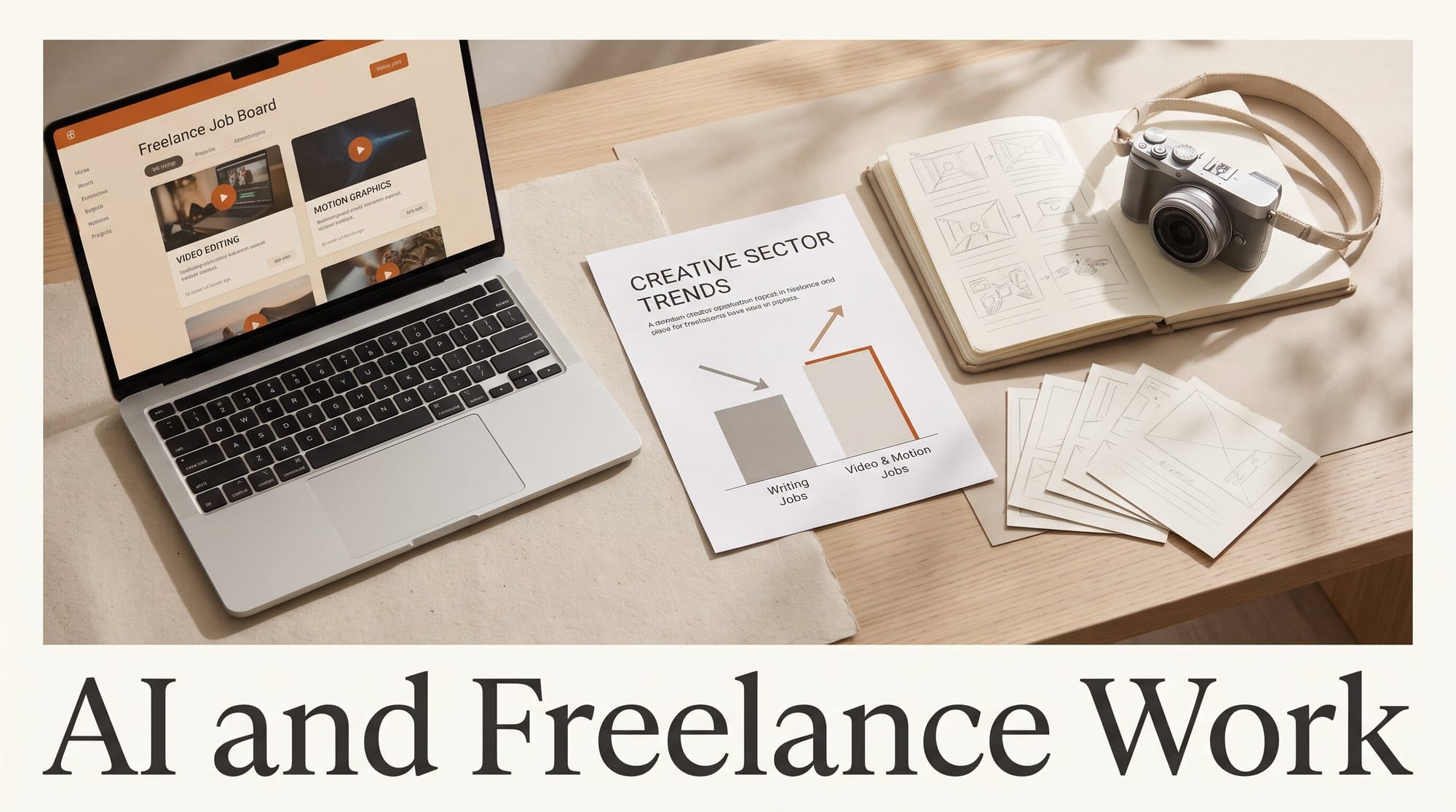
On Upwork, content writing's share of job posts fell by roughly 31% between the first half of 2025 and the first half of 2026, while video and animation postings have grown by about a third against the marketplace as a whole since 2023. Those figures come from a joint OpenAI and Upwork report published on November 10, 2026, and they match what three peer-reviewed studies and three creator-association surveys found before it. So is AI taking freelance creative work? Some of it, and unevenly. Short, single-step jobs a chatbot can do are shrinking. Finished work that mixes AI with editing, motion and judgment is growing, and clients pay for more hours of it. We read seven sources to work out which jobs are which.
Background
Freelance platforms are where AI's effect on creative work shows up first. Contracts are short, clients rewrite their briefs every time they post, and nobody has to restructure a department to stop hiring. The stakes are large: Upwork's 2026 Future Workforce Index, quoted in the OpenAI report, found that 38% of skilled US knowledge workers freelance, and Upwork's previous study put US freelance knowledge work at $1.5 trillion in earnings in 2024.
Researchers have been measuring this since ChatGPT and the first image generators arrived in late 2022. The early studies compared freelance postings before and after each launch. The new OpenAI and Upwork paper, The Rebundling of Freelance Work in the AI Age, goes a step further: it lines up more than 36,000 sampled ChatGPT conversations against Upwork's job categories to see whether the work people now do themselves with AI is the work they stopped hiring for.
One caution before the numbers. OpenAI and Upwork both have a stake in this question, and the ChatGPT side counts conversations, not hours worked or projects finished. The academic studies are independent but older. Where they agree, the pattern is worth acting on.
Deep Analysis
Writing and translation went first
Every study agrees on text. In the first one, by Xiang Hui, Oren Reshef and Luofeng Zhou, writing-related freelancers on Upwork saw monthly jobs fall 2% and monthly earnings fall 5.2% after ChatGPT launched, according to Washington University's summary of the paper, later published in Organization Science. A larger study by Ozge Demirci, Jonas Hannane and Xinrong Zhu, published in Management Science, found a 21% drop in posts for automation-prone writing and coding jobs within eight months, compared with jobs that need manual skills.
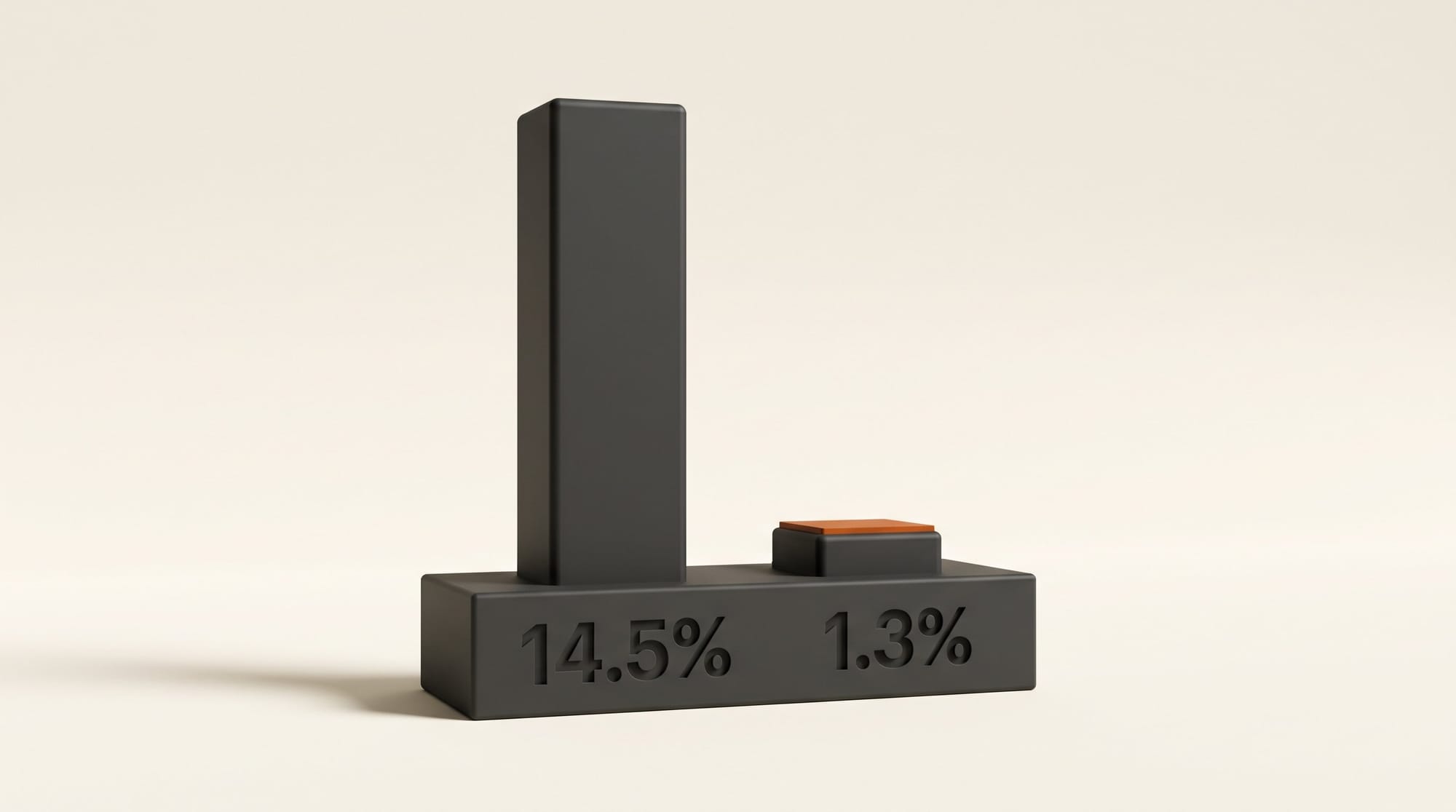
The Oxford Internet Institute team behind Winners and Losers of Generative AI, which analysed over three million postings from January 2021 to September 2023, put the drop for writing and translation at 20 to 50%. The newest data says it has not stopped: content writing makes up 14.5% of sampled ChatGPT conversations against 1.3% of Upwork posts, and over two years its postings fell at more than twice the rate of Upwork postings overall. The OpenAI and Upwork paper's reading is plain: people now draft blog posts, marketing copy and product descriptions with ChatGPT that they would once have commissioned.
Image work took a smaller, real hit
Image work has been hit too, but less, and the jobs that are left are harder. Demirci, Hannane and Zhu found a 17% decrease in posts for image creation after image generators launched. Hui, Reshef and Zhou measured individual freelancers: after DALL-E 2 and Midjourney, image-related freelancers saw monthly jobs fall 3.7% and income fall 9.4%, a steeper drop than writers saw after ChatGPT.
Being good did not protect anyone. Hui's team found that higher-rated, more experienced freelancers saw a larger drop in new jobs and income, though the authors say that result is "not definitive". The Oxford study saw the same thing for substitutable skills: "the largest reduction in demand was for experienced workers". Demirci's team found that the automation-prone jobs still posted tend to be more complex and pay more, so what remains asks more of you.
Design has not collapsed, though. Graphic, editorial and presentation design is 10.5% of Upwork posts against 2.3% of ChatGPT conversations, and the OpenAI and Upwork key takeaways state that "freelance demand for graphic design remains substantial". People generate images with AI; clients still hire someone to turn them into a finished brand, deck or campaign.
Video and finished products are where demand moved
Video runs the other way. It is 1.0% of ChatGPT conversations and 10.0% of Upwork posts, and video and animation postings grew by about a third relative to the whole marketplace between the first half of 2023 and the second half of 2025. Inside AI-related jobs, the tasks that gained share were video production, social-media campaigns and marketing automation; AI-generated written content lost share.
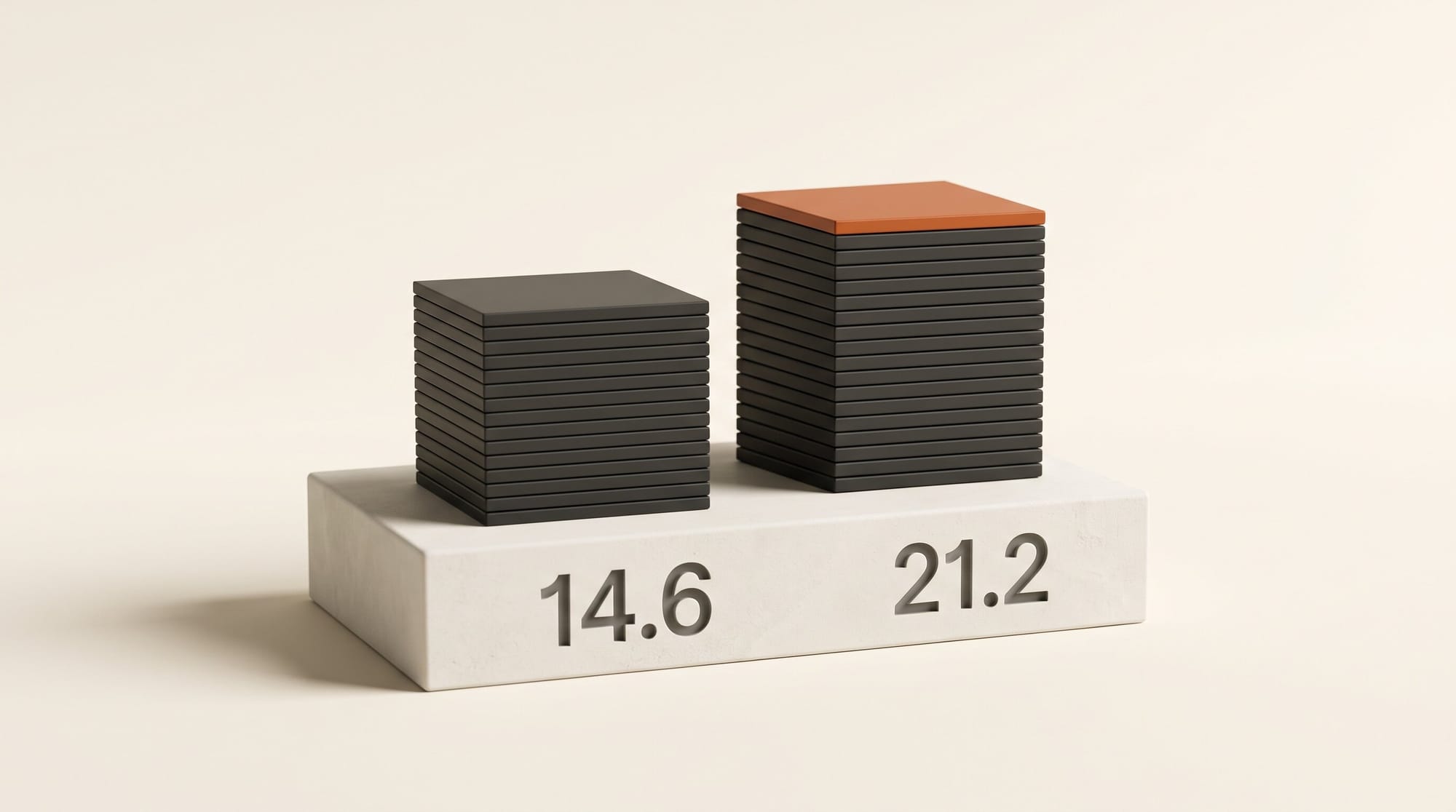
Clients are also combining work in new ways. The report's example brief asks for AI-generated video, video editing and motion graphics in one posting. The mix of tasks in AI-related postings became 45% more diverse between early 2023 and late 2025, from the equivalent of 14.6 equally common tasks to 21.2. Rare pairings, tasks that had appeared together in fewer than 200 earlier posts, made up 8.4% of task pairs in AI-related posts against 2.4% in other posts, and the effect was strongest in generative AI and creative production.
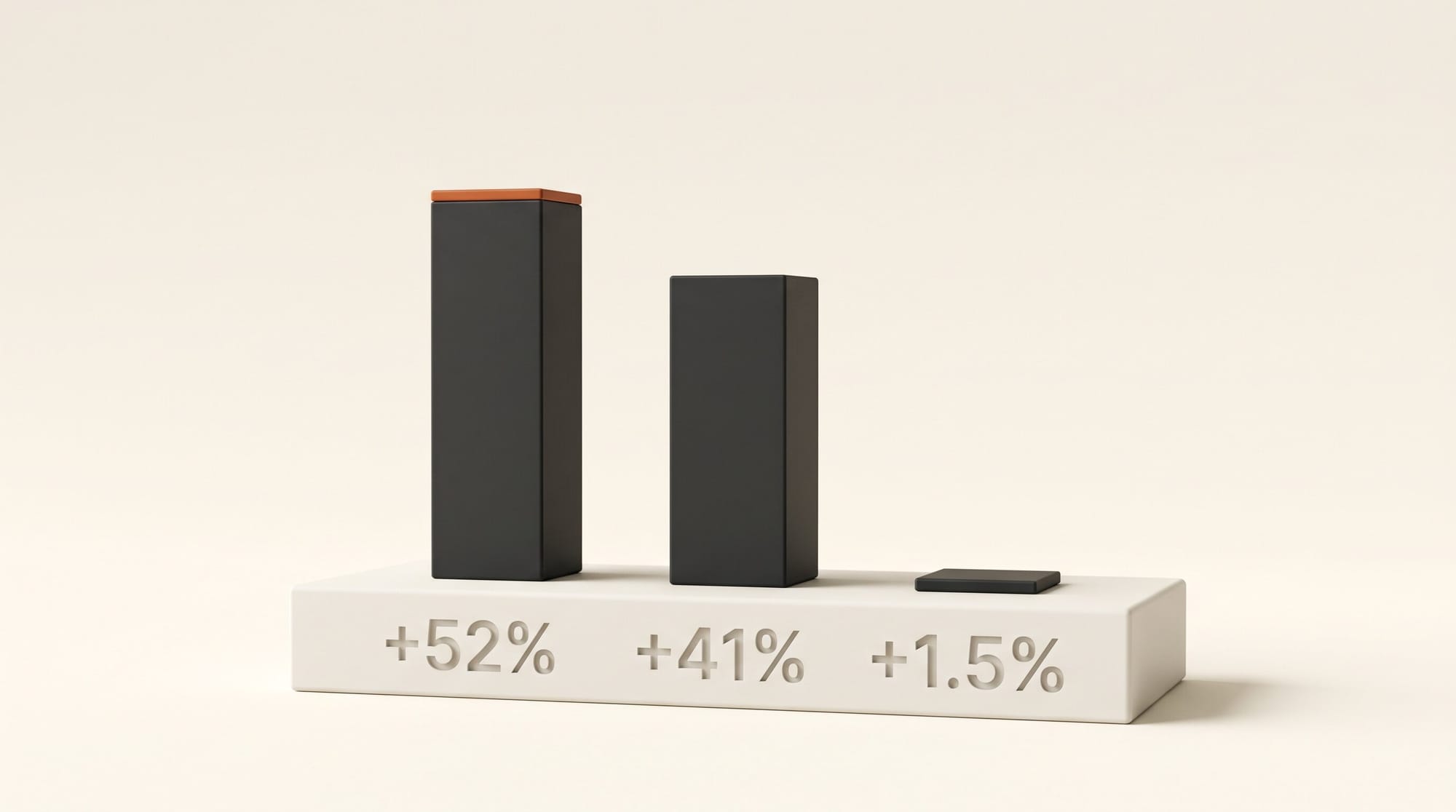
Then there is the money. Within the same job category and month, AI-related fixed-price projects had budgets about 52% higher, and freelancers on hired hourly contracts logged about 41% more hours in the first 90 days. Posted hourly rates were only 1.5% higher. Clients are not paying more per hour for AI skills. They are buying bigger projects, which the authors compare to a rebound effect: when each step gets cheaper, clients ask for more versions, a more ambitious video or more features.
The surveys show where it hurts
Platform data shows averages; surveys of working creators show who is losing. In the UK, the Association of Photographers surveyed its roughly 3,000 members in January 2026, and about 600 answered. Videomaker's report on the results says 58% had lost commissioned work to generative AI, the same share as in 2025, and the average reported loss rose 142%, from about £14,400 to about £34,900 per person. The average number of images members licensed fell 65%, from 10,500 to 4,800.
Illustrators and translators reported the same pattern earlier. In the Society of Authors survey of January 2024, with 787 responses, 26% of illustrators and 36% of translators said they had lost work to generative AI, and 37% and 43% said their income had fallen in value, as Literary Hub reported. In Japan, a Freelance League of Japan survey with 24,991 responses, reported by The Decoder, found about 12% of manga artists, illustrators and other creatives had lost income to generative AI over the year, and 2.7% had lost more than half.
These are self-reported and come from groups worried about AI, so they are not market measurements. But they point the same way as the platform data: the losses fall on people selling single images and stock-style work, not on people selling a finished production.
Impact on Creators
The data does not say freelance creative work is disappearing. The Oxford team found that net demand for freelance jobs rose after ChatGPT launched. It says the work is being unbundled and rebundled: clients do the simple step themselves and hire for the finished outcome.
If you write for clients, expect fewer one-off blog and product-copy jobs and price for what a chatbot cannot do: the reporting, the interview, the voice, the edit of AI drafts. If you illustrate or design, single images and simple graphics are the exposed part; a brand system, a deck or a campaign is still bought from people. Our guide to what AI images cost per image shows why: a client can make a draft image for cents, so your price has to be about the finished job. If you shoot photos, the AOP data says licensing is falling fastest, so commissioned shoots matter more than library sales; see where AI images can and cannot be sold to understand what stock buyers now compare you with.
If you edit video or do motion work, you are on the growing side, and the OpenAI and Upwork numbers suggest how to sell it: a fixed-price project that bundles AI-generated shots, the edit and the motion graphics. Hourly rates for AI work barely differ, so selling by the hour misses where the extra money is. Whatever your medium, say how you use AI; our analysis of whether audiences care if you use AI found that hiding it costs more trust than saying so.
| Source | Data | What it found for creative work |
|---|---|---|
| OpenAI and Upwork (Nov 2026) | 36,000+ ChatGPT conversations; Upwork posts through April 2026 | Content writing share of posts down about 31% in a year; video and animation up about a third against the market; AI projects 52% larger budgets |
| Hui, Reshef, Zhou (Organization Science) | Upwork freelancers before and after ChatGPT, DALL-E 2, Midjourney | Image freelancers: jobs down 3.7%, income down 9.4%; writers: jobs down 2%, earnings down 5.2% |
| Demirci, Hannane, Zhu (Management Science, 2025) | Job posts on a global freelancing platform | Image creation posts down 17%; writing and coding posts down 21% within eight months |
| Teutloff et al. (JEBO, Jan 2025) | 3 million+ posts, Jan 2021 to Sep 2023 | Writing and translation down 20 to 50%; net freelance demand up |
| Association of Photographers (Jan 2026) | About 600 of about 3,000 members | 58% lost commissioned work; average loss about £34,900; licensed images down 65% |
| Society of Authors (Jan 2024) | 787 responses | 26% of illustrators and 36% of translators lost work |
| Freelance League of Japan | 24,991 responses | About 12% of creatives lost income to generative AI |
Key Takeaways
1. Text went first: content writing's share of Upwork posts fell about 31% in a year, and studies put the drop for writing and translation at 20 to 50%.
2. Image work took a smaller hit, a 17% fall in image-creation posts and 9.4% lower income for image freelancers, and experience did not protect top-rated freelancers.
3. Video and animation grew by about a third against the market, and AI-related jobs increasingly bundle AI video, editing and motion graphics.
4. AI projects pay more because they are bigger: 52% larger budgets and 41% more hours, but hourly rates only 1.5% higher. Price by the project.
5. Surveys show the pain is concentrated: 58% of Association of Photographers members say they lost commissioned work, and the images they license fell 65%.
What to Watch
The platform data runs through April 2026, and the task analysis through 2025. The OpenAI and Upwork authors call their findings a baseline for "how wider use of AI agents may further change the work clients purchase from freelancers". The next edition will show whether agents eat into the bundled video and design projects that are growing now, or whether clients keep hiring people to direct them.
Watch two other things. Hui, Reshef and Zhou measured only the short run; longer studies will show whether lost writing and image jobs come back as editing and direction work. And watch the creator-association surveys for the cost of a lost commission: the AOP's average loss more than doubled in a year even though the share of members affected stayed at 58%, a sign that for the people it hits, the hit is getting bigger.
FAQ
Is AI taking freelance creative jobs?
Some of them. Content writing's share of Upwork job posts fell about 31% between the first half of 2025 and the first half of 2026, and image-creation posts fell 17% after image generators launched. But video and animation postings grew, and an Oxford study found net freelance demand rose after ChatGPT.
Which freelance creative jobs are most at risk from AI?
Short, single-step jobs a chatbot or image generator can finish alone: blog posts, product descriptions, translation and simple images. Studies put the drop for writing and translation at 20 to 50%. Jobs that deliver a finished production, such as an edited video with motion graphics, are growing.
Are graphic designers losing work to AI?
Simple image jobs are. Image-related freelancers on Upwork saw monthly jobs fall 3.7% and income fall 9.4% after DALL-E 2 and Midjourney. Yet graphic, editorial and presentation design is still 10.5% of Upwork job posts, and OpenAI and Upwork say freelance demand for it remains substantial.
Do freelancers who use AI earn more?
Per project, yes; per hour, barely. On Upwork, AI-related fixed-price projects had budgets about 52% higher than similar work posted in the same month, and hourly contracts logged about 41% more hours. Posted hourly rates were only 1.5% higher, so the gain comes from bigger projects.
How many photographers have lost work to AI?
In the Association of Photographers' January 2026 survey of its members, most of them in Britain and Europe, 58% said they had lost commissioned work to generative AI, the same share as in 2025. The average reported loss rose to about £34,900 per person, and the number of images members licensed fell 65%.