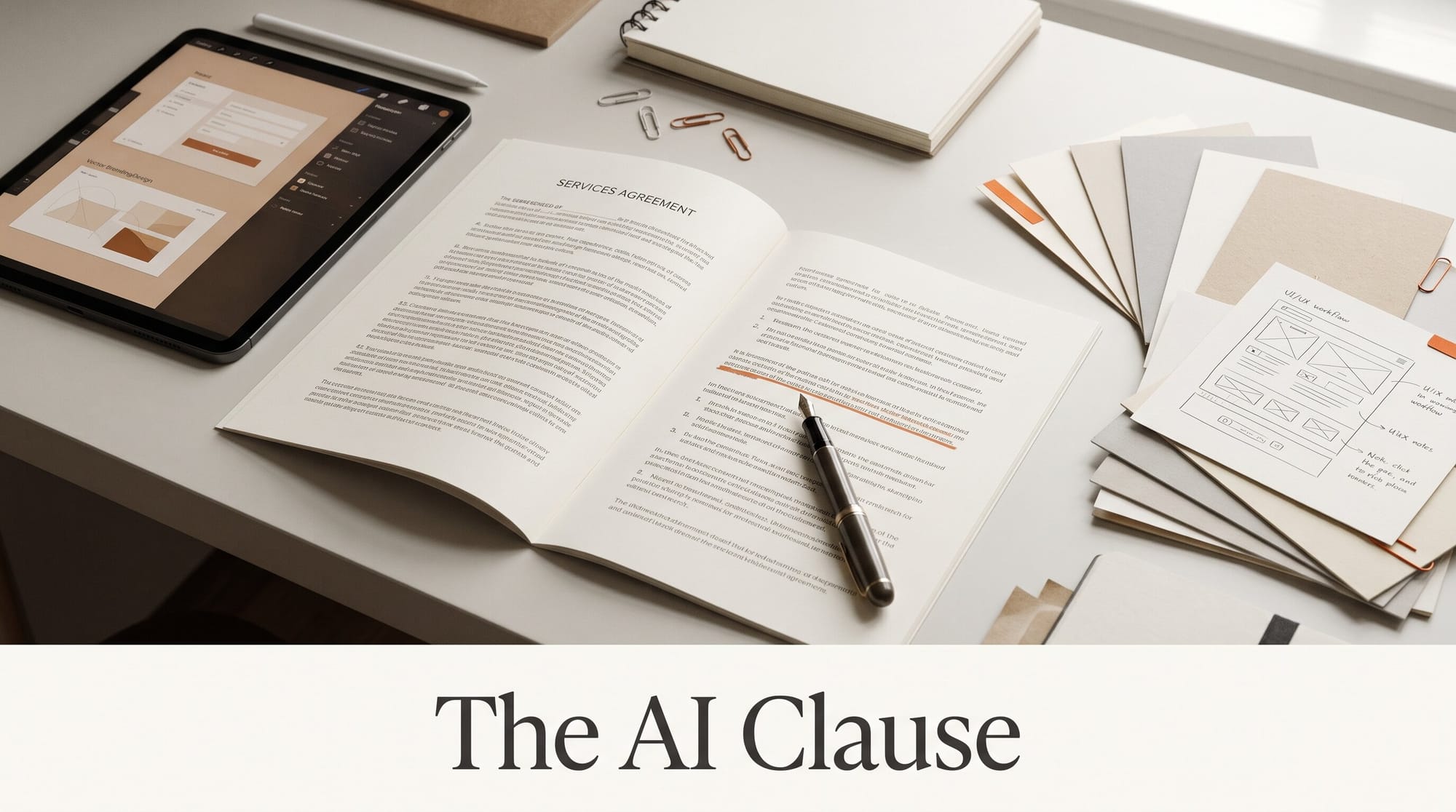
An AI clause in a freelance contract is a short section that says which parts of the work were made with AI tools, what the client owns as a result, and what you can honestly promise about it. Most freelance templates were written before image generators existed, and they promise three things AI output cannot fully back: that the client gets the full copyright, that the work is unique to them, and that nothing in it infringes anyone else's rights. The US Copyright Office said in January 2025 that the "mere provision of prompts" does not make you an author, and on March 2, 2026 the Supreme Court declined to revisit the human-authorship rule. If your contract hands over a copyright that the AI-made parts never had, the gap is yours.
This is not legal advice, and for a large contract a lawyer should read your final wording. What follows reads the documents that actually set the rules, from the Copyright Office to the terms of Midjourney, OpenAI, Adobe and Fiverr, and turns them into five lines your contract should say.
Background
The standard freelance creative contract has a familiar shape. On final payment the client receives all rights in the deliverables, usually as a full assignment of copyright. The freelancer warrants that the work is original and does not infringe anyone's rights, and agrees to cover the client's costs if it does. None of that mentions tools, because it never had to: a designer who drew a logo in Illustrator owned the copyright in it and could hand it over.
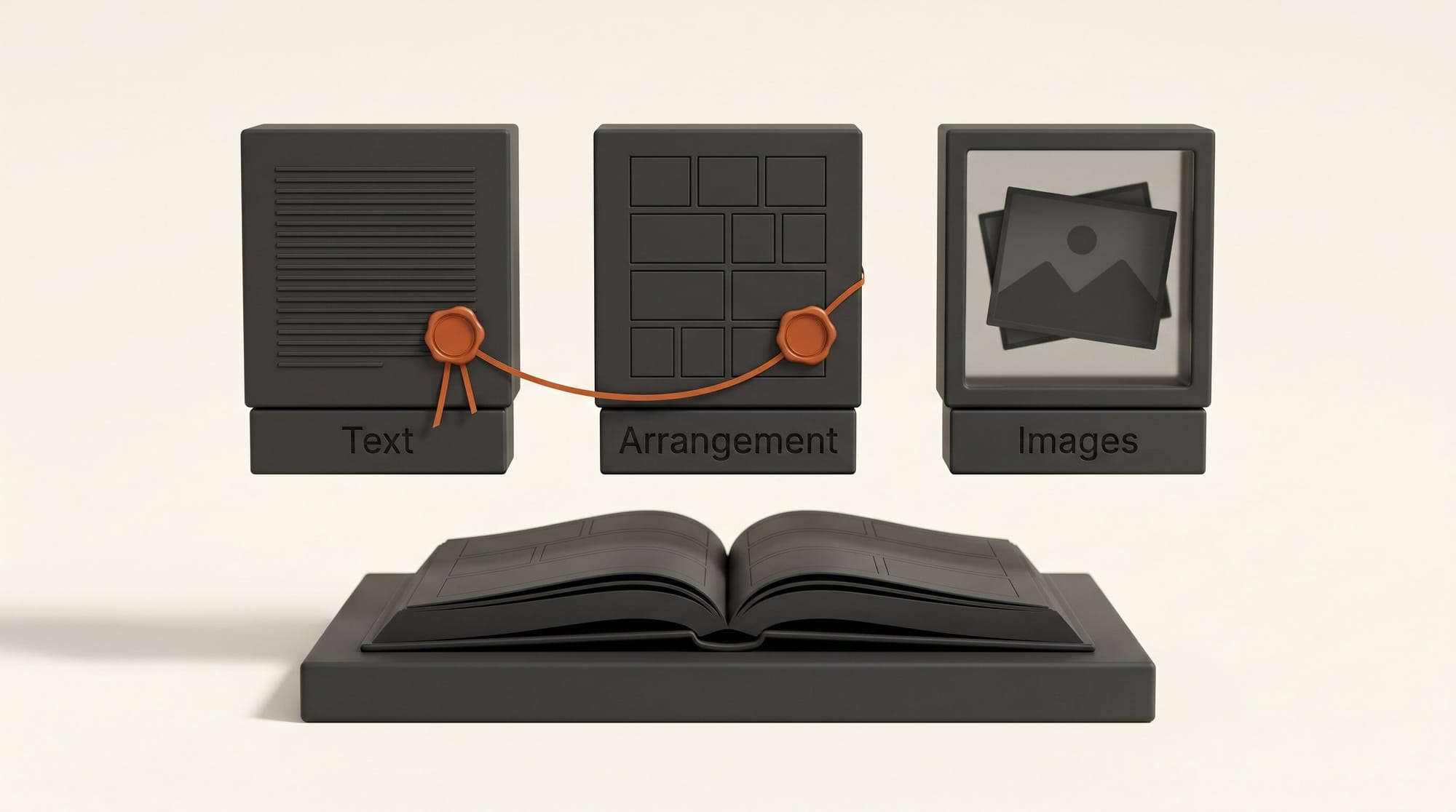
Generative AI removed the assumption underneath. In February 2023 the Copyright Office reviewed its registration for Zarya of the Dawn, a comic book with Midjourney images inside. The Office kept protection for the author's text and for "the selection, coordination, and arrangement" of the words and pictures, but concluded that "the images in the Work that were generated by the Midjourney technology are not the product of human authorship" and cancelled the original certificate. The book stayed protected as a whole. The individual pictures did not.
Two years later the Office turned that decision into general policy. Its report on the copyrightability of AI outputs, released January 29, 2025, says protection exists "only where a human author has determined sufficient expressive elements," and does not extend to "the mere provision of prompts." It also says that using AI as a tool, or including AI material in a larger human work, does not stop the human parts from being protected. The courts have not moved the line either. When Stephen Thaler asked the Supreme Court to recognise a work made autonomously by his AI system, the Court denied review on March 2, 2026, leaving the human-authorship requirement in place.
Deep Analysis
Put a typical freelance contract next to the documents that govern AI output and three of its promises stop lining up. A fourth question, disclosure, is where platforms and regulators have already moved, and writers already have model wording for all of it.
The copyright you transfer may not exist
An assignment clause hands over the rights you hold. If a logo's mark came straight out of an image generator, the client receives your lettering, your edits and your arrangement, but the generated shape itself carries no copyright for anyone to own. A competitor who copies that shape is copying unprotected material. A client paying for a brand mark is usually paying for exactly the part they cannot stop others from using.
How much you changed is what decides it. The Copyright Office treats AI as a tool when a person controls the expressive result: redrawing a generated concept by hand, compositing several elements, painting over a base, cutting a clip into a sequence. A prompt alone, however long, is not enough. So the useful question for each deliverable is not "did I use AI" but "which visible parts are mine".
The Office also makes the split a matter of record. Its registration guidance says applicants "have a duty to disclose the inclusion of AI-generated content" and that AI content "that is more than de minimis should be explicitly excluded from the application." A client who later registers your illustration has to describe which parts the AI made. If you never told them, they cannot fill in the form correctly, and an incorrect registration is what got the Zarya certificate cancelled.
Your AI tool does not back your warranty
The tools promise less than your contract does. OpenAI's terms of use (effective January 1, 2026) assign you "all our right, title, and interest, if any, in and to Output", then add that "output may not be unique" and "other users may receive similar output from our Services." Note the "if any". A freelancer who promises a client a one-of-a-kind image made in ChatGPT is promising more than the company that made it.
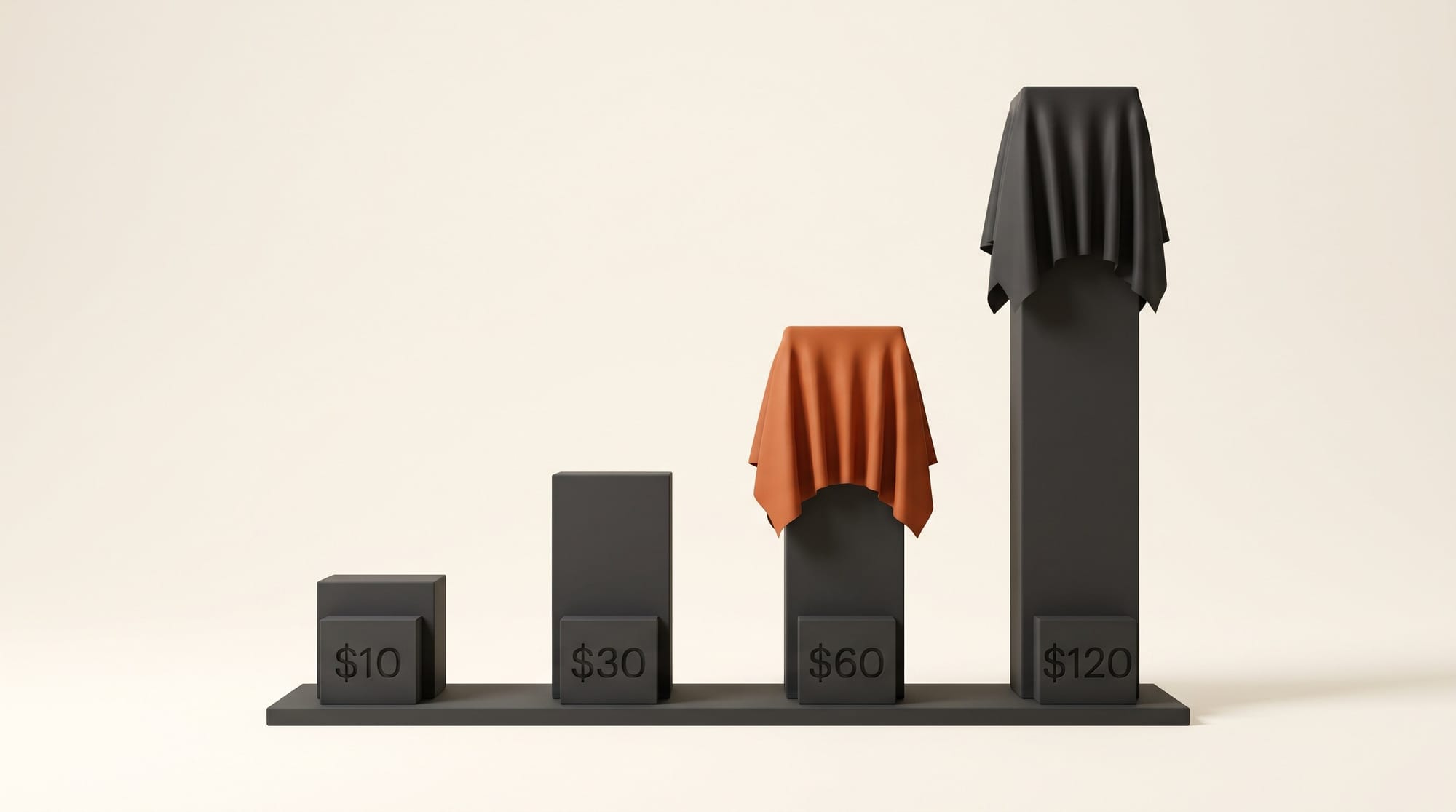
Midjourney's terms of service (version effective May 27, 2026) say you own your assets "to the fullest extent possible under applicable law", with one exception: a company, or an employee of a company, with more than $1,000,000 a year in revenue must be on a Pro or Mega plan to own them. The same terms give Midjourney a perpetual, worldwide licence to everything you make, say your content is "publicly viewable and remixable" by default, and provide the assets "AS IS", without any warranty of title or non-infringement. You also agree to indemnify Midjourney against third-party claims arising from your use. Stealth mode, which keeps your images private, is only on the Pro ($60 a month) and Mega ($120 a month) plans, according to Midjourney's plan comparison. On the $10 Basic or $30 Standard plan, a client's unreleased campaign concepts are public by default.
Adobe goes furthest, and it is still narrow. Its Firefly product description (published August 27, 2026) lists the features covered by Adobe's IP indemnity, from Text to Image and Generative Fill to Generate Speech and Generate Music. But the indemnity applies only "if you are a customer and your agreement with Adobe includes a link to this page's URL", and it excludes capabilities "powered or provided by non-Adobe trained models" and anything labelled beta or trial. If your agreement does not link that page, or you picked a partner model inside Firefly, Adobe does not stand behind the output, and your own non-infringement warranty stands alone.
Platforms already put the question in writing
Freelance marketplaces have written the rule most private contracts still lack. Fiverr's AI guidelines permit AI "across all service categories", but say freelancers "must also honor a client's explicit request for non-AI work" and that "generic, unmodified, or reused AI output does not meet Fiverr's quality standards." They put the first move on the client: "If you do not want AI used in your order, it's essential to say so clearly, either before placing the order or immediately after." In a dispute, Fiverr checks whether the client stated expectations up front and whether the delivery reflects the freelancer's "own professional effort and meaningful input". Misrepresenting AI use can end in a cancelled order, a full refund and a permanently suspended account.
That is a workable template for direct clients too: a stated preference before work starts, an honest description of the workflow, and judgment on the result rather than on the tool. Without a clause, the same argument happens after delivery, with no agreed standard to settle it.
Regulation is pushing the same way for work published in Europe. Since August 2, 2026, Article 50 of the EU AI Act has required anyone who publishes realistic AI-generated or manipulated images, audio or video (the Act's "deep fakes") to disclose it, with what Jones Walker's summary of the rule calls "tailored disclosure treatment for evidently artistic, creative, satirical, fictional, and analogous works." The client usually publishes, so the client usually carries that duty, and they can only meet it if you told them what was generated.
Writers already have model wording
Authors got there first. The Authors Guild publishes model contract clauses on AI for book deals. One reserves AI training rights to the author unless the contract grants them expressly. One says "Author shall not be required to use generative AI or to work from AI-generated text." Another requires the author to "disclose to Publisher if any AI-generated text is included in the submitted manuscript", with a bracketed cap of "[a de minimis/5%]" left for the two sides to negotiate.
Disclosure, a ceiling, a right to say no and a limit on training: those are the four moving parts, and none of them is specific to books. Designers, illustrators, video editors, voice artists and composers can borrow the same structure and add the two things visual and audio work needs most, a split of what the client owns and a warranty sized to what the tools actually promise.
Impact on Creators
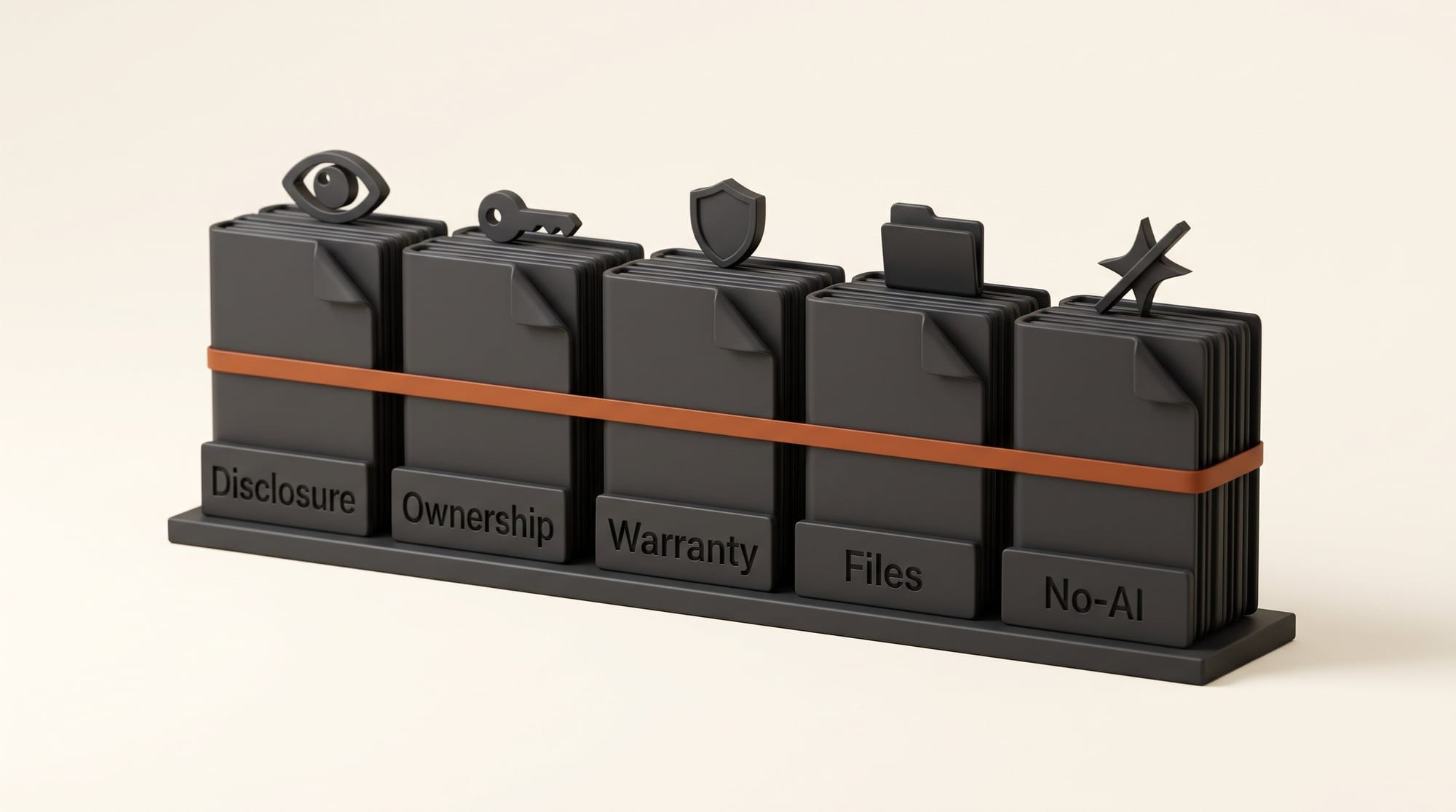
The fix is a short AI section in your contract or proposal, plus one habit at delivery. Here are the five lines in plain words. Adapt them to your work and, for big jobs, have the wording checked.
- Disclosure. "I use AI tools for [concepts, backgrounds, upscaling, voice drafts]. At delivery I will list which deliverables contain AI-generated elements and which tools made them." Name categories in the contract and specific apps at delivery, so the clause does not go stale when you switch tools.
- Ownership. "On payment, the client receives all rights I hold in the deliverables. AI-generated elements may not be protected by copyright; I transfer whatever rights exist in them." This keeps the assignment honest without weakening what you really own: your edits, compositing, lettering and arrangement.
- Warranty. Promise what you control: that your own contributions are original, that you used each tool under terms that allow commercial use, and that you did not prompt for a named living artist, a brand or a real person. Do not promise that AI elements are unique; OpenAI's own terms say they may not be.
- Client files. "Client material goes only into tools the client approves, and never into a public gallery." Unreleased products, logos and faces are what clients worry about most.
- No-AI option. If the client wants no AI at all, say yes, and price it as the different job it is. Fiverr's rule, honour an explicit no-AI request made up front, works just as well off the platform.
Two habits make those lines hold up. Keep your working files: layered PSDs, edit timelines, prompt history and the sketches you redrew. They show which parts are yours if a client registers the work, or if someone claims it was entirely AI-made. And for anything the client must own outright, such as a logo, a mascot or a signature character, use AI to explore and make the final by hand, so the part they are paying for is the part copyright protects.
Check your plans before the next job, too. On Midjourney, move to Pro before a confidential project starts, not after the concepts are already public. If you rely on Adobe's indemnity, confirm that your agreement links the Firefly terms and that you stayed on Adobe's own models. For how audiences react when you say you used AI, see our analysis of whether audiences care about AI disclosure. For where freelance demand is moving, read what the data says about AI and freelance work, and for the wider legal picture, our AI copyright and licensing guide.
Key Takeaways
- The Copyright Office protects human-made expression only. Prompts alone do not count, and the Supreme Court left that rule in place on March 2, 2026.
- A standard assignment clause transfers only the rights that exist, so purely AI-generated elements reach the client unprotected.
- OpenAI says output "may not be unique". Midjourney supplies assets "AS IS" with no non-infringement warranty. Adobe's indemnity covers only customers whose agreement links its Firefly terms, and only Adobe-trained models.
- Fiverr already requires freelancers to honour an explicit no-AI request and can refund the client and suspend the account when AI use is misrepresented.
- A five-line AI clause (disclosure, ownership, warranty, client files, no-AI option) plus kept working files closes most of the gap.
What to Watch
Three things could move these lines. The first is where "sufficient expressive elements" begins: the Copyright Office's report sets the principle, but heavy editing, compositing and image-to-image work still sit in a grey zone, and the first registration disputes over those workflows will tell freelancers how much reworking a deliverable needs. The second is indemnity. Adobe's covers only listed features on its own models; if more tool makers extend coverage to individual subscribers, the warranty in your contract becomes far easier to back. The third is how the EU applies its disclosure rule to creative work, which will decide how much clients need to know about the files you send them. Until those settle, a clause that says what you used, and what you can honestly promise, is the cheapest protection a freelancer has.
FAQ
Do I have to tell clients I use AI?
Usually your contract and your platform decide it, not a general law. Fiverr requires freelancers to honour an explicit no-AI request and treats misrepresenting AI use as grounds for a refund and suspension. If a client registers the work with the US Copyright Office, they must disclose AI-generated material that is more than de minimis, which they can only do if you told them. Telling clients up front costs less than arguing after delivery.
Can a client own the copyright in an AI-generated image?
Only in the parts a person authored. The Copyright Office protects human selection, arrangement and editing, but not material generated from prompts alone, as the Zarya of the Dawn decision showed. A client can own your edits and composition; nobody owns the raw generated image.
Who is liable if AI-generated client work infringes someone else's rights?
Under most freelance contracts, the freelancer, through the warranty and indemnity clauses. Midjourney supplies assets without any non-infringement warranty and asks you to indemnify it, and Adobe's Firefly indemnity applies only to customers whose agreement links its terms. Narrow your warranty to what you control.
What should an AI clause in a freelance contract say?
Five things: which kinds of AI tools you use and that you will list AI elements at delivery; that the client gets all rights you hold, with AI elements possibly unprotected; a warranty limited to your own work and licensed tool use; where client files may go; and an option, priced separately, for no AI at all.
Can I use Midjourney for client work?
Yes, on any paid plan, as long as you are not a company (or an employee of one) with more than $1,000,000 a year in revenue, which needs Pro or Mega. Images are public by default below the $60 Pro plan, so upgrade before confidential work, and tell the client which deliverables include Midjourney elements.