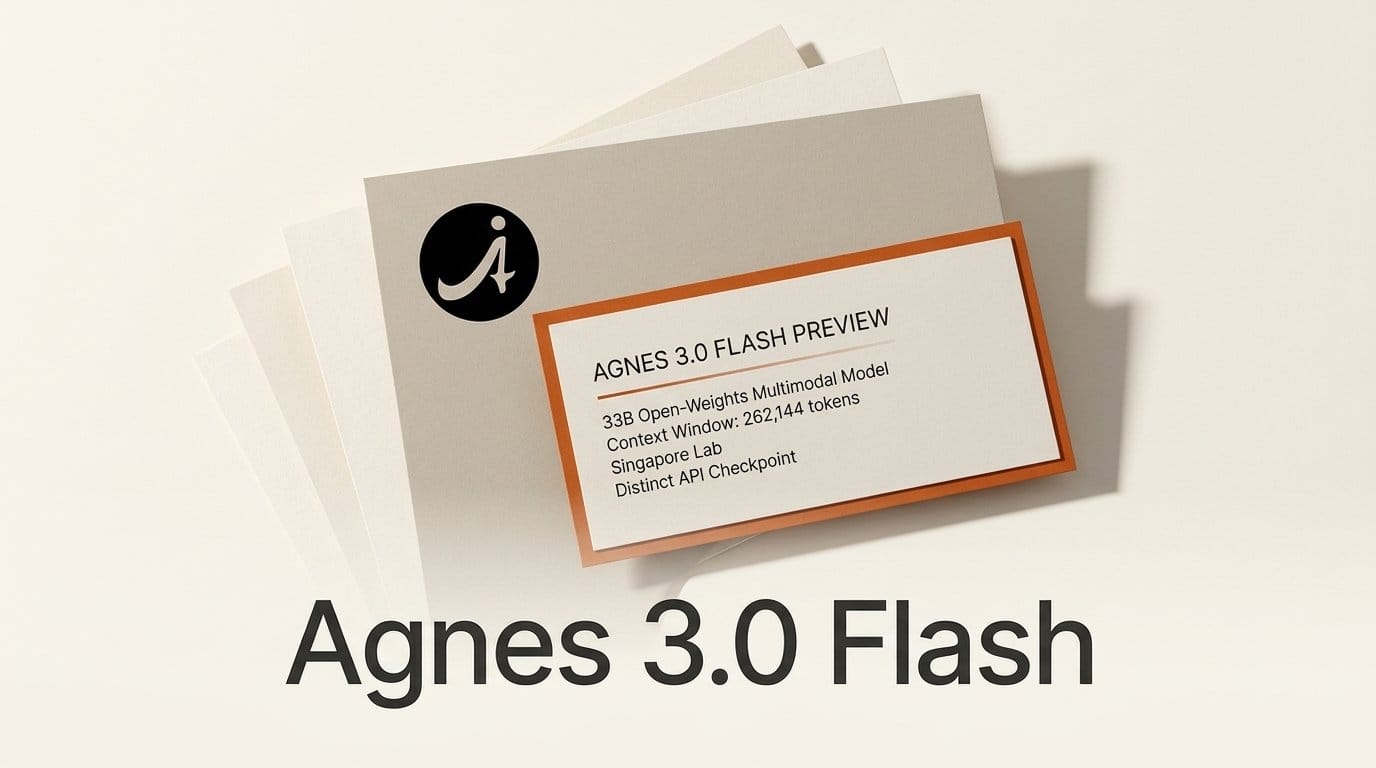
On 11 September 2026, the Singapore lab Agnes AI published an open-weights multimodal model called Agnes-3.0-Flash Preview to Hugging Face under an Apache 2.0 licence. It is a 33B-parameter hybrid-attention decoder with a 262,144-token context window that reads text, images and video, and it can run on a single workstation.
There is a catch, and the model card states it in the first section rather than hiding it. The weights you can download are not the Agnes 3.0 Flash that sits near the top of the Artificial Analysis listing. That is a separate production checkpoint, served only over the API, with a different configuration and different numbers. Anyone who downloads the Preview expecting the leaderboard model will get something meaningfully weaker, and the benchmark table below shows by how much.
What Agnes actually released
Agnes AI is a Singapore-headquartered lab whose models were trained at the National University of Singapore. According to Fintech News Singapore, it runs three model lines: Agnes-2.0-Flash for text, Agnes-Image-2.0-Flash for image editing, and Agnes-Video-V2.0 for video generation, with the image and video models both placing in Artificial Analysis top-10 groupings. HackerNoon reported it as the first Singapore lab to appear on that leaderboard at all.
That matters for context. This is not an anonymous weight dump. It is a lab with shipped image and video products releasing its first open text-and-vision checkpoint, which is why the Preview picked up community quantisations (GGUF, FP8 and NVFP4 repackings) within three days of landing.
The two checkpoints are not the same model
The distinction is documented, but it is scattered across three pages that do not agree with each other. Here is what each source actually says.
| Agnes-3.0-Flash Preview (open weights) | Agnes 3.0 Flash (production API) | |
|---|---|---|
| How you get it | Download from Hugging Face, Apache 2.0 | API only, no weights published |
| Parameters | 33B, disclosed | Not disclosed |
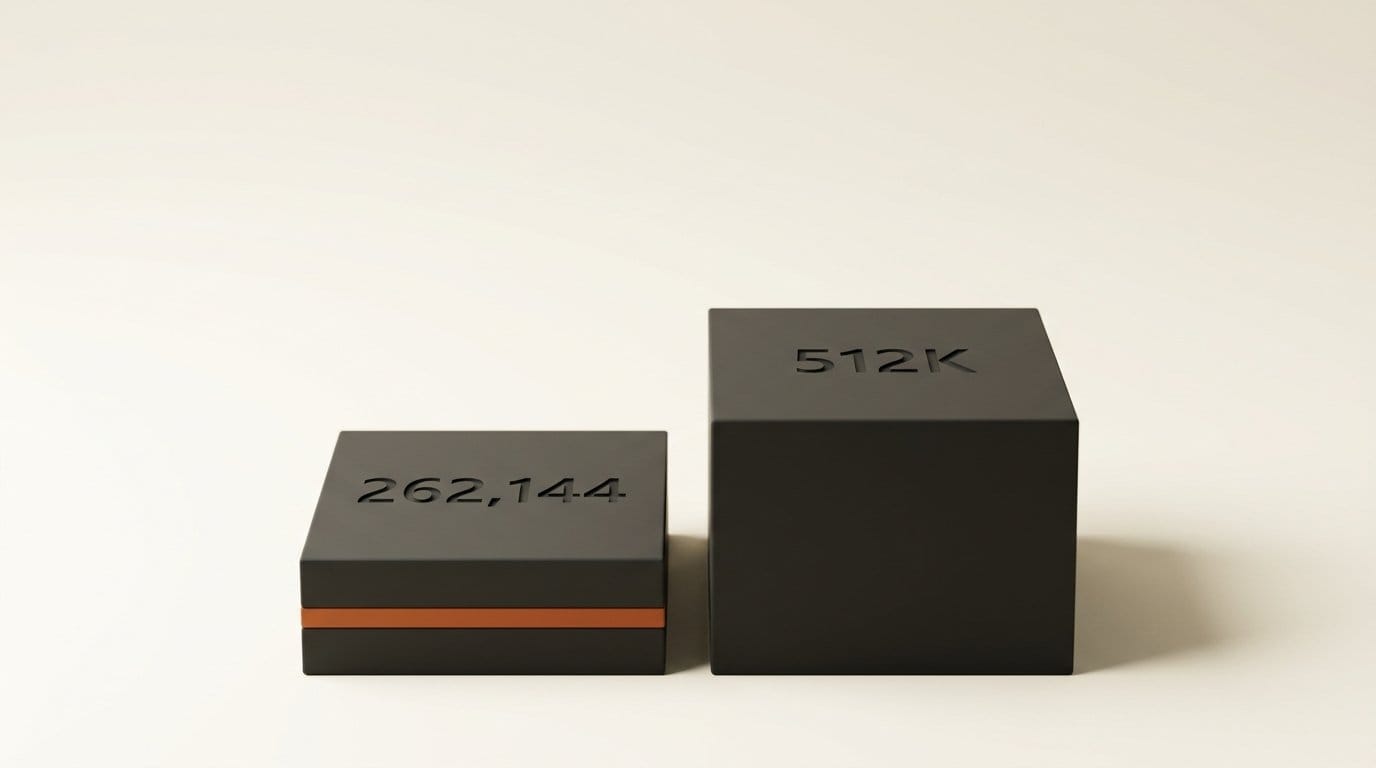
| Context window | 262,144 tokens (model card) | 512K tokens (Agnes docs), described as 1M on the model card |
| Inputs | Text, image, video | Text and image URL |
| Price | Your own hardware | $0.05 per 1M input, $0.15 per 1M output, all currently listed at $0 |
| Artificial Analysis score | Not listed | Intelligence Index 36 |
Note the context-window row. Agnes AI's own documentation page gives the production model 512K, while the Hugging Face model card describes that same production checkpoint as having "a 1M-token context window". Both are Agnes's own publications, and they disagree. Treat any context figure above 262,144 as unconfirmed until the vendor reconciles the two.
The pricing row is the genuinely interesting one for builders. The documented rates are $0.05 and $0.15 per million tokens, but the docs currently list all three line items, including cached input, at $0. A free multimodal endpoint is worth an afternoon of evaluation on its own, with the obvious caveat that promotional pricing is not a plan.
How the architecture fits 262K context on one box
The efficiency claim is not marketing. The Preview is a 72-layer decoder that alternates two attention types in a 3:1 pattern: 54 layers run a gated delta rule, which is recurrent and holds a per-layer state whose size does not grow with sequence length, and 18 layers run standard global attention. Only those 18 layers carry a KV cache that expands as context fills.
That is the whole trick. In a conventional 72-layer transformer, every layer's cache grows linearly with context, so a 262K-token prompt is what forces multi-GPU deployment. Cutting the growing caches to a quarter of the stack is what puts a long-context multimodal model inside a single workstation's memory budget.
The rest of the configuration is conventional enough to be easy to reason about: hidden size 5120, SwiGLU feed-forward at intermediate size 17408 plus a parallel 2048 branch, 24 query heads against 4 KV heads on the global layers, a 248,320-token vocabulary, and a 27-layer vision tower at patch 16 with 2x2 spatial merging projected into the text hidden size. Positions use 3-axis rotary encoding across text, height and width, which is what lets the same stack take video frames.
Where the Preview actually lands on benchmarks
These are the model card's own reference figures for the open checkpoint. Agnes attaches an unusually honest disclaimer to them, warning that the columns were "compiled from different sources, harnesses, and model snapshots" and do not constitute a controlled head-to-head evaluation. Read them as positioning, not as a bake-off.
| Benchmark | Agnes 3.0 Flash Preview (33B) | Qwen3.5 (27B) | Qwen3.8 (27B) | DeepSeek V4 Flash 0731 | Gemini 3.5 Flash |
|---|---|---|---|---|---|
| IFBench | 74.20 | 75.6 | 79.5 | 75.8 | 76.3 |
| SciCode | 38.08 | 39.5 | 46.6 | 50.3 | 53.1 |
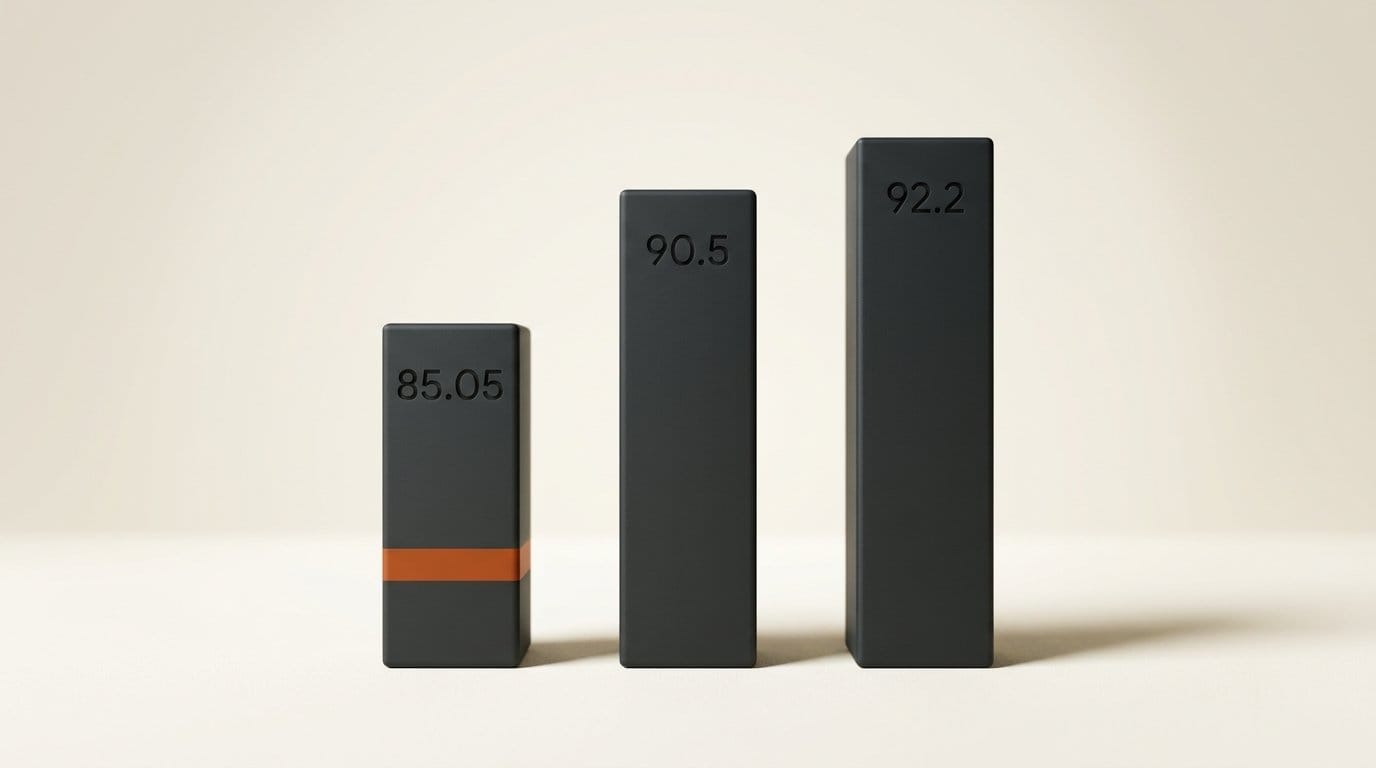
| GPQA Diamond | 85.05 | 85.8 | 90.5 | 90.8 | 92.2 |
| AA-LCR | 68.33 | 72.3 | 82.0 | 79.7 | 81.0 |
| AA-Omniscience | 23.00 | 20.7 | 18.4 | 40.4 | 51.4 |
The honest summary: the open Preview sits roughly level with the 27B class and below the frontier. It trails Qwen3.5-27B on four of five rows, though only narrowly on IFBench and GPQA Diamond, and it beats both Qwen checkpoints on AA-Omniscience. Against DeepSeek V4 Flash and Gemini's Flash tier it is clearly behind on reasoning-heavy rows, losing SciCode by 12 to 15 points.
Which is exactly why the checkpoint confusion is worth flagging. An Intelligence Index of 36 and a near-top class ranking describe the API model. The downloadable one is a competent 27B-class citizen, and that is a different purchasing decision.
How to run it today
The Preview ships its own model implementation, so it will not load without remote code enabled. The steps below come from the model card's quickstart.
- Install the dependencies. The card specifies
transformers>=5.12(tested on 5.12.1) along withtorch,torchvisionandaccelerate. The Transformers version floor is not optional, because the architecture is new. - Load with
trust_remote_code=True,dtype="bfloat16"anddevice_map="auto". Omitting the remote-code flag is the failure most people will hit first. - For images and video, use
AutoProcessorrather than the tokenizer, also with remote code. The bundled processor is what needstorchvision. - Pick a reasoning level. The chat template exposes
high(the default),mediumandlow, plus anenable_thinking=Falseswitch. Dropping tomediumis the cheapest quality-for-latency lever available. - To serve it, run the included
serve.shagainst a stock SGLang image. It overlays three files onto the image's sglang package and exposes an OpenAI-compatible endpoint on port 8080 inside the container.
One sharp edge for anyone wiring this into an agent. The model emits tool calls in its own <tool_call><function=...> text format, and the server returns that text verbatim by default. You get structured tool_calls objects back only after configuring sglang with a matching tool-call parser. Plan for that, or your agent loop will silently receive prose where it expected JSON.
What this means if you build with open models
The pattern here is becoming standard and deserves naming: a lab publishes an open checkpoint, keeps a stronger one behind the API, and lets a single product name cover both. It is the same shape as the tiering we saw when DeepSeek split its V4 line across open and served variants, and it will keep spreading because it is commercially sensible.
The practical defence is to benchmark the artefact you will actually deploy. If you are running weights locally, published leaderboard positions for the vendor's API model tell you almost nothing about what you will get. Agnes deserves credit for labelling the gap explicitly, including retitling the repository to carry the "Preview" suffix after an initial release without it. Plenty of vendors leave it implicit.
For a creative or agentic stack, the realistic role for this Preview is a local vision-capable workhorse: captioning, frame description, document and screenshot reading, and long-context summarisation where a 262K window matters more than the last five points of reasoning accuracy. For coding agents, the current open coding leaders remain a better bet on these numbers.
Frequently asked questions
Is Agnes-3.0-Flash Preview free for commercial use?
The repository carries an Apache 2.0 licence, which permits commercial use, modification and redistribution with attribution and retention of the licence text. That applies to the open Preview weights only, not to the API service, which has its own terms.
What hardware do I need to run the 33B Preview?
Agnes does not publish a minimum specification. At 33B parameters in bfloat16 the weights alone need roughly 66GB, so a single 80GB accelerator is the comfortable floor for the unquantised model. The community FP8, NVFP4 and GGUF conversions that appeared within days exist precisely to bring that down, and the hybrid-attention design means long prompts add far less cache pressure than a conventional 72-layer model would.
Why do the context-window figures disagree?
Because Agnes's own two sources disagree. The Hugging Face card gives the open checkpoint 262,144 tokens and describes the production model as 1M, while the Agnes documentation page lists the production model at 512K. The 262,144 figure for the downloadable weights is the one stated in the architecture table and is the only number tied to a checkpoint you can inspect.
Can it generate images or video?
No. The Preview is image-text-to-text: it accepts text, images and video as input and returns text. Image generation and video generation are separate Agnes product lines (Agnes-Image-2.0-Flash and Agnes-Video-V2.0), and neither is part of this release.
Does the API really cost nothing?
The documentation lists rates of $0.05 per 1M input tokens and $0.15 per 1M output tokens, then notes that all three line items, including cached input, are currently $0. That reads as introductory pricing rather than a permanent tier, so treat free access as a window for evaluation and assume the listed rates when you model production costs.
How does it compare to the Artificial Analysis Intelligence Index score of 36?
That score belongs to the production API checkpoint, not to the downloadable Preview, which Artificial Analysis does not currently list separately. The model card is explicit that the Preview's benchmark results "should not be attributed" to the API model, and the reverse holds too.