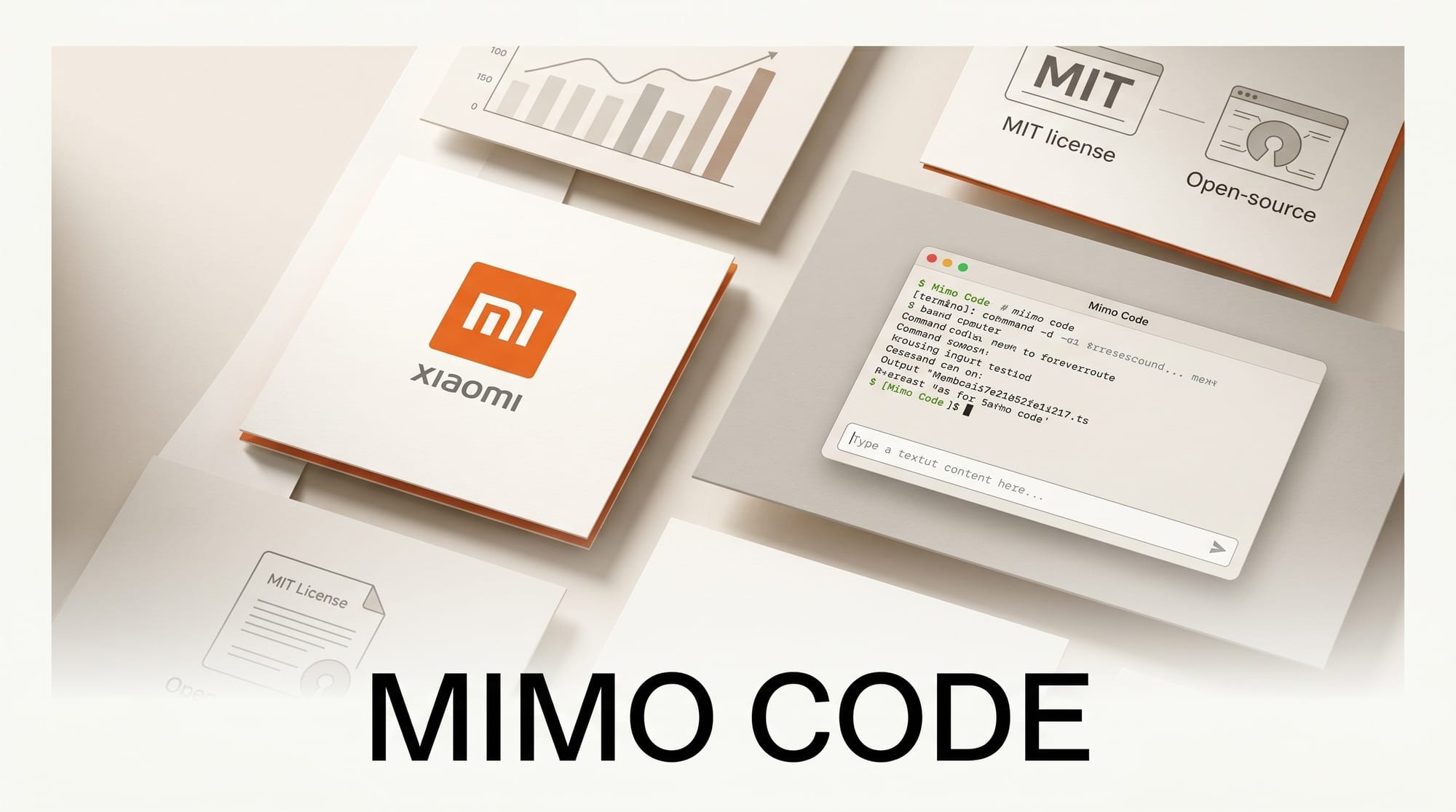
Xiaomi has open-sourced MiMo Code, a free terminal-based AI coding agent that directly targets Anthropic's Claude Code. Released under the permissive MIT license, it ships with persistent memory across sessions and runs on Xiaomi's own MiMo-V2.5-Pro model out of the box, while also supporting third-party models like Claude Sonnet 4.6. For developers, it is a no-cost, fully open alternative to the closed coding agents that have dominated the terminal so far.
What Happened
Xiaomi's MiMo team published MiMo Code on June 10, 2026, as a command-line coding agent built as a secondary development on the open-source OpenCode project. The official MiMo Code announcement frames the release around long-horizon tasks: work that spans dozens or hundreds of steps, where most single-session agents lose track of what they were doing. The whole stack, agent and model, is open and free to modify, distribute, and use commercially.
Why It Matters
Most capable terminal coding agents are closed and metered per token. An MIT-licensed agent that bundles a strong free model lowers the barrier for solo developers, students, and small teams who cannot justify a monthly coding-assistant bill. As AIBase noted, MiMo Code also plugs into other large models such as DeepSeek and Kimi, so teams can swap in whichever backend fits their budget or privacy needs rather than being locked to one vendor.
Key Details
The agent leans on three design pillars: parallel sampling with verification, layered memory that persists state across sessions through checkpoints, and cross-session project memory that learns beyond a single task. According to Xiaomi's published benchmarks reported alongside the launch, MiMo Code scores 62% on SWE-Bench Pro and 73% on Terminal Bench 2, edging out Claude Code on both. Source and install instructions live on the MiMo Code GitHub repo. Treat the benchmark gap as vendor-reported until independent tests confirm it.
What to Do Next
On macOS or Linux, install it with a single command, curl -fsSL https://mimo.xiaomi.com/install | bash, then launch the agent by typing mimo in your terminal; Windows users can install the CLI via npm. Point it at a real repository and give it a multi-step task to see whether the persistent memory holds up across a longer session. If you already follow Xiaomi's model work, this builds on the same family behind its 99% MiMo-v2.5 API price cut and its 1,000-tokens-per-second open model.