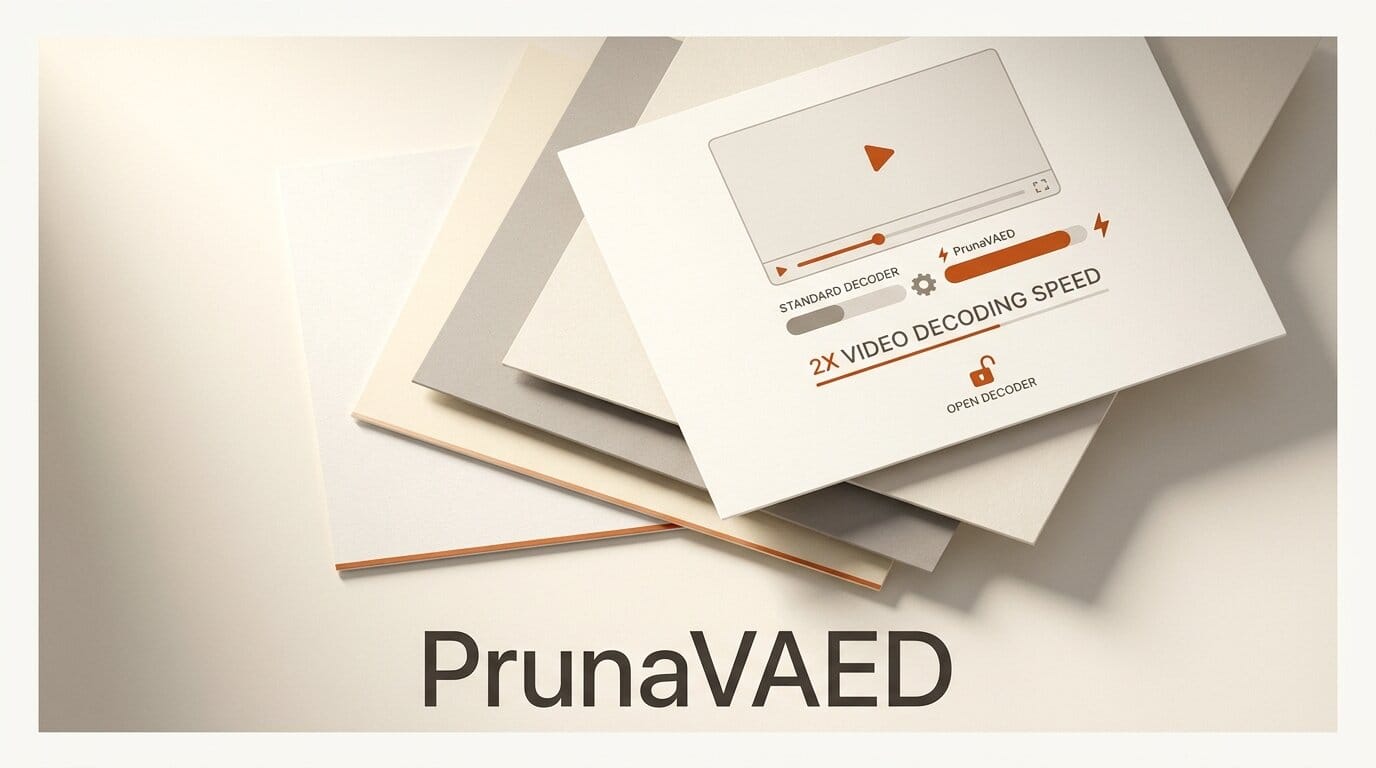
PrunaVAED, a new open-weight video decoder from Pruna AI, is a drop-in replacement for the VAE decoder in LTX-2.3 that turns finished latents into video up to 2.08x faster while cutting peak VRAM roughly in half. It slots into existing Diffusers pipelines with no retraining and no change to your prompts.
How to Use It
If you already generate video with LTX-2.3 in the Diffusers library, PrunaVAED is a direct swap for the decode stage. Load it in place of the stock VAE decoder and run the same distilled or two-stage pipeline you use now. The model is bitwise identical to the LTX-2.3 VAE from the input convolution through the first upsampling block and only prunes channels in the later upsampling layers, so the visual output stays close to the original while the decode step runs faster and fits in less memory. Pruna ships an end-to-end example that generates a short clip and decodes the latents with both the stock decoder and PrunaVAED, so you can measure the difference on your own hardware before committing.
Why It Matters for Creators
Decoding is the step where a finished latent becomes actual pixels, and on longer or higher-resolution clips it is a real share of the total wait. Cutting that time by up to half means faster iteration: more takes per hour when you are dialing in motion, timing, or a prompt. The roughly 50% drop in peak VRAM matters even more for anyone running LTX-2.3 locally on a single consumer GPU, where memory, not raw speed, is often the wall that stops a render from finishing at all.
It fits a broader push to squeeze open video and image models onto modest hardware, the same goal behind 4-bit diffusion in Diffusers. Optimization layers like these are what make open models practical outside a data center.
Key Details
Speedup: 1.68x on a 5-second 720p clip (841ms to 500ms), rising to 2.08x on a 10-second 1080p clip (4.9s to 2.36s), per Pruna's published benchmarks.
Memory: Roughly 50% lower peak VRAM during the decode step.
How it works: About 15% fewer decoder parameters through selective channel pruning in the upsampling blocks, identical to the stock VAE through the early layers.
Availability: Open weights under the LTX-2 Community License, usable through Diffusers or the LTX.io framework alongside the base LTX-2.3 Diffusers checkpoint.
What to Do Next
Download the weights from the PrunaVAED model card and run Pruna's decode-comparison script against your usual LTX-2.3 resolution and clip length to see the real gain on your GPU. If the numbers hold, it is a low-risk swap: same prompts, same pipeline, faster output.