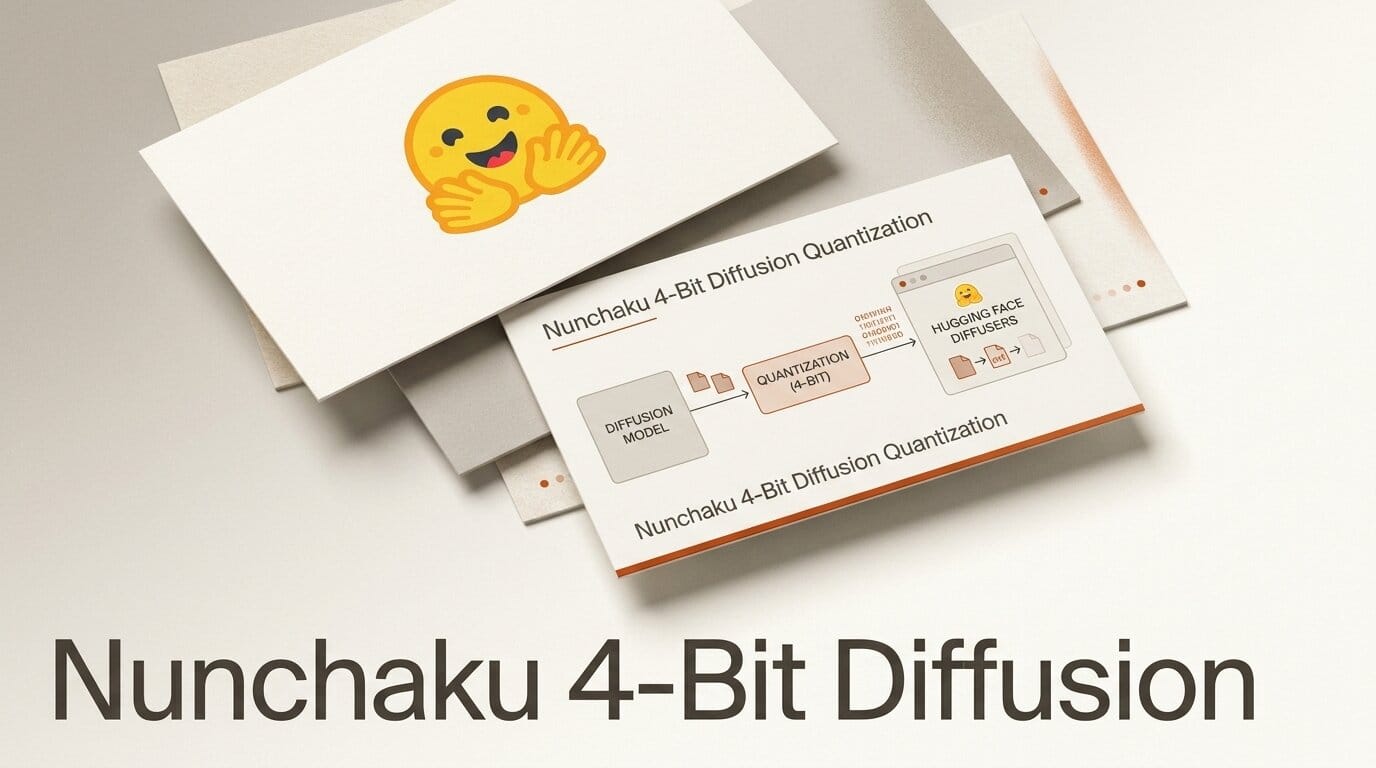
Hugging Face has added native Nunchaku 4-bit quantization to the Diffusers library, cutting the VRAM cost of running high-quality image models by up to half. Announced on July 23, 2026, the integration lets you load pre-quantized diffusion checkpoints with a standard from_pretrained() call, no custom pipeline or local compilation required.
Try It: Generate on a Consumer GPU
The practical win is memory headroom. Nunchaku's SVDQuant method compresses model weights to 4 bits while keeping quality close to full precision, delivering up to 50 percent lower peak VRAM and roughly a 30 percent speedup from quantization alone, rising to 1.8x when combined with torch.compile. In Hugging Face's example, ERNIE-Image-Turbo renders a 1024x1024 image in about 1.7 seconds using around 12 GB of VRAM, versus roughly 24 GB for the BF16 version. That moves flagship image generation from a rented A100 onto a card you may already own.
Why It Matters for Creators
VRAM is the wall most creators hit when they try to run image models locally. A model that needs 24 GB locks out every consumer GPU below the top tier; the same model at 12 GB opens up to mainstream cards. Because the quantized checkpoints load through the normal Diffusers API, this is not a fork or a fragile custom build, it is the same code you already write with one different model ID. That lowers the barrier to keeping generation local, private, and free of per-image API fees.
Key Details
Method: SVDQuant moves activation outliers into weights and represents the hardest matrix portions as a 16-bit low-rank branch, then quantizes the rest to 4 bits. It builds on the original Nunchaku engine.
Hardware: NVFP4 checkpoints require Blackwell GPUs (RTX 50 series, RTX PRO 6000, B200); INT4 runs on older Turing, Ampere, and Ada cards.
Models: Ready-to-use checkpoints include ERNIE-Image-Turbo and Krea 2 Turbo, with more in the lite-infer collection. You can quantize your own models using the diffuse-compressor toolkit.
What to Do Next
Read the Diffusers Nunchaku documentation for the exact install and loading steps, then pull an INT4 checkpoint that matches your GPU generation and swap it into an existing Diffusers script. For local runners already optimizing on quantization, this pairs naturally with workflows like Unsloth's NVFP4 local models.