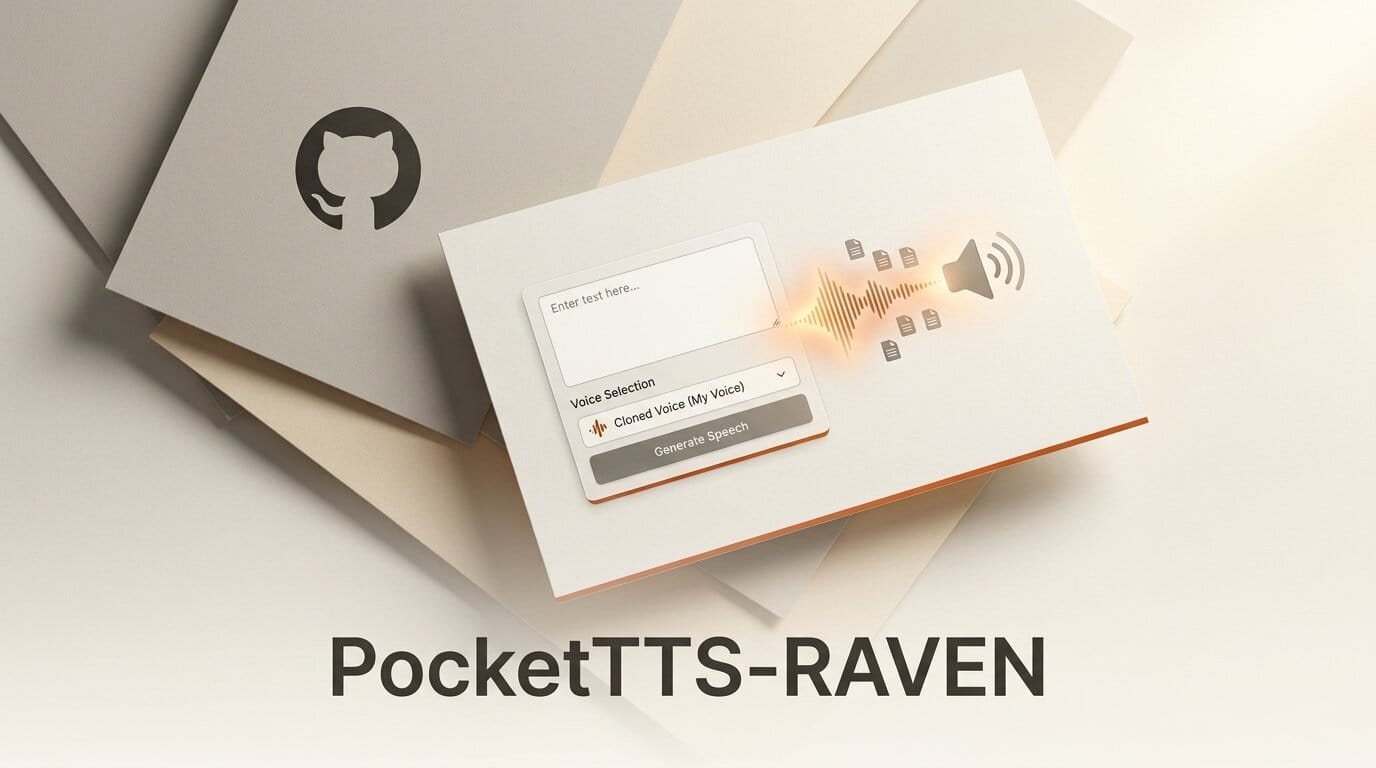
A new open-source project called PocketTTS-RAVEN runs text-to-speech and voice cloning entirely inside a browser tab. There is no server call, no GPU, and no account. You load a page, clone a voice from a short clip, type text, and hear speech generated on your own device at faster-than-realtime speed.
What Happened
Developer Panagiotis Kalogiros released PocketTTS-RAVEN on July 7, 2026, as a WebAssembly build of Kyutai's Pocket TTS model, optimized with ONNX Runtime. The GitHub repository ships the browser app, an OpenAI-compatible speech server, and C bindings under an MIT license. The initial browser transfer is roughly 65 to 67 MB, with voice cloning pulling an extra 14 MB compressed on first use.
Why It Matters
Most local text-to-speech tools assume a Python environment, a ComfyUI graph, or a discrete GPU. PocketTTS-RAVEN removes all of that. Because it builds on Kyutai's open speech research and keeps every step on-device, cloned voices and source audio never leave your machine. For creators making voiceovers, drafts, or accessibility audio, that means a private, install-free workflow that works on a laptop or a phone.
Key Details
Voice cloning needs 6 to 15 seconds of clean speech. A Mimi encoder computes the voice embedding once, caches it locally, then reuses it in milliseconds. Reported speeds reach about 14x realtime in a desktop browser (roughly 70 ms first-audio latency), 3 to 4x realtime on an iPhone, and up to 33x realtime in the native M4 Max build. The author documents the graph rewrites and caching tricks behind those numbers in the optimization notes. Generated clips can be cleaned up through a round-trip into the AudioMass web editor. Note that the upstream Pocket TTS model carries prohibited-use terms against impersonation, fraud, and deception.
What to Do Next
Open the project page, record or upload a 15-second voice sample, and generate a test line to judge the clone quality for your own voice. If you route audio through apps, the built-in /v1/audio/speech endpoint is OpenAI-compatible, so you can point existing code at a local server with no cloud key. For a broader look at where browser and on-device speech is heading, compare it with on-device TTS across 31 languages and open-weight voice cloning models.