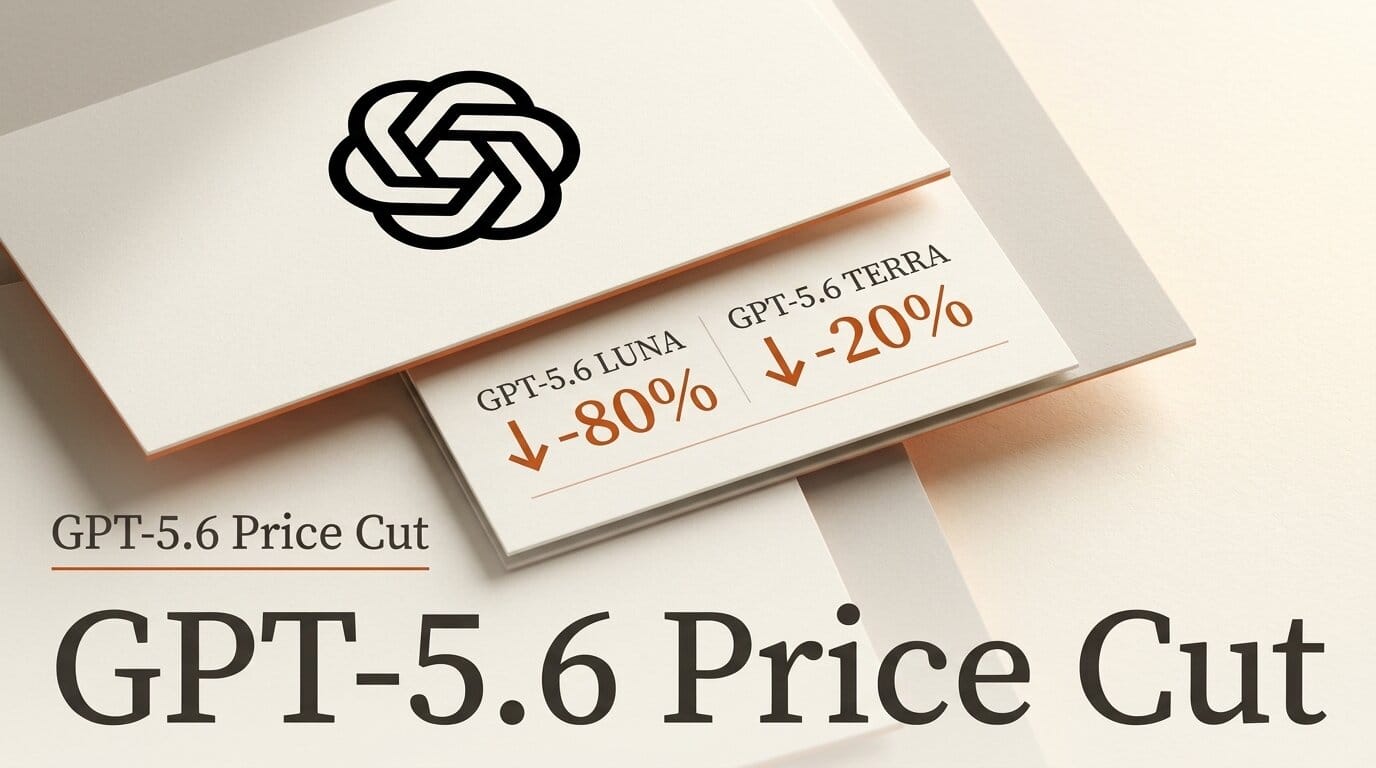
OpenAI cut API prices on its two cheaper GPT-5.6 tiers on July 30, 2026, dropping the mid-size Luna model by 80% and the larger Terra model by 20% while leaving its top Sol tier unchanged. The move, which OpenAI framed as advancing the price-performance frontier, pushes the cost of running its GPT-5.6 model tiers down to levels that make high-volume automation and agent workflows meaningfully cheaper overnight.
What Happened
Effective immediately, GPT-5.6 Luna now costs $0.20 per million input tokens and $1.20 per million output tokens, down from $1 and $6. That is roughly an 80% reduction on both sides of the meter. Terra, the step-up reasoning model, fell to $2 per million input and $12 per million output from $2.50 and $15, a 20% cut. As Unite.AI reported, the reductions apply only to the two lower tiers, while Sol, the most capable model in the family, keeps its existing pricing.
OpenAI also said it is expanding how much GPT-5.6 usage it allows inside ChatGPT itself, so the cheaper economics reach paid chat subscribers and not just API developers, according to 9to5Mac.
Try It: Reprice Your Pipeline
If you run a batch job, an agent loop, or a content pipeline on GPT-5.6, swap the model string to the Luna tier and rerun your cost estimate. A workload that processed a million input and output tokens for $7 on Luna now runs for about $1.40, reflecting the up to 80% cut on the cheaper tiers. For tasks like bulk tagging, transcript cleanup, first-draft copy, or classification inside a larger creative workflow, Luna at $0.20 in and $1.20 out is now priced to sit in the hot path where you previously would have reached for a budget model. Reserve Terra for the reasoning-heavy steps and keep Sol for the few calls that genuinely need the top tier.
Why It Matters for Creators
Token cost is the quiet tax on every AI product a builder ships. When the per-call price drops 80%, workflows that were too expensive to run at scale, such as generating variations for every asset or running an agent that iterates dozens of times, suddenly pencil out. OpenAI made the cut as companies grow more sensitive to AI costs, and the pressure is competitive: cheaper open-weight models and rival APIs have been undercutting frontier labs on price all year. For anyone building on top of these models, a price war among providers is the best possible news.
Key Details
Luna: now $0.20 per million input tokens and $1.20 output, down from $1 and $6 (about 80% off).
Terra: now $2 per million input and $12 output, down from $2.50 and $15 (20% off).
Sol: unchanged, remains the flagship tier.
Effective: July 30, 2026, live in the API now, with expanded GPT-5.6 usage rolling into ChatGPT.
What to Do Next
Audit which GPT-5.6 tier each part of your stack actually needs, then route the high-volume, low-complexity calls to Luna and measure the new bill. If you have been running a competing model for cost reasons, this is a good week to rerun your benchmark and see whether Luna now wins on both price and quality for your specific task.