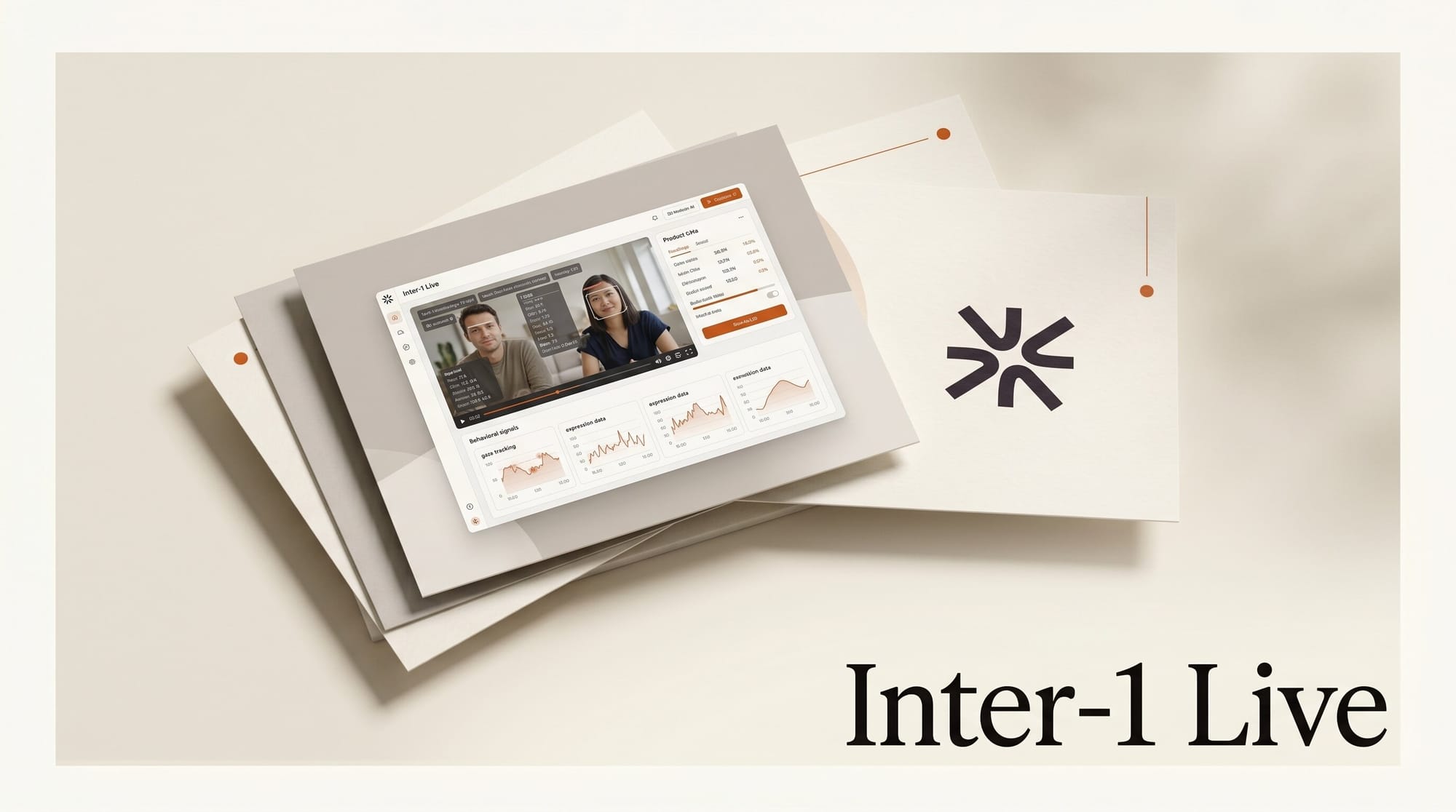
Interhuman AI launched a streaming API for Inter-1 on May 20, 2026, extending the model's behavioral analysis capabilities from uploaded video files to live video streams over WebSocket. Inter-1 now processes live video in real time, detecting 12 behavioral signals including engagement levels, hesitation, agreement, and rapport. Full announcement and API reference: interhuman.ai/blog/inter-1-streaming.
What Changed
When Inter-1 launched in April 2026, it operated on uploaded video files. Users sent a clip and received a behavioral analysis with detected signals, confidence scores, and rationales. The streaming API removes that constraint.
The new Stream API uses a WebSocket connection to process video in sliding 8-second windows that advance every 3 seconds. The server emits typed events in real time: signal.detected (with signal type, probability, and behavioral rationale), signal.ended, engagement.updated, and conversation_quality.updated. The model analyzes voice, face, and body language together, not transcripts alone.
Interhuman AI reports a sub-1.0 processing ratio, meaning analysis completes faster than the video duration. During congestion, the system sheds redundant windows transparently rather than queuing indefinitely.
How the API Works
Developers connect via WebSocket, push video chunks of any size, and receive behavioral events as the session progresses. The full event reference is at the Signals API documentation. Access requires an API key from platform.interhuman.ai. Billing applies only to analyzed and delivered video seconds, not to buffered or shed windows.
The conversation quality index runs across five dimensions continuously: clarity, authority, energy, rapport, and learning. Each dimension produces a periodic score update that applications can use to surface live coaching prompts or log session quality for post-session review.
What Creators and Developers Can Build
The real-time behavioral layer enables use cases that upload-based analysis cannot support. A few examples directly relevant to content creators:
- Live stream engagement detection: Monitor audience engagement signals during a live broadcast and trigger dynamic changes (pacing, topic shifts, format changes) based on detected hesitation or disengagement patterns
- Interview and podcast coaching: Surface live cues to interviewers when a guest shows stress, uncertainty, or increasing engagement, informing follow-up questions in real time
- Video coaching tools: Build tools that give on-camera presenters immediate feedback on energy, clarity, and rapport during rehearsal sessions before recording
The underlying model architecture connects to a broader line of research in streaming social task detection. The StreamSense approach, documented in an arXiv paper from early 2026, describes the coupling of lightweight streaming encoders with selective expert routing to make live multimodal analysis practical. Inter-1 operates in this space as a commercial API rather than a research system.
What to Do Next
Inter-1 streaming is available now via API key at platform.interhuman.ai. The stream API is distinct from the standard REST endpoint, which remains available for upload-based analysis. If you are building tools that respond to live human communication rather than recorded footage, this is the first broadly available behavioral analysis API with WebSocket support.
Start with the API documentation, connect the WebSocket in test mode with a short clip, and review the event structure before building the full application flow.