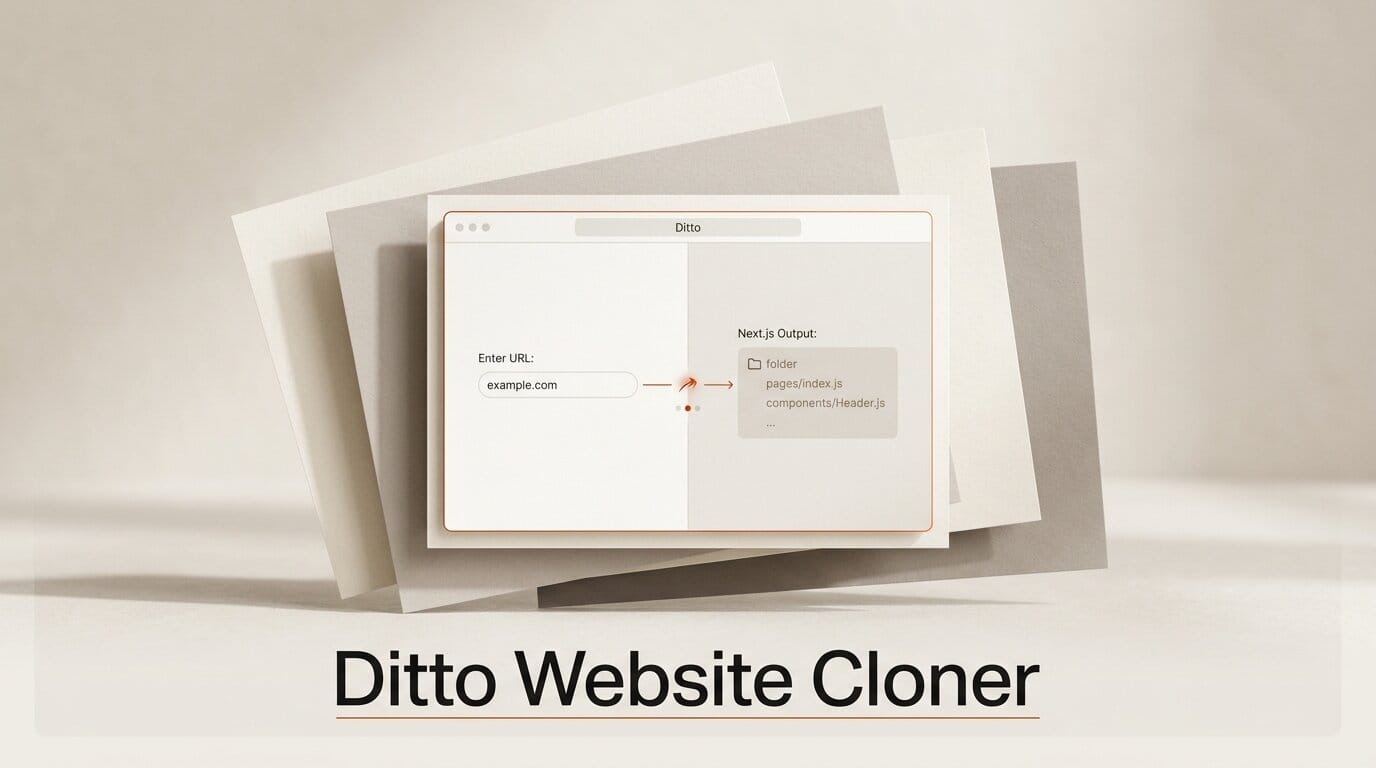
Ditto is a free, open-source tool that clones any public website into clean, componentized front-end code in about five minutes. Point it at a URL and it returns a self-contained TypeScript project, with no manual scraping or hand-rebuilding required. Unlike most "AI" cloners, Ditto is fully deterministic: it captures what the browser actually rendered rather than pointing a language model at the page and hoping for the best.
Try It: Rebuild a Reference Site in Minutes
Install the open-source project from the ion-design/ditto.site repository, or use the hosted API with a key. Feed it the URL of a landing page you want to study or fork, and Ditto emits a Next.js App Router project by default (or Vite React on request) with extracted design tokens, web fonts, and responsive layouts. From there you own the code: restyle it, swap the copy, and ship it as your own starting point instead of rebuilding a layout from scratch.
Why It Matters for Creators
For anyone who builds websites, the slowest part of starting a new project is often recreating a layout you already have in front of you. Ditto turns that into a one-command step and returns editable components, not a flattened screenshot. Because it ships a Model Context Protocol server, an AI coding agent can call Ditto directly to pull a reference design into a build, similar to how Figma Make pushes generated designs to GitHub. The deterministic approach also means the output is byte-stable and reproducible, which matters when you need the clone to match the source exactly.
Key Details
Output: Componentized Next.js App Router projects by default, or Vite React on request, written in TypeScript.
Styling: Tailwind v4 or plain CSS, with design tokens, fonts, and responsive breakpoints preserved.
License and price: MIT-licensed, fully open source, and free to use or self-host.
Access: Hosted API, self-hosted deployment, or an MCP server for AI agents.
What to Do Next
Clone a site you admire and read the generated components to learn how its layout is built, then use it as scaffolding for your own project. Keep in mind that cloning a live site is a starting point for your own work, not a license to republish someone else's brand or content. Start with a simple landing page to see how faithfully the output matches the original before pointing it at anything more complex.