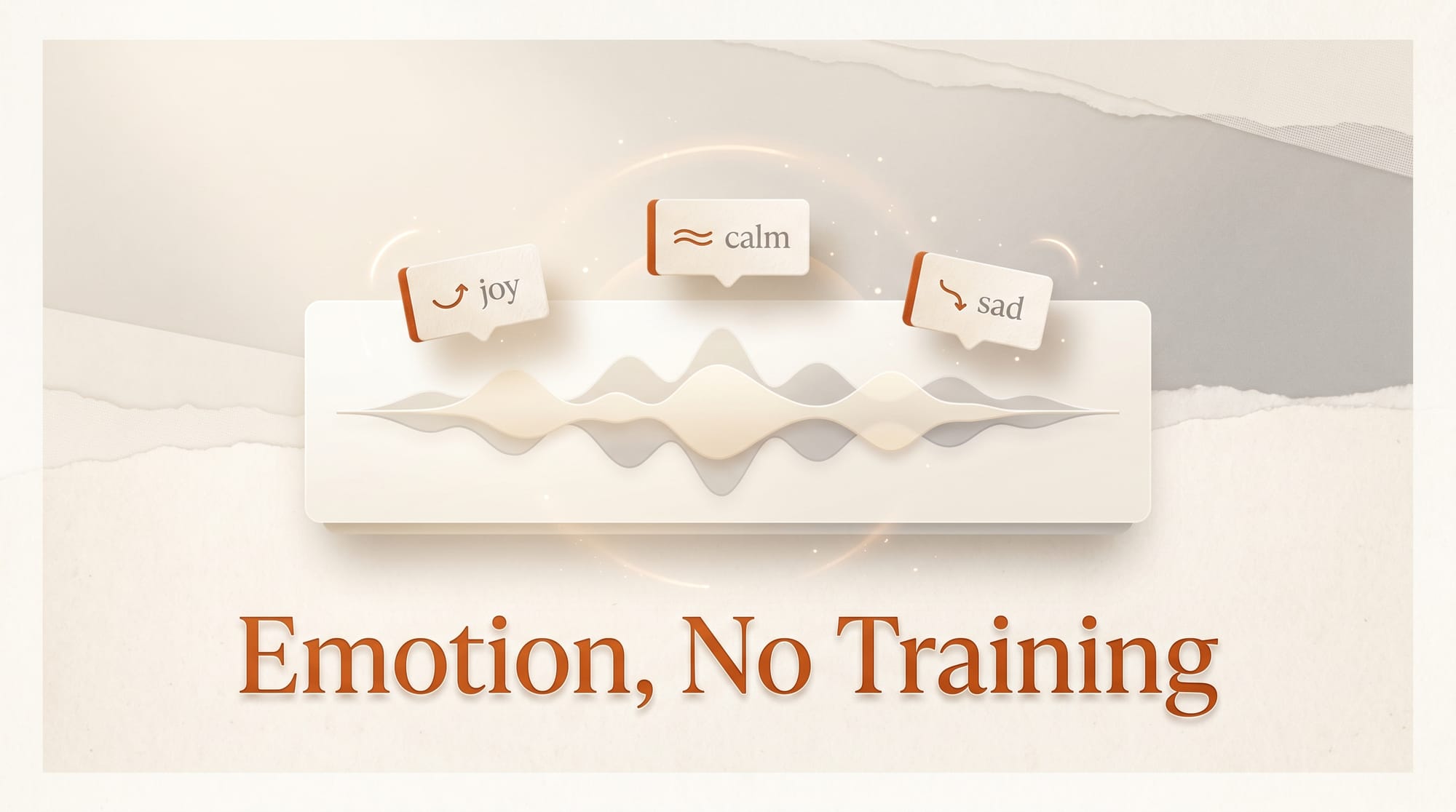
Researchers published Darwin-TTS on April 15, 2026, a text-to-speech model that adds emotional expression to AI voice without any training, fine-tuning, or new data. The method blends just 3% of a general-purpose LLM into an existing TTS model, and the result is speech that carries natural emotion, costing about $5 in electricity and taking under 10 seconds to apply.
For the broader landscape, see our complete producer guide to AI music and audio in 2026.
What Happened
The VIDRAFT_LAB team discovered that Qwen3-1.7B (a general-purpose language model) and Qwen3-TTS-1.7B share perfectly identical architecture across every relevant dimension, hidden size, layer count, attention heads. That exact match made it possible to merge their weights directly using linear interpolation with no dimension remapping.
At a 3% blend ratio (lerp alpha=0.03), emotional qualities from the LLM transfer into the TTS model through 84 FFN tensors. The merge runs on CPU in under 10 seconds. The result, Darwin-TTS-1.7B-Cross, is available on Hugging Face under Apache 2.0, with a live demo space where you can test it immediately. The training code is also open source.
The sweet spot is narrow. At 5% the emotion intensifies; at 10% and above the model collapses, producing garbled output or 655-second audio files. The 3-5% range is empirically found, not theoretically derived, and the method has only been confirmed to work within the Qwen3 model family so far.
Why It Matters
Emotional expressiveness has been one of the hardest problems in AI voice. Most open-source TTS models sound competent but flat, they handle words accurately but miss the tonal variation that makes narration, dialogue, or character voices feel alive. The standard solution has been to fine-tune on emotional speech datasets or use commercial APIs like VoxCPM2 that have been explicitly trained for this.
Darwin-TTS short-circuits that approach entirely. If you already have a capable TTS base model and a compatible LLM, you can transfer emotional capacity in seconds without any labeled data, GPU training time, or model access agreements. For creators running local voice pipelines, this is a meaningful capability unlock at essentially no cost.
The limitation is real: this has only been confirmed to work with Qwen3 family models where architectures happen to be identical. It will not generalize until someone finds another matching pair. But the principle, that emotional speech can emerge from cross-modal weight transfer without training, is new, and the community will likely test it against other architectures quickly.
Key Details
- Method: Linear interpolation of FFN weights between Qwen3-1.7B and Qwen3-TTS-1.7B
- Blend ratio: 3% (alpha=0.03), sweet spot for emotion without collapse
- Merge time: Under 10 seconds on CPU
- Cost: Approximately $5 in electricity
- Training required: None
- License: Apache 2.0
- Model: huggingface.co/FINAL-Bench/Darwin-TTS-1.7B-Cross
- Demo: Live Hugging Face Space
- Limitation: Currently confirmed only with Qwen3 model family
What to Do Next
If you run a local voice pipeline using the Qwen3 TTS model, test this merge immediately. The Hugging Face demo space requires no setup, you can run a sample in minutes to evaluate whether the emotional quality matches your use case before deciding to merge your local model. The emotional enhancement is described as subtle at 3%, so evaluate it in the context of your specific content type: narration, dialogue, and character voice will each respond differently.
For creators exploring open-source audio tools, this pairs well with other recent TTS advances. The technique extends the Darwin Evolutionary Merge Framework, which has been used for LLM merging, this is its first application to speech. Watch for community experiments testing other model family pairs in the coming weeks. If similar architecture matches exist for other TTS and LLM pairs, the approach could become a standard method for adding expressiveness without training.