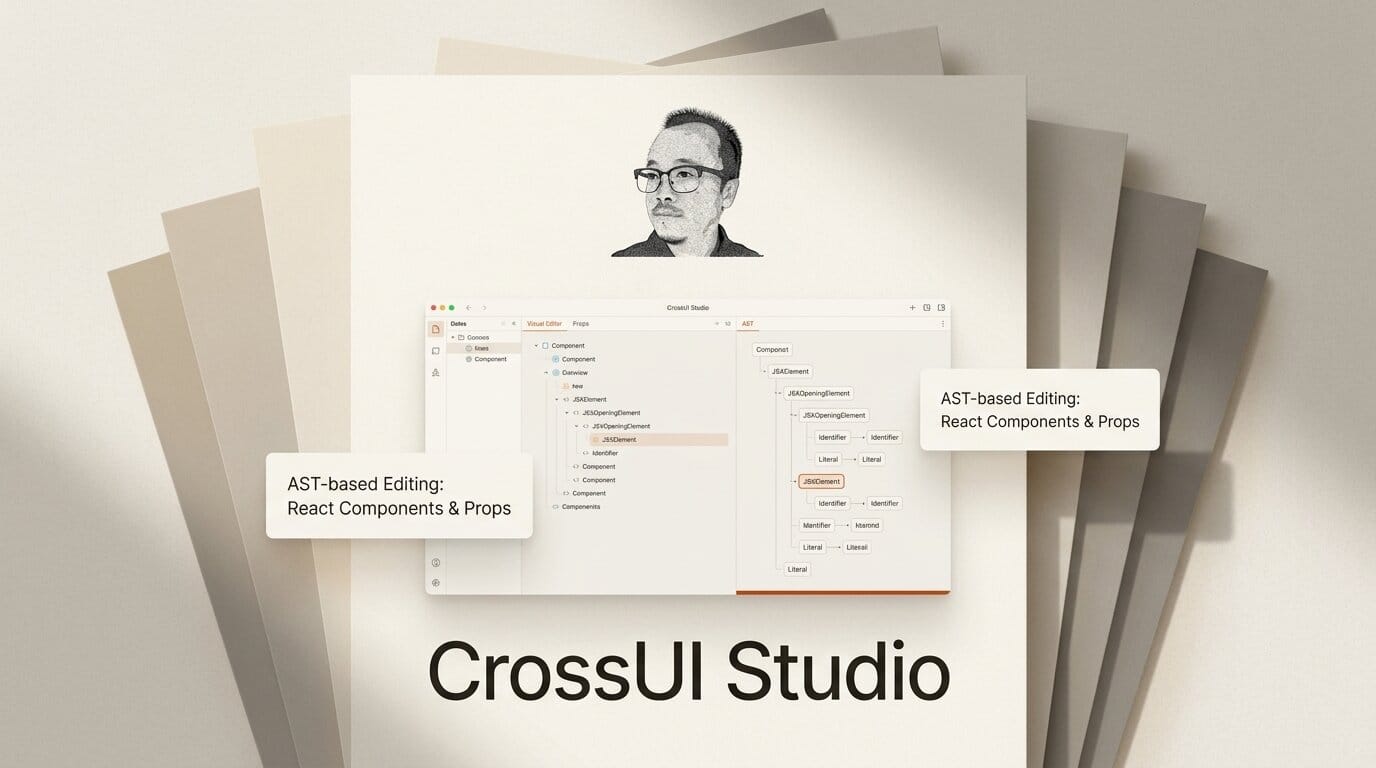
A new visual editor for React called CrossUI Studio launched on Hacker News on July 1, 2026, with a claim that separates it from the crowded design-to-code field: every change you make on its canvas is written back to your source file as a precise Abstract Syntax Tree (AST) patch, one property at a time, with no export step and no lock-in. For developers who abandoned earlier visual tools because they mangled hand-written code, that promise is the whole story.
What Happened
CrossUI Studio surfaced as a Show HN post describing itself as "a visual IDE for React that edits your real AST." Instead of generating fresh code you paste into a project, it opens your existing repository, renders your live React and Material UI components on a canvas, and treats that canvas as a peer editor of your source of truth. The team behind it has been publishing engineering notes for months, including a detailed piece on why they rejected the export-and-fork model that most tools rely on.
Why It Matters
The company frames the category around a simple check it calls the git diff test: open a real component, change a button from variant="text" to variant="contained", then run git diff. Most visual editors fail it, either by re-emitting the entire file (stripping comments, reshuffling imports, normalizing formatting) or by refusing to touch existing files at all. CrossUI's model, which it names Symmetric Collaborative Development, aims for a diff so clean it survives code review. For anyone maintaining a production codebase, that is the difference between a toy and a tool you can actually merge.
Key Details
CrossUI positions itself against three existing approaches. Export-and-fork generators like Lovable hand you code and then walk away, which works for greenfield components but not for editing what you already have. SDK-ownership platforms like Plasmic store components in a proprietary model and become a runtime dependency. CrossUI instead keeps your React source as the single source of truth and writes atomic AST patches back to disk, so stopping use of the tool tomorrow breaks nothing. The team has also documented adjacent tooling, such as visualizing React imports without a build to debug deep import failures.
What to Do Next
If you work in a React and MUI codebase and want a visual layer that respects your diffs, open CrossUI Studio against a throwaway branch and run the git diff test yourself before trusting it on real work. Change a single prop, inspect the patch, and confirm your comments and formatting survive. Visual-to-code editing keeps maturing across the ecosystem, from design canvases to repo-aware assistants like Figma Make connecting to production codebases. The tools that win will be the ones that leave your source cleaner than they found it.