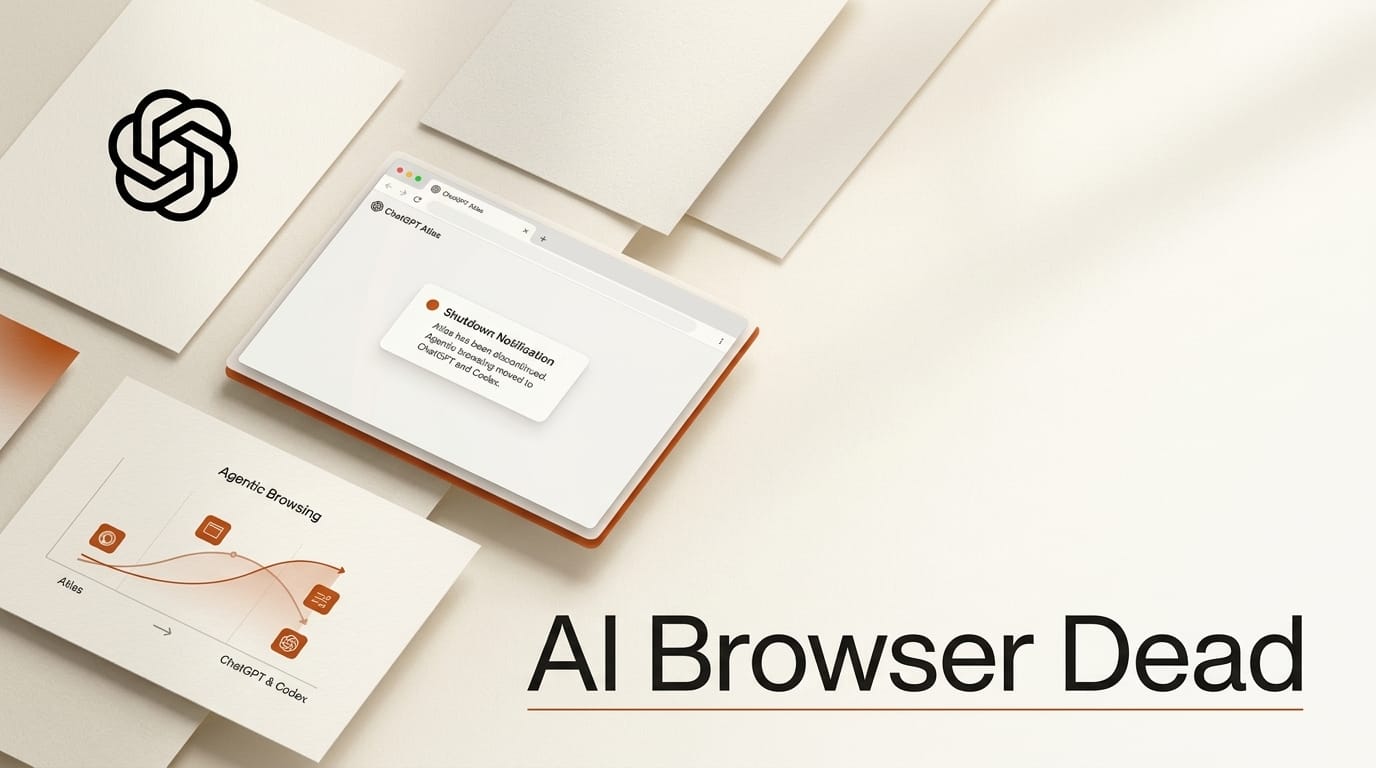
On August 9, 2026, OpenAI shut down ChatGPT Atlas, its standalone AI browser, less than a year after launch. The company is not asking anyone to switch browsers. Instead it is folding agentic browsing into the ChatGPT desktop app, a new Chrome extension, and Codex. That decision is bigger than one product retirement. It is the clearest signal yet that the standalone AI browser, the category Perplexity, The Browser Company, and others bet on, has hit an adoption wall.
Background
Atlas was OpenAI's bet on a dedicated AI browser: a Chromium-based app with an agent that could click, fill forms, and pull research on your behalf. It launched in October 2025 on macOS only. Eight months later there was still no Windows, iOS, or Android build, and OpenAI concluded it is more effective to embed agentic browsing into the products people already use than to convince them to adopt a whole new default browser. The wind-down was first signaled weeks ago, but August 9 was the hard cutoff after which the app stops opening, browsing, and receiving security updates.

Deep Analysis
The Atlas shutdown is worth reading closely because the reasons OpenAI gave apply to every company chasing the same category. Three forces are pushing agentic browsing out of standalone apps and into extensions and existing surfaces.
The default-browser moat is real
Getting someone to change their default browser is one of the hardest asks in consumer software. Chrome, Safari, and Edge come preinstalled, hold years of saved passwords and history, and sit one tap away on every device. A new AI browser has to be dramatically better to overcome that inertia, and an agent that occasionally clicks the wrong button is not dramatically better. OpenAI concluded, per its own transition guidance, that shipping the same agentic features as a Chrome extension meets users where they already are rather than fighting that moat head-on.
Platform reach beat product ambition
Atlas never left macOS. For a tool meant to become a daily driver, shipping on one desktop operating system and no mobile at all is close to disqualifying, because agentic browsing is most valuable exactly when you are away from your main workstation. A Chrome extension and a desktop app inherit Chrome's and the operating system's reach instantly. This is the pattern that observers flagged as a steep adoption wall: once an incumbent surface can host the same capability, the standalone app's only remaining advantage is a cleaner integration, which rarely justifies a full browser migration.
The agent is a feature, not a destination
The deeper lesson is architectural. The value of agentic browsing is the agent, not the chrome around it. Users do not want a new place to keep tabs and bookmarks. They want the clicking, form-filling, and research-gathering to happen wherever they already work. Folding that agent into the ChatGPT desktop app and Codex reframes it as a capability that travels with the assistant, not a product you have to visit. That is a more durable position, and it is why the surviving agent-first browsers will be under pressure to justify why their agent needs a whole browser wrapped around it.
Impact on Creators
If you built any workflow on Atlas, the migration is urgent and manual. Export your bookmarks as HTML from Atlas settings, because they do not transfer automatically, and copy the addresses of any open tabs and important pages, since open tabs and browsing history do not carry over either. Your ChatGPT conversation history stays intact in your account. Then install the ChatGPT desktop app, which now ships a built-in browser with multiple tabs, downloads, website logins, autofill, password management, and extension support, according to OpenAI's transition details. For tasks that need your existing profile or logged-in sessions, use the new Chrome extension, and move any scripted browser flows into Codex so they survive the cutover.
The broader takeaway for creators is a planning one. Agentic browsing is now a portable capability, not a place. Standardize your automations on the surface with the widest reach and the clearest longevity, which today means an extension in your existing browser plus the assistant's desktop app, rather than a single-vendor standalone browser that can be retired on eight months notice.
There is also a lesson about how much to invest in any one agent's interface. The workflows that survived this shutdown cleanly are the ones built on portable primitives, exported bookmarks, saved page addresses, and scripted flows in Codex, rather than on Atlas-specific settings that had no export path. When you adopt the next agent-first tool, ask first how you would leave it, and keep your automations described in a form you can carry to whatever surface wins.
Key Takeaways
Atlas failed on distribution, not on the idea of an AI agent in the browser. The default-browser moat, single-platform reach, and the reframing of the agent as a feature rather than a destination all pushed OpenAI to embed the capability instead of shipping a standalone app. For creators, the immediate work is manual data export before the deadline and rebuilding agentic flows inside the ChatGPT desktop app, the Chrome extension, and Codex. The strategic lesson is to bet your workflows on surfaces with broad reach and staying power rather than single-vendor browsers.
What to Watch
The question now is whether any standalone AI browser survives this thesis. Perplexity's Comet and The Browser Company's agent-first efforts face the same distribution math OpenAI just walked away from, and the surviving players will have to prove their agent is enough better to justify a full browser switch. Watch whether Google's decision to embed agentic features directly into Chrome accelerates the same consolidation, and whether OpenAI's Chrome extension can match the tighter integration Atlas offered. If the extension route works, expect more AI-browser projects to quietly become extensions over the next year. If it does not, the standalone browser may get a second life. Either way, the burden of proof has shifted decisively toward the incumbents.