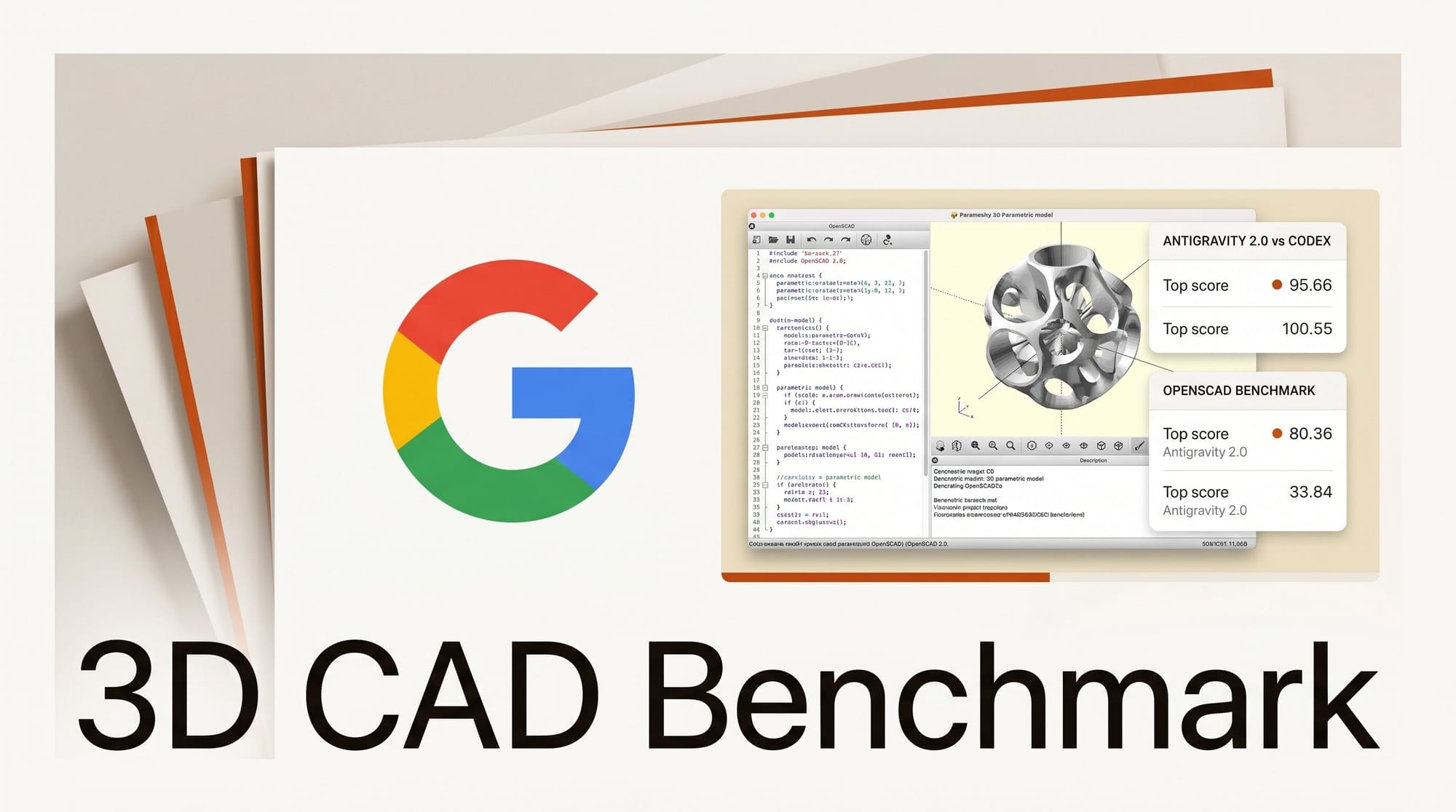
A new third-party benchmark released May 21 pitted six AI coding tools against the same challenge: build a parametric model of the Pantheon in OpenSCAD using only reference images. Google Antigravity 2.0, the agent-first desktop platform Google launched at I/O 2026, took the top quality score (4.5 out of 5) and was the only system to render the dome's interior coffered ceiling unprompted.
The benchmark is one of the first real-world tests of Antigravity 2.0's new architecture, which dropped the original VS Code-style IDE in favor of a standalone agent app that orchestrates parallel subagents and previews work in the loop.
Try It: Generate Parametric CAD from Reference Images
The workflow that ranked first in the benchmark is reproducible today. Download the desktop app from antigravity.google, install OpenSCAD locally, then start a new project with this prompt pattern: two reference images plus "Use the OpenSCAD CLI to render previews and iterate until the result matches." Antigravity will run renders in a loop, comparing each PNG against your references, and stop when it converges. Architects, 3D printer enthusiasts, and product designers can use the same pattern for any object whose form is captured in 2 to 3 reference photos.
Why It Matters
Parametric CAD has been a gap in AI tooling. Image-to-3D pipelines like Meshy, Tripo, and Rodin produce mesh assets but not editable, dimension-driven code. The benchmark shows that an agent loop with file write, CLI execution, and visual feedback can close that gap, producing OpenSCAD source that designers can keep iterating on by hand. The same loop architecture applies to other code-driven design tools: Blender Python, CADQuery, and Fusion 360 Python all expose scripting surfaces a similar agent could drive.
Key Details
Antigravity 2.0 paired with Gemini 3.5 Flash High took roughly 12 minutes to complete the Pantheon test, the slowest run on speed but the highest on quality. ModelRift's own tool placed second with a human-in-the-loop visual-annotation workflow on the same model. Codex 5.5 High delivered the densest output, with column inscriptions, but had mesh export issues that broke later edits.
Pricing for Antigravity is tied to the new Google AI Ultra plan at $100 a month (five times the limits of AI Pro), and the standalone CLI replaces the old Gemini CLI on June 18.
What to Do Next
If you generate 3D assets weekly, install Antigravity 2.0 and OpenSCAD and run the benchmark prompt on one object from your library this week. Compare time and quality against your current pipeline. The agent loop pattern (write code, render preview, iterate visually) is the actual workflow lesson here, and it generalizes beyond OpenSCAD to any CAD format with a CLI renderer.