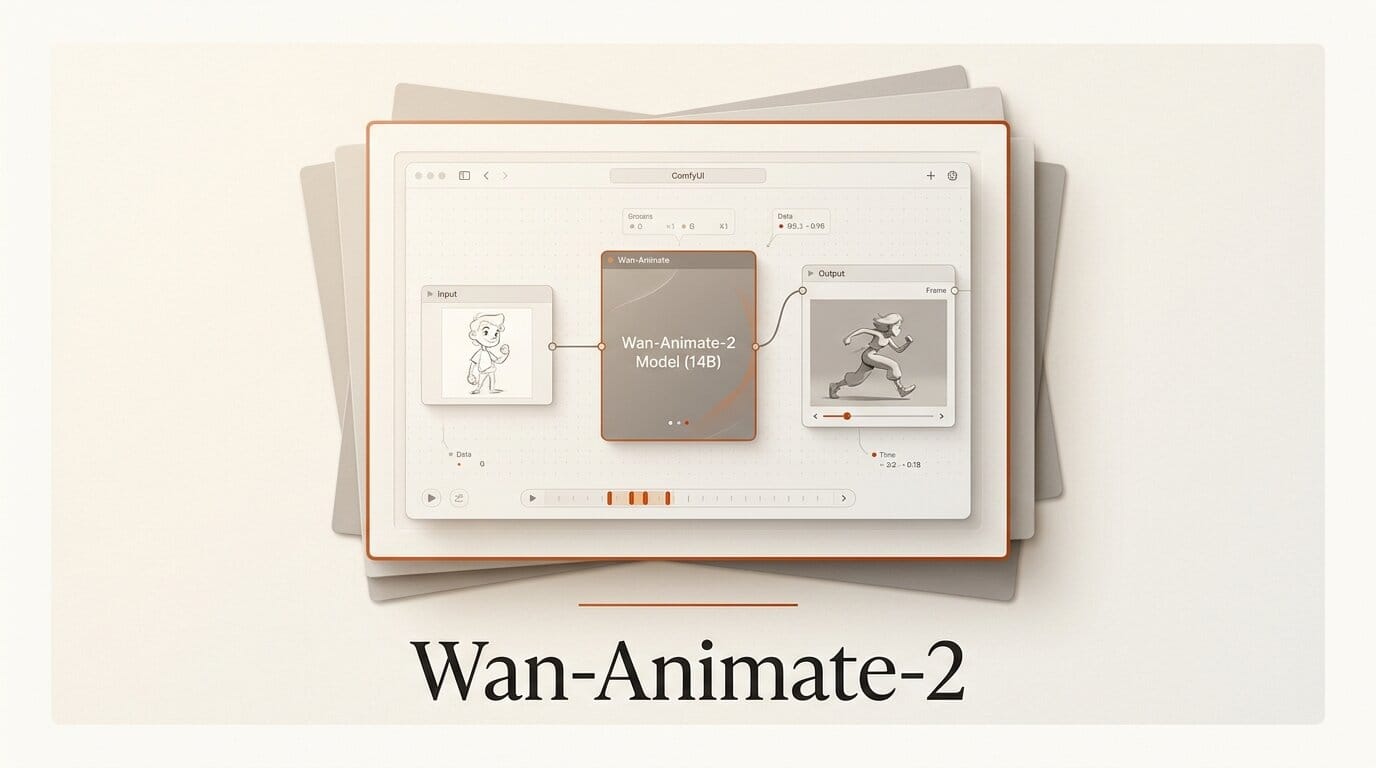
Alibaba's Tongyi Lab released Wan-Animate-2 on August 7, 2026, a 14-billion-parameter character animation model shipped under the permissive Apache-2.0 license. Two days later it landed inside ComfyUI as a set of native nodes, which means a single reference image plus a driving video is now enough to animate or replace a character on your own GPU, with no cloud API and no per-second billing. The accompanying paper was posted to arXiv on August 6, and the base and distilled weights, inference scripts, and a real-time streaming variant all went public on the same day.
For creators who have watched open-weights video models chase closed tools like Runway and Sora, this is the animation-specific piece that was missing: a controllable, identity-preserving system that takes a still character and makes it move exactly like the person in a reference clip.
What Wan-Animate-2 Does
Wan-Animate-2 is built for two closely related jobs. The first is character animation: you provide a reference image of a character and a driving video of any performance, and the model transfers that motion, including facial expression and body pose, onto your character while keeping its identity stable. The second is character replacement: you drop a new character into existing footage so it inherits the original subject's movement and scene lighting. The official project page demonstrates both single-character and multi-character driving, where one video can animate several characters at once.
The headline capability that separates this release from earlier animation tools is text-driven viewpoint control. The output camera angle is decoupled from the driving video, so you can type a prompt to change the perspective independently of how the source clip was shot. That is a control axis most prior character-animation methods simply do not expose.

What Changed From the First Wan-Animate
The original Wan-Animate leaned on intermediate motion extractors, separate modules that first estimated pose and expression before a second stage rendered the frames. Wan-Animate-2 removes that middle step entirely. As the Alibaba Cloud writeup explains, the redesigned Diffusion Transformer consumes the driving video directly, which the authors credit for the jump in motion fidelity and identity preservation. Fewer stages means fewer places for the character's face to drift between frames.
The other structural change is the addition of a real-time path. Alongside the full Base model, the release includes a distilled variant and a Lite build aimed at streaming use cases such as digital avatars and live hosts, where latency matters more than maximum quality.
| Capability | Wan-Animate (v1) | Wan-Animate-2 |
|---|---|---|
| Motion pipeline | Intermediate motion extractors | Direct driving-video consumption |
| Viewpoint control | Tied to source clip | Text-driven, decoupled camera |
| Multi-character driving | Limited | Single-to-many and many-to-many |
| Real-time streaming | No | Yes, via Lite variant |
| License | Apache-2.0 | Apache-2.0 |
Running Wan-Animate-2 in ComfyUI
ComfyUI added day-two support through two experimental nodes, documented in the ComfyUI Wiki writeup. The first, WanAnimate2ToVideo, drives a character from a reference image using a source video, with controls for pose strength and timing. The second, WanAnimate2Cache, caches the pose branch activations to roughly halve generation time on repeat runs.
A working first pass looks like this:
1. Fetch the model files. Comfy-Org publishes ComfyUI-ready components, including bf16 and int8 diffusion models, LoRA weights, the text encoder, VAE, and CLIP vision. The int8 build is the one to grab if you are VRAM-limited.
2. Load your inputs. Feed a clean reference image of your character and a driving video into the WanAnimate2ToVideo node, then write a short prompt describing the character's appearance and background.
3. Pick a sampling profile. The distilled variant runs 10 steps with no classifier-free guidance on a Euler scheduler, which is the fast default. The Base model wants 40 steps with standard guidance for maximum fidelity.
4. Add the cache node for iteration. Once you like a setup, wire in WanAnimate2Cache so subsequent renders reuse the pose branch and finish in about half the time.
The full source, inference code, and weights are mirrored on the Wan-Animate-2 GitHub repository if you would rather script it outside ComfyUI.
Hardware and the Real-Time Lite Variant
This is a large model, and the honest picture is that top-quality output still wants serious silicon. The model card lists 8 A800 GPUs for 720p generation on the Base model and 2 A800 GPUs for 480p on the distilled variant. Most solo creators will not have that, which is where the int8 build and ComfyUI's caching come in. The caching node needs roughly 12.5 GB of system RAM at 480x832 resolution and 81 frames, a target that is reachable on a single high-end consumer card.
| Variant | Steps | Best for | Reference hardware |
|---|---|---|---|
| Base | 40, with guidance | Maximum fidelity 720p | 8x A800 |
| Distillation | 10, no guidance | Fast iteration 480p | 2x A800 |
| Lite | Streaming path | Real-time avatars and live hosts | Optimized for low latency |

Why It Matters for Creators
Character animation has been the stubborn gap in the open-weights video stack. Text-to-video models such as the open-weights MiniMax H3 and the audio-capable FLUX 3 Video generate motion from scratch, but they do not let you take a specific character design and puppet it with a real performance. Wan-Animate-2 fills exactly that slot, and it does so under a license that permits commercial use.
The practical payoffs are concrete. An illustrator can animate a static character sheet by acting out the motion on a phone camera. A short-film maker can replace an actor with a stylized character while keeping the original blocking and lighting. A VTuber or live host can drive an avatar in real time with the Lite variant. Because the whole thing runs locally through ComfyUI, none of that footage has to leave the machine, which matters for client work and for anyone animating unreleased character IP.
Frequently asked questions
Is Wan-Animate-2 free to use commercially?
Yes. The weights are released under Apache-2.0, which permits commercial use, modification, and redistribution. Always read the full license text on the model card before shipping a product built on it.
Do I need an 8-GPU server to run it?
No, though the reference numbers are steep. The 8 and 2 A800 figures are the paper's benchmarks for 720p and 480p. In practice, the int8 diffusion build plus ComfyUI's cache node bring 480x832 work within reach of a single high-end consumer GPU, at lower resolution and speed.
What is the difference between the Base and distilled models?
The Base model runs 40 sampling steps with classifier-free guidance for the best quality. The distilled model runs 10 steps with no guidance, trading some fidelity for roughly four times fewer steps, which is the right pick for iterating on a shot.
Can it animate more than one character at once?
Yes. Wan-Animate-2 supports single-to-multiple and multiple-to-multiple driving, so one or more driving videos can animate several characters in the same output.
How is this different from a text-to-video model?
Text-to-video models invent motion from a prompt. Wan-Animate-2 transfers motion from a real driving video onto a character you supply, which gives you frame-level control over exactly how the character performs and keeps its identity consistent.