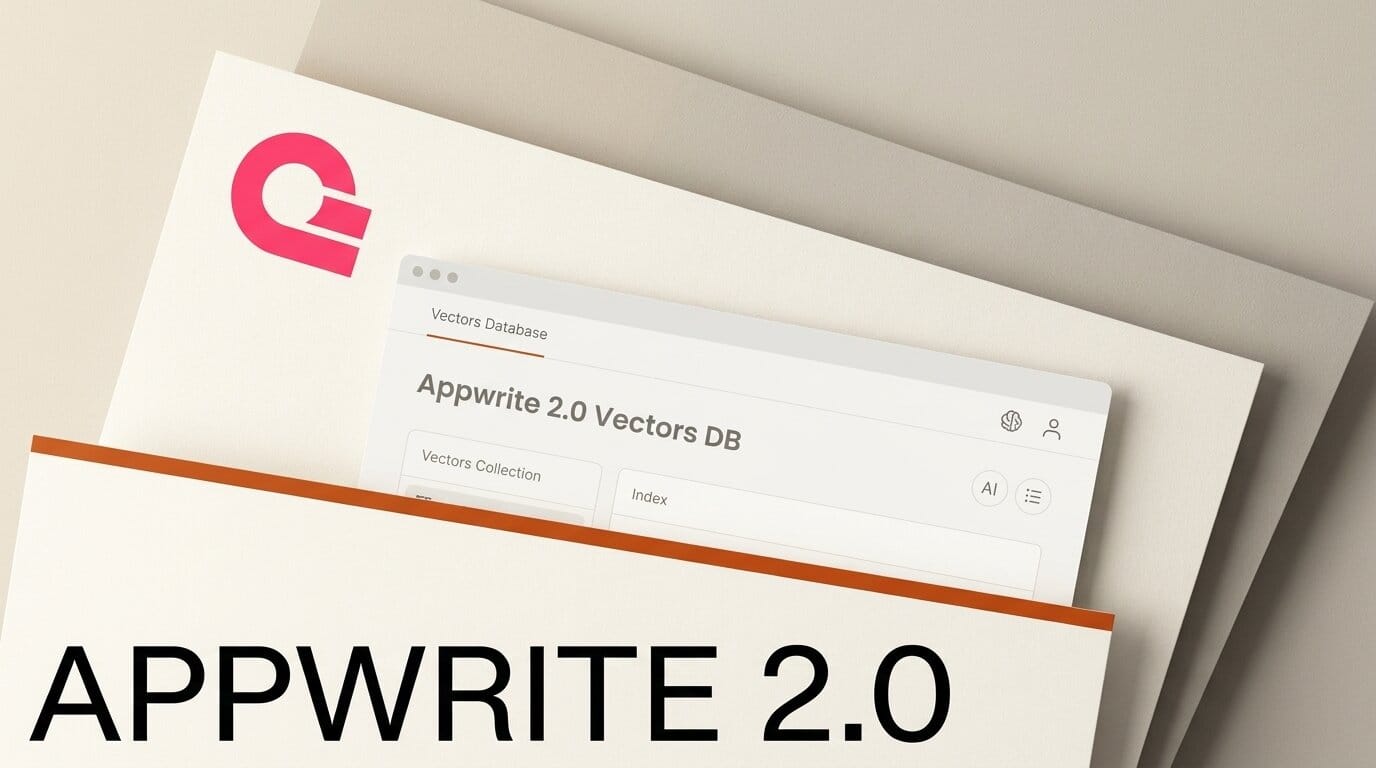
Appwrite 2.0, announced on August 31, 2026, is a major rebuild of the popular open-source backend platform, and its most important addition for people building AI apps is VectorsDB, a native embeddings database with built-in embedding models. The Appwrite 2.0 release replaces the engine underneath the platform and ships a Community Edition you can self-host.
What This Enables
With VectorsDB you can add semantic search or retrieval-augmented generation to an app without wiring up a separate vector service or a standalone embedding API. Appwrite's built-in embedding models turn text into vectors inside the same backend that already holds your data, auth, and storage, using HNSW indexing with cosine, dot product, or Euclidean distance. The vectors sit alongside the rest of the databases product, so for a creator building an AI chatbot, a docs search, or a recommendation feature, that collapses three services into one and keeps everything on infrastructure you control.
Why It Matters for Creators
The pitch for Appwrite 2.0 is removing vendor lock-in for AI builders. Alongside VectorsDB it adds native PostgreSQL with pgvector, MySQL, and a schemaless DocumentsDB, so you choose the store instead of accepting a proprietary one. Because the full platform is open source and self-hostable, the AI features you build are not tied to a single cloud's pricing or availability.
Key Details
Release: Appwrite 2.0, the second major generation of the platform, announced August 31, 2026.
VectorsDB: Embeddings database with fixed dimensions per collection, built-in embedding models, and HNSW indexing.
Databases: Native PostgreSQL 18 and 17, MySQL 8.4 and 8.0, DocumentsDB, and the new TablesDB.
Also new: S3-compatible Storage API, OAuth 2.1 and OpenID Connect server, organization-level firewall and domains, and a rebuilt Console.
What to Do Next
Self-host the Community Edition or start on Appwrite Cloud, then create a VectorsDB collection and push a few text records to test semantic search before adding it to a live project. If you already run Appwrite 1.x, review the migration notes in the announcement first, since the engine underneath the platform has changed.