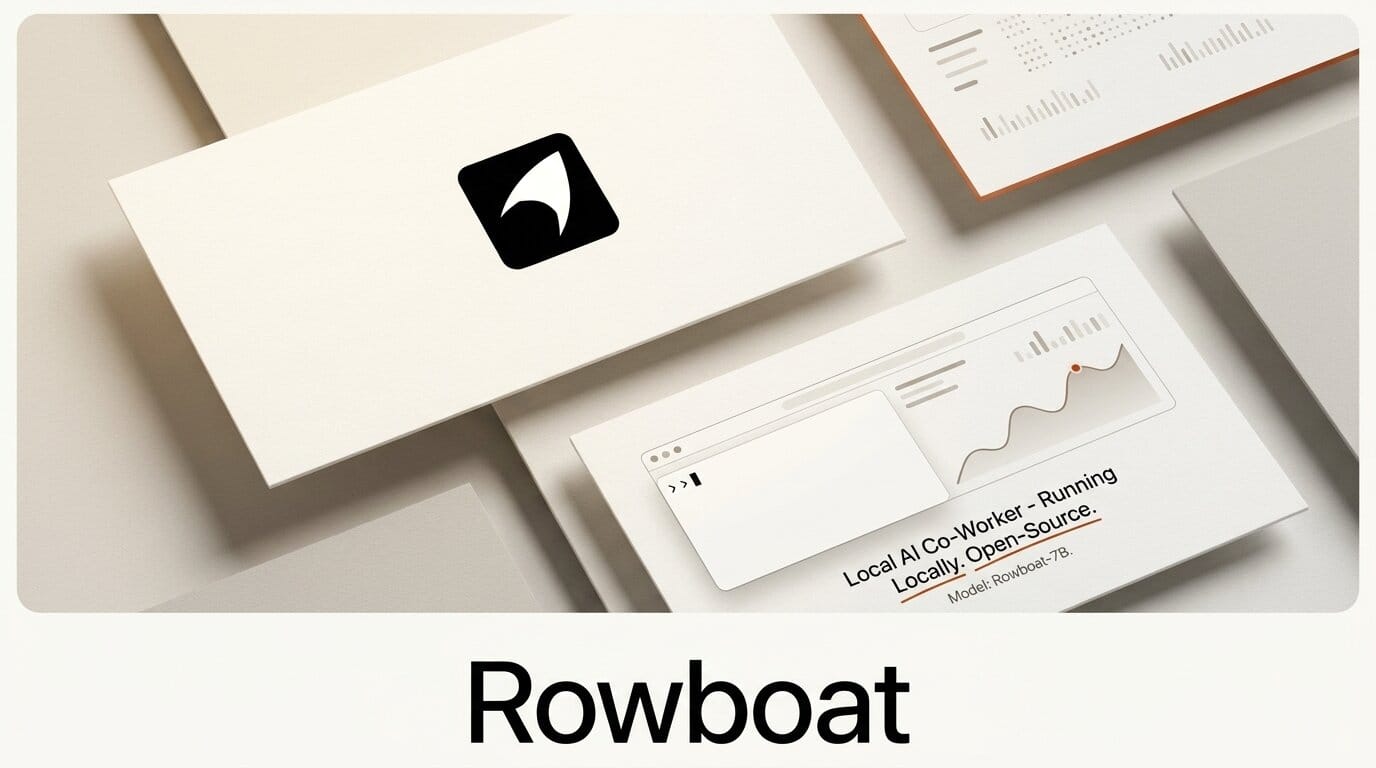
Rowboat, an open-source desktop AI coworker from Y Combinator startup Rowboat Labs, reached version 0.7.1 on July 7, 2026 and hit the front page of Hacker News the same day as a "local-first alternative to Claude Desktop." The pitch is narrow and specific: instead of a chat window that forgets everything between sessions, Rowboat builds a persistent knowledge graph out of your email, meetings, and conversations, stores it as plain Markdown on your own machine, and lets on-device or hosted models act on it. It is Apache-2.0 licensed, runs on Mac, Windows, and Linux, and works with local models through Ollama or LM Studio as well as any hosted provider you bring a key for. The Show HN thread framed it as a full work app rather than a wrapper around a single model.
For creators and builders weighing whether to hand their inbox, notes, and code context to a cloud assistant, Rowboat is the clearest open-source answer yet to Anthropic's Claude Cowork. This guide breaks down what actually shipped, how it compares, and how to stand up a local AI coworker in about half an hour.
What Rowboat Is and What Just Shipped
Rowboat describes itself as "a desktop AI coworker with a memory of your work and built-in surfaces to act on it." The distinction it draws is between retrieval and memory. Most assistants reconstruct context on demand, pulling a few documents into a prompt for one answer and discarding the connections afterward. Rowboat instead indexes your work into a durable, backlinked graph of people, projects, decisions, and commitments, then keeps that graph around so every surface can read and write to it.
The July 7 releases came fast: v0.6.8 on July 6, then v0.6.9, v0.7.0, and the stable v0.7.1 all on July 7, the last one titled around runtime and token optimizations. That cadence matters because it signals the project is in active daily development rather than a static demo. The download installers for all three desktop platforms live at rowboatlabs.com/downloads.
Rowboat vs Claude Cowork vs Claude Desktop
The three tools overlap but solve different problems. Claude Desktop is a polished chat client tied to Anthropic's models. Claude Cowork extends that into a persistent, always-on assistant with its own surfaces. Rowboat is the open-source, local-first take on the Cowork idea, with model choice as its core lever.
| Capability | Rowboat | Claude Cowork | Claude Desktop |
|---|---|---|---|
| License | Apache-2.0, open source | Proprietary | Proprietary |
| Data location | Local Markdown files | Anthropic cloud | Anthropic cloud |
| Model choice | Ollama, LM Studio, any hosted key | Claude only | Claude only |
| Persistent memory | Knowledge graph | Project memory | Per-chat only |
| Work surfaces | Email, meetings, browser, notes, code | Multiple surfaces | Chat plus MCP |
| Cost | Free, plus local compute | Subscription | Subscription tiers |
| Offline capable | Yes, with local models | No | No |
The tradeoff is straightforward. Cowork gives you Anthropic's best models and zero setup. Rowboat gives you ownership of your data and freedom to run a small local model for routine drafting while reserving a hosted model for the hard reasoning. If you have already read our local AI vs cloud AI decision guide, Rowboat is a concrete case study in the local column.
The Knowledge Graph: Why Local Memory Changes the Workflow
Rowboat's central bet is that knowledge work, unlike coding, is not won by the raw model. It is won by context that survives. The app ingests Gmail and calendar events, transcribes meetings, and reads your Slack, then extracts entities and writes them as linked Markdown notes. The result is an Obsidian-style graph you can literally open in Obsidian or any Markdown editor, because there is no proprietary database locking it in.
Because the graph is plain files, you can read, edit, or delete any node at any time. That inspectability is the privacy story: your inbox and meeting history never leave the machine unless you point a surface at a hosted model. It is also the portability story. If Rowboat disappears tomorrow, your knowledge base is still a folder of Markdown you own.
The Work Surfaces
Rowboat ships several purpose-built surfaces rather than a single chat box, and each one reads from and writes to the shared graph:
- Email client: sorts messages by importance and drafts replies that learn your writing style over time.
- Meeting notes: a local, Granola-style note-taker that taps mic and speaker, produces a live transcript, and summarizes into Markdown that updates the graph.
- Browser: an isolated environment where an agent can navigate and act on web tasks alongside you.
- Code mode: parallel coding agents powered by Claude Code or Codex, orchestrated through the Agent Client Protocol.
- Notes: an Obsidian-style system with graph view, bases view, and voice notes.
- Background agents: jobs that fire on an event such as a new email, or on a schedule, with web search, browser control, and code execution.
Integrations arrive one click at a time: Gmail, Google Calendar and Drive, and Slack today, with Outlook planned. On top of that, Rowboat speaks the Model Context Protocol, so any MCP server for tools like Linear, Jira, GitHub, or X plugs in, and it can pull in Composio tools, Exa search, Deepgram voice input, and ElevenLabs voice output.
How to Set Up a Local AI Coworker in Rowboat
Standing up a fully local configuration takes roughly 30 minutes on a machine with a capable GPU or Apple Silicon:
- Install Rowboat. Download the installer for your platform from the v0.7.1 release page and launch the app.
- Install a local model runner. Set up Ollama or LM Studio and pull a mid-size instruct model that fits your VRAM, such as an 8B to 14B model for drafting.
- Point Rowboat at the local endpoint. In settings, select the local provider so routine tasks stay on-device. Optionally add a hosted API key for heavier reasoning and let Rowboat swap models per task.
- Connect one integration. Start with Gmail so the graph has real material to index. The app builds people, project, and commitment nodes as it reads.
- Turn on a background agent. Create a simple trigger, such as drafting a reply when a message from a key contact arrives, and let it run against the local model.
- Open the graph. Inspect the generated Markdown in Rowboat's notes view or in Obsidian to confirm what it captured and prune anything you do not want stored.
Config files live under a local .rowboat/config directory as plain JSON, so voice, search, and tool keys are easy to audit and version.
What This Enables for Creators and Builders
For an independent creator or small studio, Rowboat collapses several subscriptions into one owned system. Your meeting notes, inbox triage, research browser, and coding agents all share the same memory, so a background agent can draft a client reply that already knows the last three calls and the open Linear tickets. Because the graph is local Markdown, you can pipe it into other tools, feed it to a newsletter workflow, or keep a durable record of decisions without paying per seat. Pairing Rowboat with a Markdown-native agent workspace like Syncpen or a local retrieval layer such as UCP-Local keeps the entire stack on your hardware.
The Tradeoffs and Limits
Rowboat is early. At v0.7.x the surfaces exist but polish varies, integrations beyond Google and Slack are still landing, and running everything locally demands real hardware. A small local model will draft email well but will not match a frontier model on complex reasoning, which is exactly why Rowboat lets you route to a hosted key when it matters. The knowledge graph is only as good as what you feed it, and indexing an inbox for the first time takes time and compute. Teams that want zero setup and the strongest model on every task will still find Claude Cowork simpler.
What to Do Next
If you value data ownership and model flexibility, download Rowboat, connect a single integration, and run it alongside your current assistant for a week before committing. Watch how well the knowledge graph captures your actual projects, and test a local model against a hosted one on the tasks you do most. Keep an eye on the release cadence, since the project is shipping multiple builds a day and the surfaces are maturing quickly.
Frequently Asked Questions
Is Rowboat really free?
Yes. The core application is open source under Apache-2.0 and free to run. Your only costs are local compute and any hosted API keys you choose to add for heavier tasks.
Does my data leave my machine?
Not unless you route a surface to a hosted model. The knowledge graph, email, and meeting notes are stored locally as Markdown files you can read, edit, or delete at any time.
What models can Rowboat use?
Any model. Locally it works with Ollama and LM Studio, and it supports bring-your-own-key for hosted providers, with the ability to swap models per task.
How is Rowboat different from Claude Cowork?
Claude Cowork is proprietary, cloud-based, and Claude-only. Rowboat is open source, local-first, stores data as Markdown, and lets you choose any model, including on-device ones.
Can Rowboat write and run code?
Yes. Its code mode runs parallel coding agents powered by Claude Code or Codex through the Agent Client Protocol, and background agents can execute code on triggers or schedules.
Which integrations are supported today?
Gmail, Google Calendar, Google Drive, and Slack are available now, with Outlook planned. Through MCP it also connects tools like Linear, Jira, GitHub, and X, plus Composio, Exa, Deepgram, and ElevenLabs.