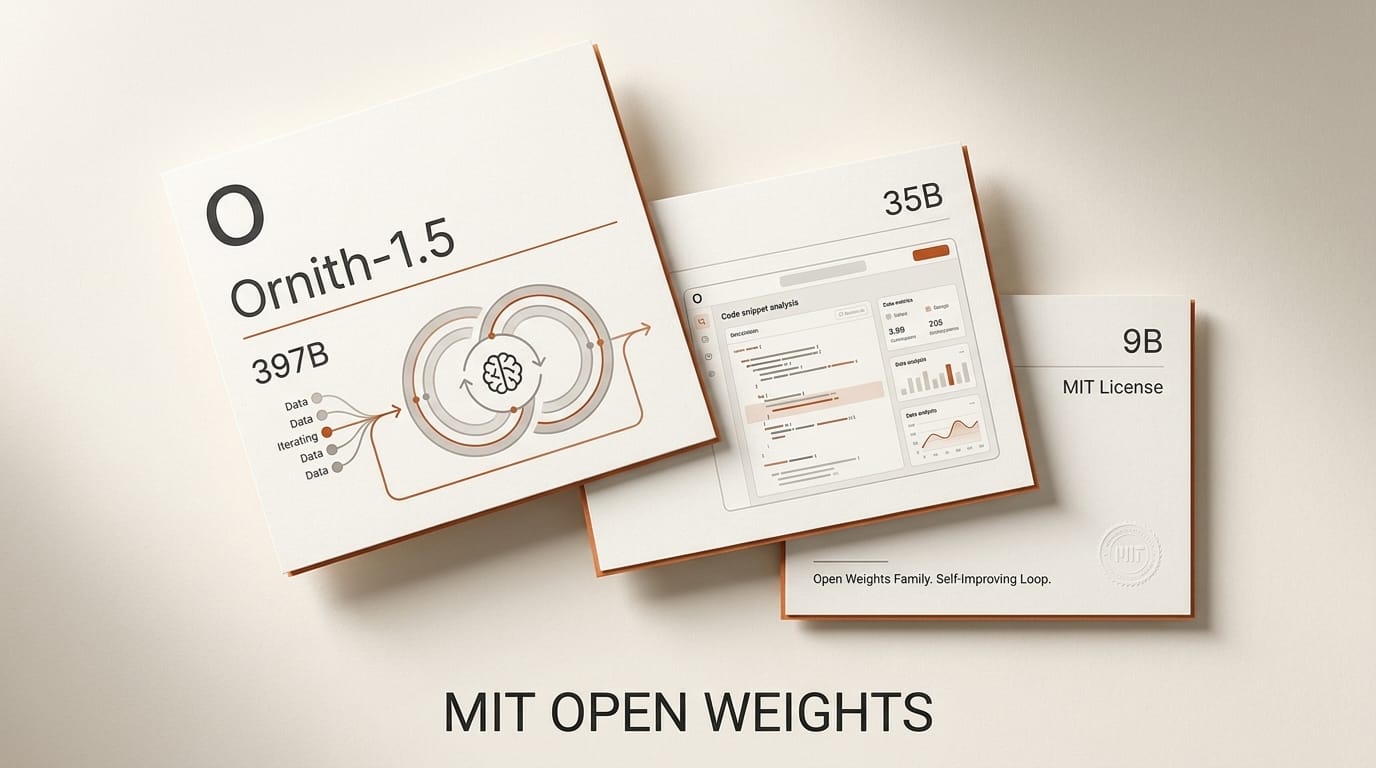
On August 19, 2026, Ornith AI released Ornith-1.5 as open weights under the MIT license: a 397B mixture-of-experts flagship, a 35B MoE that activates 3B parameters per token, and a 9B dense model with a quantized mobile build. The company reports the flagship trading blows with Claude Opus 4.8 on coding and terminal benchmarks.
The benchmark claims are vendor-reported and should be treated accordingly. The training method is the genuinely interesting part, and it is not a benchmark claim at all.
What Shipped
Three models, one release, reported at launch by TestingCatalog and AI Weekly. The Hugging Face collection holds the weights, and the project page covers the technical detail.
| Model | Architecture | Terminal-Bench 2.1 | DeepSWE |
|---|---|---|---|
| Ornith-1.5-397B | MoE flagship | 85.1 | 56.0 |
| Ornith-1.5-35B-A3B | MoE, 3B active per token | 68.5 | 79.0 |
| Ornith-1.5-9B | Dense, mobile quant available | 47.0 | 70.6 |
The flagship also posts 92.8 on GPQA Diamond and 86.6 on BrowseComp. MIT licensing across the family is notable in itself. Many open weight releases carry custom licenses with usage restrictions or revenue thresholds. MIT has none of that, which makes the commercial question trivial.
All three sizes sit under the Ornith AI organisation on Hugging Face. This follows Ornith-1.0 from June 2026, so the cadence is roughly two months between generations.

The Self-Improvement Loop
The training method is what separates this release from the steady stream of open weight launches.
Ornith-1.0 wrote scaffolds around a fixed set of human-curated tasks. Ornith-1.5 proposes the tasks itself. The loop runs in three stages: task proposal, scaffold generation, and solution rollout. The system proposes progressively harder tasks, generates a task-specific scaffold for each, and produces the reinforcement learning rollouts. All three components receive reward signals simultaneously using GRPO optimisation.
The significance is about a bottleneck. Curated task data is expensive, slow, and finite, and it is increasingly the constraint on post-training rather than compute. A system that generates its own progressively harder curriculum sidesteps that, at least in domains where success can be checked automatically.
That last clause is the important qualifier. This works for coding and terminal tasks because you can run the code and see whether it passed. It does not obviously transfer to domains without a cheap automatic verifier, which is most of the interesting ones. Self-improvement here means self-improvement on verifiable tasks, not general capability bootstrapping.

Which Size You Should Actually Run
For most people reading this, the 397B is a benchmark story rather than a practical option. A 397B mixture-of-experts model needs serious hardware even with sparse activation, and if you are renting that much GPU you are usually better served by a hosted API.
The 35B with 3B active per token is the interesting one. Sparse activation means it computes like a much smaller model while holding more knowledge, which is exactly the tradeoff that makes MoE attractive for self-hosting. Note the oddity in the table though: the 35B posts a higher DeepSWE score than the flagship. Vendor-reported numbers with that kind of inversion usually indicate benchmark noise or differing harness configurations rather than the mid-size model genuinely beating the flagship at software engineering.
The 9B dense with a mobile quantization is the one with the clearest use case. On-device inference means no API cost, no network round trip, and no data leaving the phone. The scores are much lower, but for constrained tasks like classification, extraction or short drafting, a 9B that runs locally beats a frontier model you cannot reach offline.
MoE models are also worth understanding before self-hosting. They quantize less predictably than dense models, so a dense model at a smaller parameter count is often the easier practical choice if you plan to run heavily quantized on consumer hardware.

Reading the Benchmarks Honestly
Every headline number in this release comes from Ornith AI's own evaluation runs, averaged over five. That is more rigorous than a single run, and it is still self-reported.
The comparison being drawn is against Claude Opus 4.8 at 85.0 on Terminal-Bench 2.1 and 59.0 on DeepSWE. Ornith reports 85.1 and 56.0. Read plainly: essentially level on one, behind on the other. The framing as "trading blows" is fair. The framing as "beats" that has appeared in some coverage is not.
Benchmarks also measure a narrow slice. Terminal-Bench and DeepSWE test agentic coding in specific harnesses. They say little about long-context reliability, instruction following under pressure, refusal behaviour, or the failure modes that determine whether a model is pleasant to work with daily. Open weights at least mean you can test this yourself rather than taking anyone's word, and community results tend to surface on public leaderboards such as the Open LLM Leaderboard within a couple of weeks.
For context on the current open weight field, our coverage of GLM-5.3 covers a direct competitor released five days earlier.
Key Takeaways
1. Three models under MIT: a 397B MoE flagship, a 35B MoE with 3B active per token, and a 9B dense with a mobile build.
2. MIT licensing removes the usage restrictions and revenue thresholds attached to many open weight releases.
3. The self-improvement loop proposes its own tasks, builds scaffolds and generates RL rollouts, all rewarded simultaneously via GRPO.
4. Every benchmark figure is vendor-reported. On the stated numbers the flagship is level with Claude Opus 4.8 on Terminal-Bench and behind on DeepSWE.
What to Watch
The first thing worth watching is whether independent evaluation reproduces the reported scores. Open weights make that possible, and community results usually appear within a couple of weeks. If they land close, the self-improvement method deserves serious attention. If they land well below, this becomes another cautionary tale about self-reported evaluation.
The second is whether self-generated curricula spread. If the approach holds up, expect other labs to adopt it quickly, because the alternative is buying task data that gets more expensive every quarter. The limitation to automatically verifiable domains is the thing to watch for someone solving.
Frequently Asked Questions
What is Ornith-1.5?
An open weight model family released August 19, 2026 in three sizes: 397B MoE, 35B MoE with 3B active parameters per token, and 9B dense with a quantized mobile build.
What license is it under?
MIT, across the family. That permits commercial use, modification and redistribution without the usage restrictions or revenue thresholds common in other open weight licenses.
Does it really beat Claude Opus 4.8?
On the vendor's own numbers it is level on Terminal-Bench 2.1 (85.1 against 85.0) and behind on DeepSWE (56.0 against 59.0). "Trading blows" is accurate; "beats" is not.
What does self-improving actually mean here?
The system proposes its own progressively harder training tasks, generates a scaffold for each, and produces the reinforcement learning rollouts, with all three stages rewarded together. It applies to tasks whose success can be checked automatically, such as code.
Which size should I run?
The 35B MoE for self-hosting, since sparse activation keeps compute cost near a much smaller model. The 9B for on-device work. The 397B is realistically a hosted or benchmark proposition.
Are the benchmarks independently verified?
Not at launch. All figures come from Ornith AI's own runs, averaged over five. Because the weights are open, independent reproduction is possible and worth waiting for.
Deep dive by Creative AI News.
Subscribe for free to get the weekly digest.