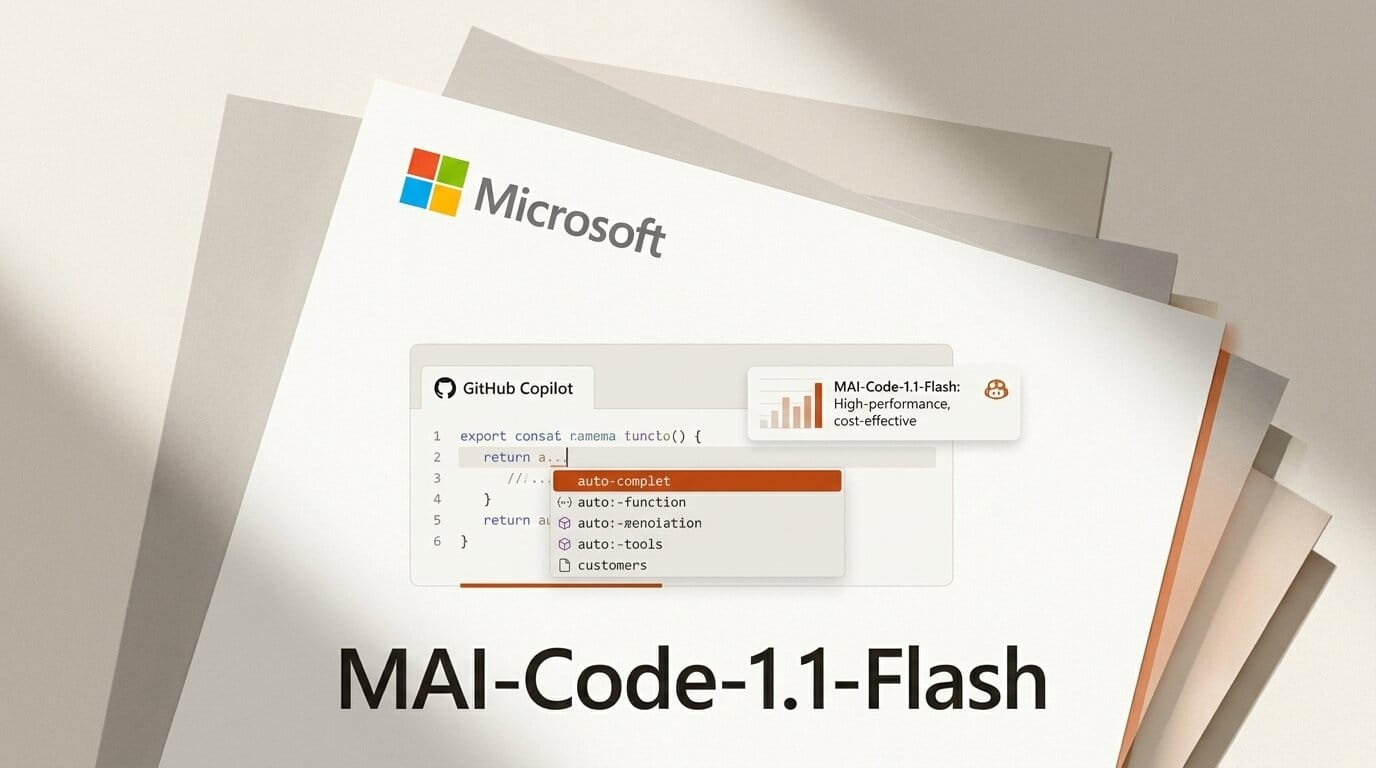
Microsoft shipped MAI-Code-1.1-Flash on August 11, 2026, a small, efficient coding model that is now in production inside GitHub Copilot and Visual Studio Code. It is the successor to MAI-Code-1-Flash, which Microsoft first showed at Build in June 2026. The headline for developers is cost: the new model produces higher quality code at 25 percent greater token efficiency and roughly a quarter of the price of the June release. It also posts a 22 percent improvement on Terminal-Bench 2.1 in the GitHub Copilot CLI and a 15 percent gain on .NET tasks, and it adds native vision so it can read screenshots and diagrams.
For anyone who codes with an AI assistant, a cheaper, faster model that is already wired into the tools you use matters more than a new frontier benchmark. Below is what changed, how it compares to the model it replaces, exactly what it costs, and how to switch to it in Copilot today.
What Changed in MAI-Code-1.1-Flash
MAI-Code-1.1-Flash is a point upgrade with real substance. Microsoft says it improves across four axes at once: coding quality, instruction following, tool use, and raw speed. Tokens stream about 25 percent faster and the model uses roughly 25 percent fewer tokens to finish the same task, which compounds into both lower latency and lower bills. The company also reports downstream engagement gains from its own telemetry: code survival, meaning code the model wrote that stays in the file, rose 4 percent, and developer return visits rose 9 percent.
The biggest capability addition is native vision. Where the June model was text only, 1.1-Flash can now interpret images directly, so you can paste a screenshot of a broken UI, a design mock, or an error dialog and have the model reason over it. The rollout also widened the surface area: per the GitHub changelog, the model is selectable in Copilot CLI, the Copilot cloud agent, the Copilot app, Copilot Chat on GitHub, VS Code, Visual Studio, GitHub Mobile, JetBrains IDEs, Eclipse, and Xcode. That broad footprint continues a pattern from June, when Microsoft steadily pushed the original Flash model onto more Copilot surfaces over several weeks.

MAI-Code-1.1-Flash vs the June Model
The June model, MAI-Code-1-Flash, was Microsoft's first in-house small coding model to ship inside Copilot, introduced at Build in June 2026. Version 1.1-Flash keeps the same "small workhorse" positioning but improves nearly every number that a working developer cares about. GitHub will retire MAI-Code-1-Flash across all Copilot experiences on September 10, 2026, so this is a replacement, not a parallel option.
| Attribute | MAI-Code-1-Flash (June 2026) | MAI-Code-1.1-Flash (Aug 2026) |
|---|---|---|
| Vision (image input) | No | Yes, native |
| Terminal-Bench 2.1 (Copilot CLI) | Baseline | Plus 22 percent |
| .NET tasks | Baseline | Plus 15 percent |
| Token efficiency | Baseline | 25 percent fewer tokens |
| Streaming speed | Baseline | 25 percent faster |
| Relative cost | Baseline (1x) | About one quarter |
| Status | Retires Sept 10, 2026 | In production now |
The pattern here is familiar for small models: hold the size, push efficiency, and let price do the work. Microsoft is competing on cost-per-good-token rather than chasing a top spot on a public leaderboard.
Pricing: A Quarter of the Cost
MAI-Code-1.1-Flash is priced at 0.20 dollars per 1 million input tokens, 0.02 dollars per 1 million cached input tokens, and 1.20 dollars per 1 million output tokens. Inside GitHub Copilot, annual subscribers are billed at a 0.25x premium request multiplier, so a single agent request against this model counts as a quarter of a premium request rather than a full one. The exact pricing and multiplier are listed in the GitHub changelog.
That multiplier is the practical story. If your team burns through premium requests on agent loops, refactors, and test generation, moving routine work to a 0.25x model stretches the same Copilot allotment roughly four times further. Cached input at 0.02 dollars per million also rewards long-context, repeat-prompt workflows where the same files are read again and again.

How to Switch to MAI-Code-1.1-Flash in Copilot
The model is off by default, so you have to select it. It is available to paid individual, business, and enterprise Copilot customers. Here is the fastest path in VS Code, with the same idea applying to Visual Studio and JetBrains IDEs.
- Update GitHub Copilot and the Copilot Chat extension to the latest version so the new model appears in the picker.
- Open the Copilot Chat panel and click the model selector at the bottom of the input box.
- Choose MAI-Code-1.1-Flash from the list. If it is missing, confirm your plan is paid and that an admin has enabled the model for your organization.
- For terminal work, run the Copilot CLI and set the model there as well, since the CLI is where the 22 percent Terminal-Bench gain shows up.
- Test vision by pasting a screenshot of a failing UI or an error dialog into chat and asking for a fix.
- Watch your premium request usage in Copilot settings to confirm requests are billing at the 0.25x rate.
Because MAI-Code-1-Flash retires on September 10, 2026, teams already standardized on the June model should plan the swap now. The June rollout notes on selecting the model across surfaces are documented in the original availability changelog.
What This Enables for Creators
For builders, the win is not a single benchmark, it is the economics of iterating. A model that is fast, cheap, and vision-capable changes what you are willing to attempt inside an agent loop. You can let Copilot run more speculative refactors, generate more tests, and take more passes at a bug because each pass costs a quarter of what it used to. The vision support means front-end work gets tighter: hand the model a design screenshot and let it scaffold the component, or paste a broken layout and let it diagnose the CSS.
The token efficiency also helps long sessions stay coherent. Using 25 percent fewer tokens per task means more of your context budget survives for the actual code rather than being spent on the model's own verbosity. For solo developers and small teams on metered Copilot plans, that is the difference between running out of premium requests mid-sprint and finishing the week with headroom.

Where It Fits Against Rivals
Microsoft is not the only vendor pushing cheap coding models into Copilot. It sits alongside a crowded field of options that developers can now route between, a shift we covered in our look at AI coding model routing across Devin, Fusion, Weave, and Copilot. On the small-and-cheap axis specifically, 1.1-Flash competes with strong open-weight entrants: Moonshot's model landed inside the same surface, as we detailed when Kimi K2.7 Code arrived in GitHub Copilot, and Chinese labs keep raising the open-weights bar, most recently with LongCat-2.0.
That competitive context is exactly why Microsoft leaned on price and efficiency rather than a leaderboard crown. The pitch is not "the smartest model," it is "the model you can afford to run constantly." For most day-to-day coding, constant availability at low cost beats occasional access to a frontier tier.
Frequently Asked Questions
Is MAI-Code-1.1-Flash free?
No. It is available to paid individual, business, and enterprise GitHub Copilot customers. It is billed at a 0.25x premium request multiplier for annual subscribers, and via API at 0.20 dollars per 1 million input tokens and 1.20 dollars per 1 million output tokens.
Do I need to enable it manually?
Yes. The model is off by default. Open the model selector in Copilot Chat, the Copilot CLI, or your IDE and choose MAI-Code-1.1-Flash. Organization admins may need to enable it for business and enterprise seats first.
What happens to MAI-Code-1-Flash?
GitHub will retire MAI-Code-1-Flash across all Copilot experiences on September 10, 2026. If your workflow depends on it, plan to move to 1.1-Flash before that date.
Can it understand images?
Yes. Native vision is the marquee new capability. You can paste screenshots, design mockups, and error dialogs into Copilot Chat and have the model reason over them directly, which the text-only June model could not do.
Which IDEs and tools support it?
MAI-Code-1.1-Flash is selectable in Copilot CLI, the Copilot cloud agent, the GitHub Copilot app, Copilot Chat on GitHub, VS Code, Visual Studio, GitHub Mobile, JetBrains IDEs, Eclipse, and Xcode.
How much cheaper is it really?
Microsoft reports about a quarter of the cost of the June MAI-Code-1-Flash model, driven by both lower per-token pricing and roughly 25 percent fewer tokens used per task. For metered Copilot plans, that stretches a fixed premium-request budget significantly further.
What to Do Next
If you already use Copilot, update your extensions, switch the model to MAI-Code-1.1-Flash, and run a week of normal work to feel the cost and speed difference before the June model retires. If you manage a team, enable it for your organization and set it as the default for routine tasks while reserving frontier models for hard problems. Developers comparing notes on early behavior are doing so in the GitHub community discussion.