Meituan has finished the job it started at the end of June. On July 4, 2026, the Beijing company uploaded the actual model weights for LongCat-2.0, a 1.6-trillion-parameter open-weights coding model, to Hugging Face. The announcement landed on June 30 with a "weights coming soon" placeholder; now the 141-shard INT8 checkpoint is live and downloadable, which means the model that spent two months quietly topping developer leaderboards under the codename "Owl Alpha" is finally something you can run yourself.
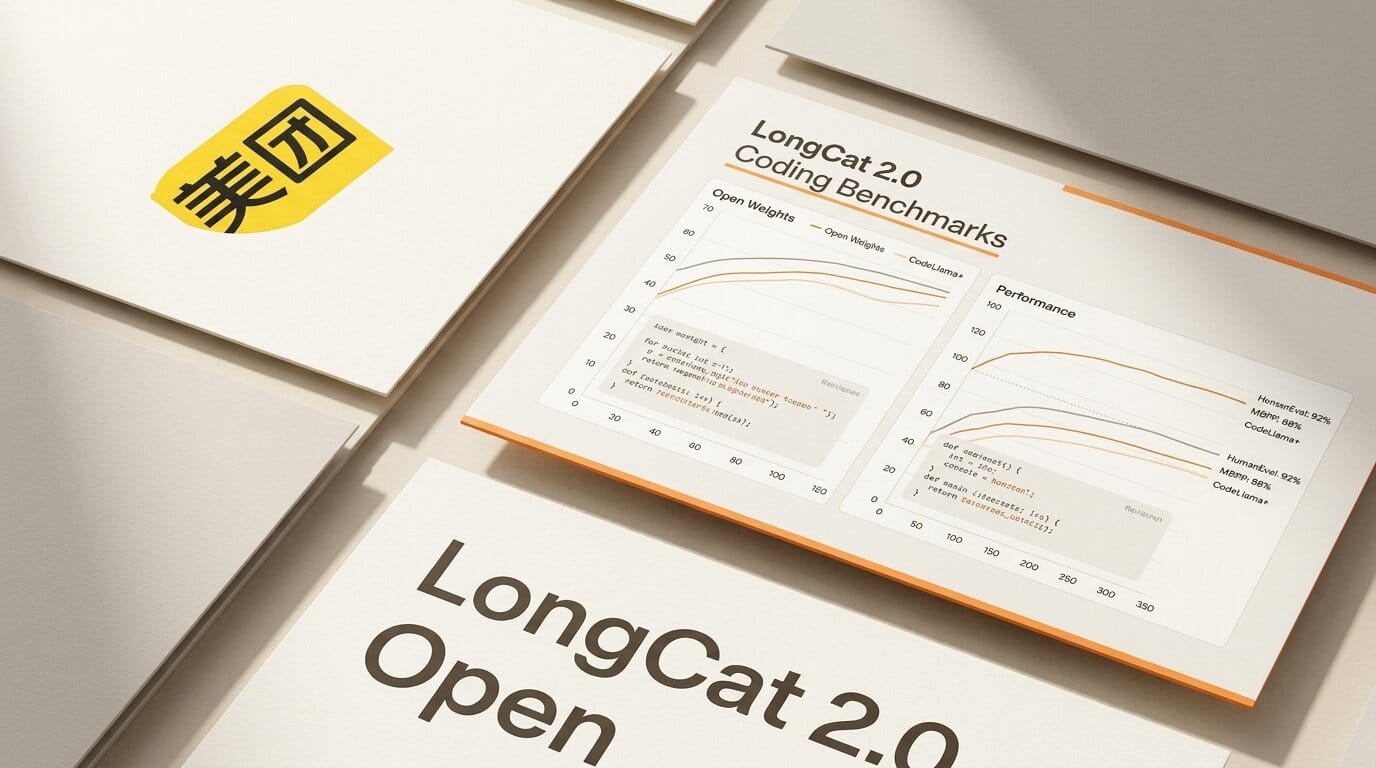
The headline number is the size: 1.6 trillion total parameters in a Mixture-of-Experts design that activates roughly 48 billion per token. But the number that matters for creators is the benchmark. LongCat-2.0 posts 59.5 on SWE-bench Pro, edging out GPT-5.5's 58.6, and it was the most-used coding model on OpenRouter before anyone knew who made it. This is a near-frontier agentic coding model that costs a fraction of the Western flagships, and it is now open under an MIT license.
What Meituan Actually Shipped
LongCat-2.0 is a large Mixture-of-Experts language model built specifically for agentic coding: writing, editing, and iterating on real codebases across long, multi-step tool-use sessions. It carries 1.6 trillion total parameters but only activates between 33 and 56 billion per token (averaging about 48 billion), so inference cost stays far below what a dense 1.6T model would demand. It ships with a native 1-million-token context window, enough to hold an entire repository in working memory.
The release went out simultaneously across three channels: the GitHub repository, Hugging Face, and Meituan's own LongCat AI site. Everything ships under the permissive MIT License, which gives developers and companies maximum legal flexibility to fine-tune, redistribute, and build products on top of the model without the usage restrictions that come with many "open" model licenses.

LongCat-2.0 vs the Field
The comparison that turned heads is the price-to-performance ratio. LongCat-2.0 matches or beats the closed flagships on coding benchmarks while charging a fraction of their API rate. Independent coverage from felloAI's breakdown and others confirms the model surpasses several Claude Opus variants on SWE-bench Pro, not just GPT-5.5.
| Model | SWE-bench Pro | Context | Input / Output ($ per M tokens) | Weights |
|---|---|---|---|---|
| LongCat-2.0 | 59.5 | 1M | $0.75 / $2.95 | Open (MIT) |
| GPT-5.5 | 58.6 | Large | Closed, higher | Closed |
| Claude Sonnet 5 | Comparable | Large | Closed, higher | Closed |
| Kimi K2.7-Code | Strong on tool use | Large | Open pricing | Open |
At $0.75 per million input tokens and $2.95 per million output tokens on OpenRouter, LongCat-2.0 undercuts the Western flagships by a wide margin. For anyone running agentic coding loops that burn through millions of tokens per task, that gap compounds fast. If you have been comparing open coding models, our look at Kimi K2.7-Code beating Opus 4.8 on tool use covers the other model creators are weighing against it.
Trained Without a Single Nvidia GPU
The technical milestone underneath the benchmark is what makes this release historic. LongCat-2.0 is, by Meituan's account, the first trillion-parameter model trained and served end-to-end on Chinese-made chips with no Nvidia hardware in the loop. Training ran across Huawei Ascend ASIC superpods (community estimates put it near 50,000 Ascend 910C accelerators) using Huawei's HCCL collective communication library, over more than 30 trillion tokens.
As Digital Today reported, this moves domestic-hardware AI from isolated demos into industrial reality: not just a proof of concept run, but a full training-and-serving pipeline behind a model that was already the top coding model on a global marketplace. Additional coverage from Yahoo Tech notes the architecture uses zero-computation experts and a shortcut-connected MoE design to keep the enormous parameter count efficient at inference time.
How to Access LongCat-2.0 Today
There are two practical paths depending on whether you want the fastest start or full local control.
- Fastest: use the API. LongCat-2.0 is live on OpenRouter at $0.75 input / $2.95 output per million tokens. Point any OpenAI-compatible client or agent framework at the OpenRouter endpoint and swap the model ID. No hardware required.
- Full control: download the weights. The INT8 quantized checkpoint is published on Hugging Face as 141 safetensors shards. INT8 cuts the memory footprint roughly in half versus full precision, though a 1.6T MoE still needs a serious multi-GPU or multi-node setup to serve.
- Wire it into your agent. Because the model is tuned for tool use, plug it into your existing coding-agent harness (Cline, Aider, or a custom loop) and give it repository access. The 1M-token context means you can load large portions of a codebase into a single session.
- Fine-tune under MIT. The permissive license lets you adapt LongCat-2.0 to your stack and redistribute the result, which is not possible with the closed flagships.
If you want to experiment with a smaller local coding agent first, our guide to running a local AI coding agent on one GPU is a gentler on-ramp before committing multi-node hardware to a 1.6T model.
What This Enables for Creators and Builders
For anyone building software with AI, LongCat-2.0 changes the cost math. A near-frontier coding model that you can call over an API for cents, or self-host under a no-strings MIT license, removes two of the biggest constraints on agentic development: per-token cost and vendor lock-in. If you run long agent loops that refactor, test, and iterate autonomously, the $0.75 input rate makes workflows that were uneconomical on closed flagships suddenly viable.
The self-hosting option matters most for teams with data-residency or privacy constraints. You can now run a top-tier coding model entirely inside your own infrastructure, no API calls leaving your network. Combine that with a 1M-token context window and you have a model that can reason over an entire large repository at once, which is exactly the capability that separates useful agentic coding from single-file autocomplete. For a sense of where the open-weights coding field is heading, our coverage of GLM 5.2's 1M-token coding plan shows how quickly long-context Chinese models are converging on the frontier.
Frequently Asked Questions
Is LongCat-2.0 actually free to use?
The weights are free and open under the MIT License, so you can download, run, fine-tune, and redistribute them at no cost. Using it through the OpenRouter API is paid at $0.75 per million input tokens and $2.95 per million output tokens, which is still far below the closed flagships.
What was "Owl Alpha"?
Owl Alpha was the anonymous codename LongCat-2.0 ran under on OpenRouter for roughly two months before Meituan revealed it. During that time it climbed to the top of the platform's coding usage charts, which is how the model built a reputation before anyone knew its origin.
How does it compare to GPT-5.5 and Claude?
On SWE-bench Pro, LongCat-2.0 scores 59.5 versus GPT-5.5's 58.6, and reporting indicates it surpasses several Claude Opus variants on the same test. It is genuinely near-frontier for agentic coding, not a budget approximation.
Can I run it on my own hardware?
Yes, but it is demanding. The INT8 checkpoint on Hugging Face is 141 shards, and even quantized, a 1.6T Mixture-of-Experts model needs a multi-GPU or multi-node server to serve. It is not a laptop or single-consumer-GPU model. For local experimentation, start with a smaller open coding model first.
Why is "no Nvidia GPUs" a big deal?
LongCat-2.0 is the first trillion-parameter model trained and served entirely on Chinese-made chips (Huawei Ascend ASICs). It proves that frontier-scale training no longer strictly depends on Nvidia hardware, which has significant implications for the global AI supply chain and for the pace of open-model releases from China.
What license does it use?
LongCat-2.0 is released under the permissive MIT License, one of the most flexible open-source licenses. That allows commercial use, modification, and redistribution with minimal restrictions, unlike the more constrained licenses attached to many other open-weight models.