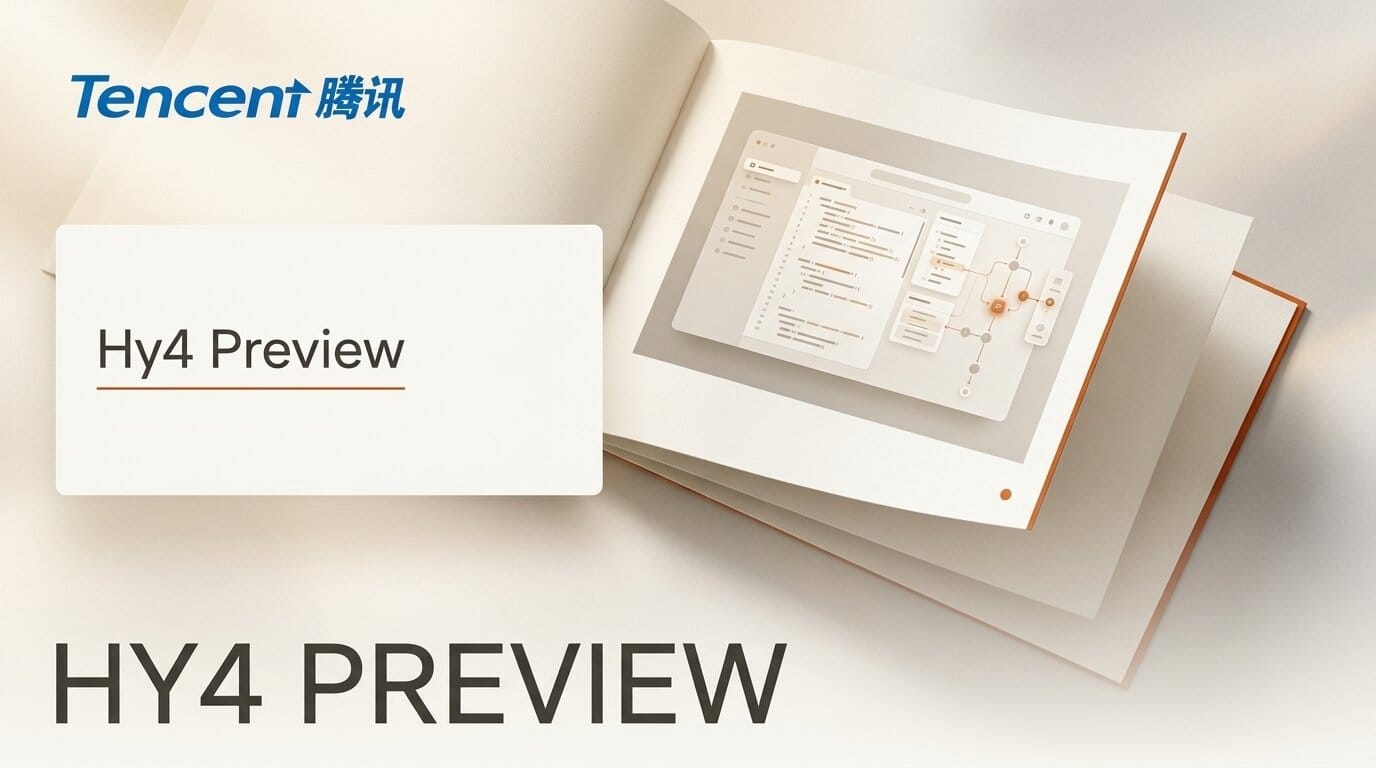
Tencent has open-sourced Hy4 preview, a 770-billion-parameter mixture-of-experts model that activates only 49 billion parameters per token and handles context windows past one million tokens. Released on August 28, 2026 under an Apache 2.0 license, it is aimed squarely at the work builders actually do: coding, office automation, data analysis, game development, and research. Tencent says its own blind evaluation puts Hy4 narrowly ahead of Zhipu GLM-5.3 and Moonshot Kimi K3, which makes this the most capable openly downloadable model to land in weeks.
What Happened
Hy4 preview is a preview-tier release, but the weights are genuinely in the open. Tencent published the full checkpoint, an FP8 quantized variant, a fine-tuning pipeline, and serving recipes so anyone can host it on eight GPUs. As TechNode reported, the model is available through Tencent's WorkBuddy and CodeBuddy apps (free for a two-week window), the Yuanbao and ima assistants, and API access on Tencent Cloud TokenHub and OpenRouter.
The headline number is scale. At 770 billion total parameters, Hy4 is more than double the size of Hy3, Tencent's previous flagship, which launched in April with 295 billion total and 21 billion active parameters. The mixture-of-experts design keeps only 49 billion parameters active on any single request, so inference cost tracks a mid-sized dense model rather than a 770B monolith. Tencent also said Hy4 helped optimize parts of its own training and inference stack, lifting end-to-end throughput 31.8 percent against a baseline.

How Hy4 Compares to the Open-Weights Coding Wave
Hy4 lands in the middle of the busiest open-weights month in memory. In the last two weeks alone, Zhipu shipped GLM-5.3 Flash, DeepSeek pushed its V4 line, and Alibaba refreshed Qwen. Tencent's internal scoring across 163 experts and 203 engineering tasks is the clearest positioning statement: Hy4 preview at 2.99 out of 4.00, GLM-5.3 at 2.92, and Kimi K3 at 2.94. The caveat is that this is a vendor-run blind eval, not an independent public leaderboard, so treat the ranking as a starting hypothesis rather than a settled fact.
| Model | Total / active params | Context | License | Tencent blind-eval score |
|---|---|---|---|---|
| Tencent Hy4 preview | 770B / 49B | 1M+ tokens | Apache 2.0 | 2.99 / 4.00 |
| Moonshot Kimi K3 | Undisclosed | 256K+ tokens | Open weights | 2.94 / 4.00 |
| Zhipu GLM-5.3 | Undisclosed | 200K+ tokens | Open weights | 2.92 / 4.00 |
| DeepSeek V4 | MoE | 128K+ tokens | Open weights | Not in this eval |
For builders, the more useful comparison is the one you run yourself. A 1M-token window is the practical differentiator here: it is enough to drop an entire mid-sized codebase, a full API spec, and a design doc into a single prompt without a retrieval layer. That is the workflow GLM-5.3 and Kimi K3 cannot match on context alone, and it is where Hy4 earns a place in the evaluation queue.
Why It Matters for Builders
Open weights under Apache 2.0 mean no per-seat license, no rate limit you did not set yourself, and no vendor that can revoke access to the model behind your product. That matters more than usual right now, because the past two weeks have shown how fragile hosted-model access can be when labs and editors feud over integrations. A downloadable checkpoint you can pin to a version and run on your own hardware is insurance against exactly that.
The million-token window changes what a single call can do. A game developer can paste an entire systems-design document plus the relevant scripts and ask for a refactor that respects both. An analyst can load a quarter of raw logs and a schema and get a structured summary in one pass. A studio building an internal agent can keep a long tool history and project context resident in the prompt instead of rebuilding it every turn. The FP8 variant, at roughly 760GB, is still a data-center-class deployment, so this is not a laptop model, but it is a model a small team can rent capacity for and control end to end.
There is also a strategic reason to keep at least one open-weights model in your stack. As model providers and coding editors renegotiate who gets access to what, teams that built on a single hosted endpoint have watched that endpoint change terms or disappear on short notice. A model you can download, fine-tune, and serve yourself is not subject to that risk. Hy4 preview is strong enough on coding and long-context work to be a credible fallback, and cheap enough on the API to prototype with before you commit to a self-hosted deployment.
Key Details
Architecture: Mixture-of-experts, 770B total parameters, 49B activated per token.
Context window: Exceeds 1 million tokens.
License: Apache 2.0 (commercial use permitted).
Access: Weights and FP8 variant on Hugging Face; API on Tencent Cloud TokenHub and OpenRouter.
API pricing: $0.834 per million input tokens, $2.501 per million output tokens.
Known limitations: Tencent notes the preview can take longer than necessary on complex questions and may over-verify its own answers.

What to Do Next
If you are already evaluating open-weights coding models, add Hy4 preview to the bake-off and test it on your longest-context task first, since that is where it should separate from GLM-5.3 and Kimi K3. If you do not run your own GPUs, route a few real tasks through the OpenRouter endpoint before committing, and budget for the preview's tendency to over-verify by capping reasoning effort where the API allows it. Pin the exact checkpoint you test so a later revision does not silently change your results.
Frequently asked questions
Is Tencent Hy4 preview free to use?
The weights are free to download under an Apache 2.0 license, which permits commercial use. WorkBuddy and CodeBuddy offer free access for a two-week window, and the API is metered at $0.834 per million input tokens and $2.501 per million output tokens.
What hardware do I need to run Hy4 preview locally?
Tencent published serving recipes for running the model on eight GPUs, and the FP8 quantized variant is roughly 760GB. This is a data-center-class deployment, not a single-consumer-GPU model. Teams without that hardware can use the OpenRouter or Tencent Cloud API instead.
How does Hy4 preview compare to GLM-5.3 and Kimi K3?
In Tencent's own blind evaluation across 163 experts and 203 engineering tasks, Hy4 preview scored 2.99 out of 4.00, ahead of Kimi K3 at 2.94 and GLM-5.3 at 2.92. Because it is a vendor-run test, independent benchmarks are worth waiting for before treating the ranking as final.
What is the context window on Hy4 preview?
Hy4 preview supports a context window that exceeds one million tokens, which is large enough to hold an entire mid-sized codebase, an API specification, and supporting documents in a single prompt without a separate retrieval step.
What are Hy4 preview's known weaknesses?
Tencent says the preview can take longer than necessary to work through complex questions and may over-verify its own answers. Capping reasoning effort where the API exposes that control can help manage both.
How is Hy4 different from Hy3?
Hy4 is more than double the scale of Hy3, which launched in April 2026 with 295 billion total and 21 billion active parameters. Hy4 raises that to 770 billion total and 49 billion active, and extends the context window past one million tokens.