If you run repeatable workflows on a chatbot (brand-tone copywriting, character-consistent image prompts, video script templates, code review checklists) the persistent-workspace feature is what makes the tool usable past the first week. On May 18, 2026, xAI shipped Skills for Grok 4.3, closing the last gap with Claude Projects, ChatGPT Custom GPTs, and Gemini Gems. This piece tests all four against the question creators actually need answered: which persistent workspace is right for the kind of work you do, and is it worth switching?
Quick picks
Pick Grok Skills if you live in a single chat surface, want native Word, slide, spreadsheet, and PDF generation without a connector, and care about persistent context that survives every conversation.
Pick Claude Projects if you need long-form file context with deep retrieval across many documents, work in code or research-heavy domains, and want connector coverage into Anthropic's creator-tools suite.
Pick ChatGPT Custom GPTs if you want to distribute or sell a workspace publicly, need external API actions, or rely on a mature GPT Store ecosystem with discovery.
Pick Gemini Gems if you already pay for Google Workspace, want tight Gmail and Drive integration, and prefer the lowest-friction setup with reasonable defaults.
Background
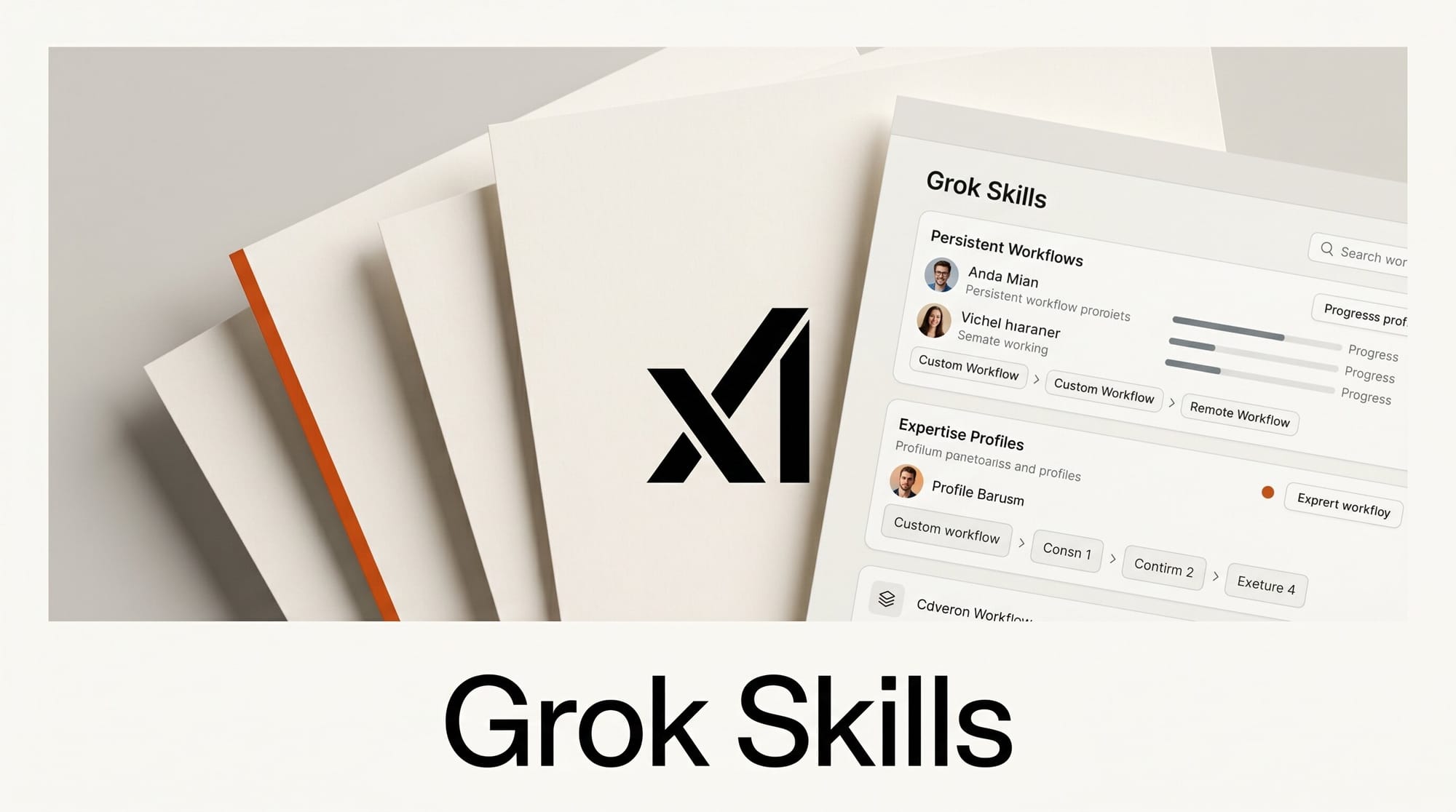
Persistent custom expertise is not a new pattern. ChatGPT shipped Custom GPTs at DevDay 2023. Anthropic shipped Claude Projects in mid-2024. Google followed with Gemini Gems in 2025. Grok was the last major chatbot without a first-party equivalent, and Skills closes that gap with three creation paths: describe the skill in conversation, upload a reference file, or use the Skill Creator to write one from scratch. Per the daily xAI release notes, Skills attaches specifically to Grok 4.3 across grok.com, iOS, and Android, with no separate paid tier listed.
The shipping difference that matters for creators is what each platform bundles. Grok ships five built-in skills out of the gate: Word document creation and editing with full formatting, slide deck generation, formatted spreadsheets with data analysis, PDF merge or split or extract tools, and a Skill Creator walkthrough. The Office-style document outputs put Grok in direct competition with Microsoft Copilot's bundled productivity. Claude, ChatGPT, and Gemini do not ship comparable native document generation in their workspace features.
Detailed comparison
Persistence model
The first decision is whether persistent context applies account-wide or project-scoped. Grok Skills attach to your account and load automatically in any conversation where they apply. There is no explicit "switch to this project" gesture. Skills compete and the one that fits the current prompt wins. Custom skills override built-ins when both could apply.
Claude Projects is the opposite. Each Project is a named container with its own conversation history, custom instructions, and uploaded files. To use Project context you start a new chat inside that Project. Cross-Project memory does not happen.
Custom GPTs sit in between. Each GPT is a discrete container with its own instructions and knowledge files, but you invoke it explicitly by opening it from the sidebar or the GPT Store. There is no automatic context-loading across the default chat.
Gemini Gems is closest to GPTs in shape. Each Gem is a named container with custom instructions and knowledge files, and you select it from the Gem switcher. New chats in the same Gem inherit its setup.
If your workflow is a handful of named contexts you switch between deliberately (a brand-voice writer, a code reviewer, a research assistant), the Project, GPT, or Gem model fits. If your workflow is "remember everything I told you about my style across every conversation," Grok's account-wide model fits.
Built-in document tools
Grok Skills ships native Word document creation and editing with full formatting, slide deck generation from prompt or outline, formatted spreadsheets with built-in data analysis, and PDF merge or split or extract operations. All four run inside the chat surface without a separate tool call to an external service.
Claude Projects does not ship native Office-style document generation. Claude can produce content and you can copy it into Pages, Docs, or Word. Anthropic's connector to Canva (announced in the Claude for Creative Work and Claude for Small Business launches) is where the native creative output happens, and it stays inside Canva rather than producing a .docx.
Custom GPTs do not ship native Office output either. The OpenAI ecosystem offers third-party document-generation GPTs from the GPT Store with mixed quality. PDFs can be produced through code-interpreter file output, but Word and PowerPoint generation requires a third-party Action or a copy-paste step.
Gemini Gems benefits from the broader Workspace integration. Gemini can draft directly into Docs, Slides, and Sheets when the user is signed in to Workspace, but the surface is the Workspace app, not the Gem itself. Native generation inside the Gem chat is text-only.
For creators who deliver client work as branded Word documents, formatted spreadsheets, or polished slide decks (think proposals, reports, pitch decks), Grok's bundle is the only chat that produces the final artifact directly.
File upload and knowledge handling
Claude Projects has the strongest file context. Upload a folder of PDFs, code files, or transcripts and Claude can answer questions across them with deep retrieval. The Project knowledge limit is generous, and Claude's long-context model handles cross-file reasoning well.
Custom GPTs supports up to 20 file uploads per GPT with a per-file size limit. Retrieval is automatic. Quality is decent on small knowledge bases and degrades on large ones.
Gemini Gems accepts file uploads via the Gem editor and through Drive integration. File handling is competent. The big differentiator is Drive integration: a Gem can be configured to read from a Drive folder rather than uploaded files, which keeps the knowledge base in sync as files change.
Grok Skills accepts file uploads as one of the three creation paths and treats them as reference material for the skill rather than a queryable knowledge base. For an active retrieval workflow (search this 200-page report and answer questions), Claude Projects is the stronger choice.
Connector availability
Each platform has been racing to add connectors so the workspace can read from real working systems.
Grok Connectors shipped recently for Gmail, Notion, and Drive. Combined with Skills, a Grok workflow can now pull real data from a connected source, apply a custom skill, and produce a finished document inside the same chat.
Claude offers a growing connector list anchored on the Creative Work suite, including integrations announced for design and productivity surfaces, plus the Model Context Protocol that opens custom connectors to anyone who can implement it.
ChatGPT's connector story runs through Actions (which require an OpenAPI spec) and a smaller list of native connectors. The maturity is higher in the GPT Store than in native first-party connectors.
Gemini Gems has the deepest Google-native integration: Gmail, Drive, Docs, Calendar, and Sheets are first-class. Non-Google connectors are limited.
Distribution and discoverability
If you want others to use your workspace, the distribution model matters.
Custom GPTs are publicly shareable. The GPT Store provides discovery and a built-in revenue-share program for paid GPTs. This is the only platform among the four with a real marketplace.
Claude Projects is share-by-link only and works inside team plans. There is no public marketplace.
Gemini Gems is share-by-link only. The Gem Gallery showcases featured Gems but is not a marketplace.
Grok Skills is account-scoped only at launch. There is no sharing primitive announced as of May 18, 2026. If you want to ship a skill to a community, you ship the prompt instructions and ask each user to recreate it.
Pricing and access
Grok Skills ships across grok.com, iOS, and Android with no separate paid tier announced. Grok 4.3 access is the gate. Per the existing Grok 4.3 API launch coverage, the model is available across Free, X Premium+, and SuperGrok tiers with usage caps.
Claude Projects requires a paid Pro or Team plan.
Custom GPTs requires ChatGPT Plus, Team, or Enterprise.
Gemini Gems is available on the free Gemini tier with usage caps and unlocked further on Gemini Advanced.
Comparison table
| Capability | Grok Skills | Claude Projects | Custom GPTs | Gemini Gems |
|---|---|---|---|---|
| Persistence model | Account-wide auto-load | Project-scoped container | Container, manual invoke | Container, manual invoke |
| Native Word output | Yes | No | No (third-party) | Via Workspace Docs |
| Native slides | Yes | No | No | Via Workspace Slides |
| Native spreadsheets | Yes | No | Via code interpreter | Via Workspace Sheets |
| PDF tools | Merge, split, extract | Read only | Via code interpreter | Read only |
| File upload limit | Per skill, soft cap | Generous | 20 files per GPT | Per Gem, soft cap |
| Connector coverage | Gmail, Notion, Drive | MCP plus partner suite | Actions plus native | Full Workspace native |
| Public marketplace | No | No | Yes (GPT Store) | No |
| Free tier access | Yes with caps | No (Pro+) | No (Plus+) | Yes with caps |
| Cross-conversation memory | Yes, automatic | Within Project only | Within GPT only | Within Gem only |
When each one wins
Grok Skills wins for creators who deliver Word docs and decks
If your output is branded Word documents, formatted spreadsheets, or pitch decks, Skills produces the final artifact in the chat without a copy-paste step. The persistence-by-default model also fits creators who repeat a single workflow (brand voice, style guide, prompt template) across hundreds of conversations rather than splitting them into named projects.
Claude Projects wins for research and code workflows
For tasks that demand reasoning across many uploaded files (a codebase, a research corpus, transcripts of several hours of interviews), Claude's file context is the strongest of the four. The Project container is the right shape when you want isolated contexts you switch between deliberately.
Custom GPTs wins for distribution
If you want other people to use your workspace publicly or charge for it, Custom GPTs is the only option. The GPT Store is a real distribution surface, and Actions let you wire in proprietary APIs that paying users can call without your having to host anything.
Gemini Gems wins for Workspace-native creators
If your day is already in Gmail, Docs, Drive, Sheets, and Slides, the Gem model gives you the lowest-friction persistence with the deepest connector to the data you already work with. Native Workspace surfaces consume Gemini output directly.
Pricing and ROI
The cost calculus is straightforward for solo creators. Grok and Gemini both offer free-tier access with usage caps, so the workspace feature itself is free. Claude Projects and Custom GPTs require paid subscriptions ($20 per month for the entry tier on both, varying by region).
For a creator delivering client work, the meaningful ROI question is whether the workspace replaces a separate tool. Grok Skills' bundled Word and slide generation can replace a $10 to $20 per month productivity tool. Claude Projects' file context can replace a separate document-QA service. Custom GPTs Actions can replace small custom-built integration code. Gemini Gems' Workspace integration removes friction inside a suite you already pay for.
Verdict
The four platforms have converged on the same idea (persistent workspace plus custom instructions) and now differentiate on what they bundle. Grok is bringing native document generation that no one else ships. Claude is doubling down on file context and connector depth. ChatGPT keeps the distribution surface. Gemini owns Workspace-native creators.
For most creators, the right move is not "switch entirely" but "match the workspace to the work." Use Claude Projects for research and code. Use Grok Skills for finished documents and decks. Use Gemini Gems if Workspace is your daily surface. Use Custom GPTs if you need to distribute. The persistent-workspace primitive is no longer the differentiator. What it produces is.
Per xAI's Build API documentation, developers can extend the same skill pattern through the API surface, which suggests Skills will get a developer-side distribution story over time. Until then, Grok Skills is best for creators who work inside Grok and want the bundled tools, not for creators who want to ship a workspace to others.
Frequently asked questions
Does Grok Skills work on the free Grok tier?
Yes. Skills shipped on grok.com, iOS, and Android with no separate paid tier announced. Grok 4.3 free access has usage caps, and X Premium+ or SuperGrok unlocks higher limits per the daily xAI release notes. There is no Skills-specific paywall as of May 18, 2026.
Can a Skill call external APIs the way Custom GPT Actions do?
Not at launch. Skills today are persistent instruction sets with bundled built-in tools. External API actions require the xAI Build API developer surface rather than the in-chat Skills feature. Expect convergence over time as Skills picks up the patterns Custom GPTs Actions established.
How does Skills interact with the recent Grok Connectors rollout?
They stack. Connectors (Gmail, Notion, Drive) read data from real working systems. Skills apply a custom expertise on top. A complete workflow is "use the Drive connector to pull this week's project files, apply my brand-voice Skill, generate a status report as a Word document." The two features compose cleanly.
What happens if two Skills could apply to the same prompt?
Per the released behavior, custom skills override built-in skills. Among multiple custom skills, the most specific match wins, with ties broken by recency of creation. If you want deterministic behavior, name your skills with explicit trigger phrases or use the Skill Creator's filter rules.
Can I export a Skill across accounts?
Not at launch. Skills are account-scoped. To share, ship the instruction text and ask each user to recreate the Skill on their own account. This is the same constraint Gemini Gems had at its launch before share-by-link arrived.
Does Skills change the API surface for developers building on Grok 4.3?
The in-chat Skills feature is separate from the API. Developers building on Grok 4.3 through the API continue to use system prompts and tool definitions to express custom expertise. The Skills pattern may extend to the API later but is not part of the May 18 launch.