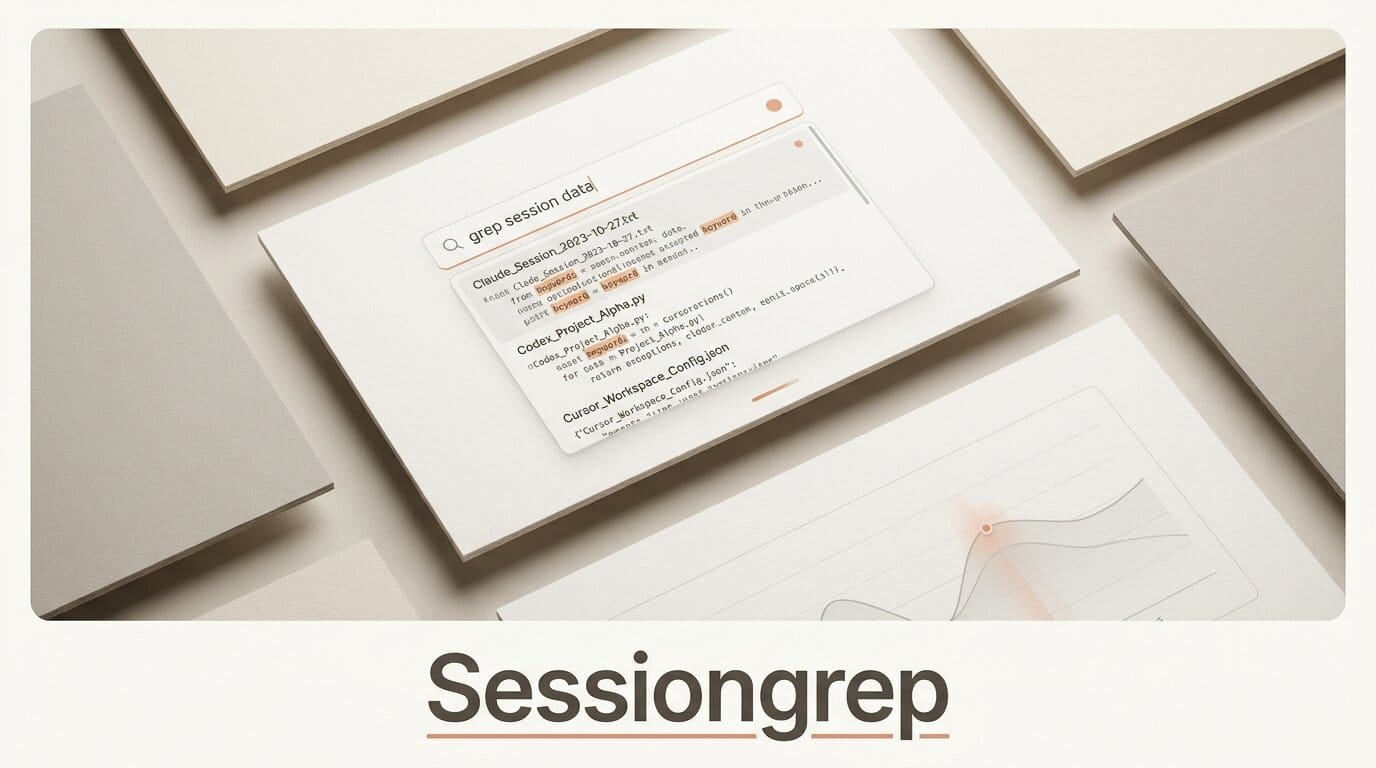
Sessiongrep is a new local-first memory layer that indexes your AI coding sessions from Claude Code, Codex CLI, Cursor, Antigravity, and Pi into a single searchable SQLite database. Released as a Show HN on July 28, 2026 by braincompany under an Apache-2.0 license, it turns the scattered transcript logs each agent writes to disk into one full-text index you can grep, browse in a TUI, or expose to an agent through its bundled MCP server. It is early (pre-release, built from source, no tagged binary yet), but the idea addresses a real and growing pain: your best prompts, fixes, and decisions are trapped inside dozens of disconnected session files.
If you run more than one AI coding tool, you have almost certainly re-solved a problem you already cracked last week, in a session you cannot find. Sessiongrep is a bet that the fix is not another cloud memory service, but a fast local index over the history you already have. You can read the full project on its GitHub repository.
What Sessiongrep Actually Does
Every CLI coding agent already keeps a history. Claude Code writes JSONL transcripts, Codex CLI keeps its own logs, Cursor stores sessions, and tools like Antigravity and Pi each have their own format. Sessiongrep reads all of them, normalizes the different provider formats into one schema, and loads them into SQLite with an FTS5 full-text search index. The result is a single command line that searches across every tool at once, filtered by keyword, provider, or recency.
It ships as two binaries. The first, sessiongrep, is the CLI and interactive terminal browser. The second, sessiongrep-mcp, is a Model Context Protocol server, so an agent can query your past sessions as a tool during a live task. That second binary is the interesting part: it means your history stops being a passive archive and becomes something the model can actively consult.

How It Works Under the Hood
The engine is deliberately boring, which is a compliment. Transcripts land in a local SQLite file, and search runs through SQLite's FTS5 full-text extension. There is no vector database, no embeddings pipeline, and no cloud round trip. Keyword search over your own words is often exactly what you want when you remember roughly what you said but not where you said it.
Freshness is handled with an incremental reindex. Every read command reindexes first, but files whose modification time and size have not changed are skipped, so search and list stay fast even as your history grows into thousands of sessions. The MCP layer builds on the same index, exposing search to any client that speaks the Model Context Protocol, which now includes Claude Code, Cursor, and a widening set of agent runtimes.
Because everything is local, the privacy story is simple: your transcripts never leave the machine. For anyone who pastes proprietary code or client work into an agent, that is a meaningful difference from hosted memory products.
Sessiongrep vs Other Memory Approaches
Agent memory is suddenly a crowded category. Here is how a local index like Sessiongrep compares to the main alternatives creators are weighing right now.
| Approach | Where data lives | Search type | Cross-tool | Best for |
|---|---|---|---|---|
| Sessiongrep | Local SQLite | Keyword (FTS5) | Yes (5 tools) | Finding past sessions fast, privately |
| Built-in tool history | Local per-tool | Manual scroll | No | Recent work in one tool |
| Mem0 and hosted memory | Cloud or self-hosted | Vector recall | Via SDK | Persistent facts injected into prompts |
| Context relays | Handle or link | Explicit handoff | Yes | Passing one context between tools live |
These are not mutually exclusive. A relay like the one we covered in our look at sharing context between AI tools by handle solves the live handoff problem, while Sessiongrep solves the retrospective search problem. Many workflows will end up using both, plus a hosted memory tool for durable facts.
Set It Up in Five Steps
Sessiongrep is pre-release and builds from source, so setup assumes a working Rust toolchain. The flow is short.
- Install Rust if you do not have it, then clone the repository with
git cloneand enter the directory. - Build and install with
cargo install --path ., which compiles both thesessiongrepCLI and thesessiongrep-mcpserver binaries. - Run your first index by issuing any read command; the tool auto-discovers transcripts from Codex CLI, Claude Code, Cursor, Antigravity, and Pi and reindexes what changed.
- Search or browse from the CLI by keyword, provider, or recency, or open the interactive TUI to scroll results with summaries and titles.
- Wire the MCP server into your agent so it can query history mid-task, giving the model recall over decisions you made in earlier sessions.

What This Enables for Creators
The payoff is not novelty, it is recall. If you build products, sites, videos, or automations with AI agents, your accumulated sessions are a private knowledge base of what worked. Sessiongrep makes that base queryable. You can find the exact prompt that produced a clean Remotion render, recover the shader fix you wrote three projects ago, or point a new agent at how you solved a similar bug last month instead of starting cold.
Wired through MCP, this changes how a session with Claude Code or Cursor begins. Instead of re-explaining your conventions every time, the agent can search your own history for the pattern and reuse it. For solo builders and small studios who cannot afford a shared internal wiki, a searchable session archive is a lightweight substitute that costs nothing and stays on your disk.

The Catch: Early and Unpolished
Sessiongrep is honest about its stage. It is described as early but usable, pre-release, with no tagged release yet, and it must be built from source. That rules out anyone unwilling to install a Rust toolchain, and it means formats can shift under you. Support for each tool depends on that tool's transcript format staying stable, so a provider changing its log layout could break indexing until the parser catches up. Treat it as a promising utility to test on a spare afternoon, not production infrastructure. But the core design, a local SQLite index with an MCP front door, is exactly the shape this problem calls for.
Frequently Asked Questions
Which AI coding tools does Sessiongrep support?
At launch it indexes Claude Code, Codex CLI, Cursor, Antigravity, and Pi, normalizing each tool's transcript format into one SQLite database with full-text search.
Does Sessiongrep send my code or transcripts to the cloud?
No. It is local-first. Everything is stored in a local SQLite file and searched on your machine, with no cloud sync, which is a deliberate privacy choice.
Is it a vector or semantic search tool?
No. It uses SQLite FTS5 keyword full-text search rather than embeddings. That is fast and predictable when you remember roughly what you wrote, though it will not do fuzzy semantic recall the way a vector store would.
How does the MCP server help?
The sessiongrep-mcp binary exposes your indexed history as a Model Context Protocol tool, so an agent can search past sessions during a live task instead of you copying context in manually.
Is Sessiongrep production ready?
Not yet. It is pre-release, builds from source, and has no tagged release. It is best treated as an early tool to experiment with rather than something to depend on.
How much does it cost?
It is free and open source under the Apache-2.0 license. The only cost is building it yourself with a Rust toolchain.