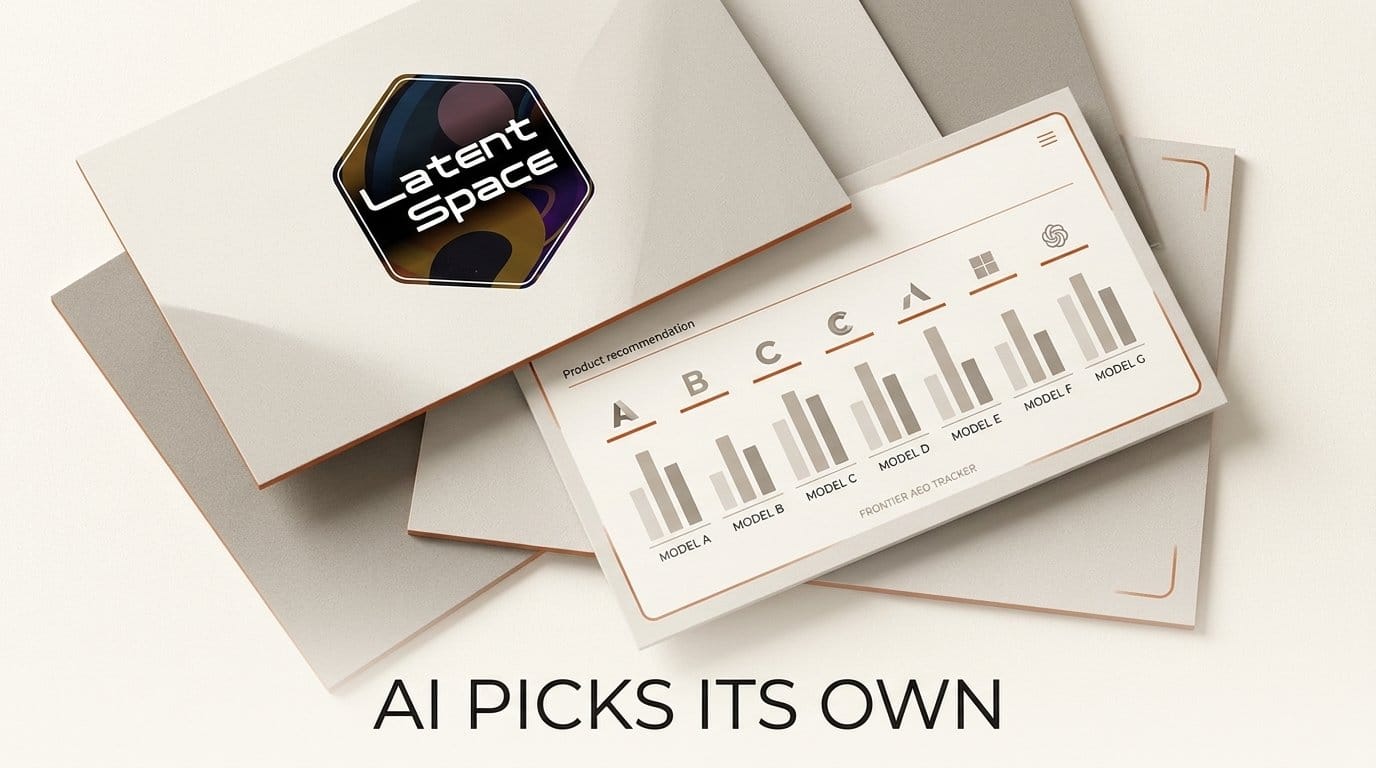
On September 7, 2026, Latent Space published the Frontier AEO Tracker, a public dataset measuring which products seven frontier AI models actually recommend. The study ran 6 prompt variations across 161 categories with web search enabled, scoring every answer for first choices, alternative choices and plain mentions. The finding that matters most to anyone building a tool: in 28 of those 161 categories, roughly 17% of the board, every model surveyed converged on the same primary pick.
The rest is a map of disagreement, and the disagreement is not random. When the models were asked to recommend a coding agent, each one reached for a tool made by its own lab. Anthropic's Opus and Fable picked Claude Code. OpenAI's Sol and Astra picked Codex. Grok picked Cursor. Muse picked Muse Code. As swyx wrote in the launch post, "I wonder why."
This matters because answer engine optimization has quietly become the channel that decides whether a tool gets discovered. The tracker extends AmplifyingAI's earlier "What Claude Code Actually Chooses" research from one model to seven, and turns a one-off study into a standing scoreboard you can query by model, category, entity or cited source.
What Latent Space actually built
The tracker is not a blog post with a chart. It is five browsable surfaces over the same corpus. The models view ranks what each individual model prefers and supports head to head comparison between two model generations. The categories view covers all 161 markets, running from the obvious (coding agents, ASR models, AI sandboxes, managed databases) to the genuinely odd (angel investors, corporate spend, payroll software). A sources view exposes which domains the models cited on the way to a recommendation.
Scoring uses a proprietary AEO score that weights first choices most heavily, then alternative choices, then mentions. It also applies negative weights for mild and strong anti-recommendations, which the authors describe as rare but real. Answer extraction across the whole corpus was performed by GPT-6 Astra, and Latent Space says every prompt and answer pair is inspectable, which is the part that separates this from the usual vendor-funded leaderboard.

Every model has a house favorite
The clearest signal in the data is self-preference. In the interactive coding agent category, the pattern holds across every lab that ships both a model and a coding tool.
| Model | Lab | Coding agent it favors | Made by the same lab |
|---|---|---|---|
| Claude Opus 5 | Anthropic | Claude Code | Yes |
| Claude Fable 5.1 | Anthropic | Claude Code | Yes |
| GPT-5.6 Sol | OpenAI | OpenAI Codex | Yes |
| GPT-6 Astra | OpenAI | OpenAI Codex | Yes |
| Muse | Meta | Muse Code | Yes |
| Grok | xAI | Cursor | No |
| SWE-1.7 | Cognition | Devin | Yes |
Six of the seven models point at a stablemate. Grok is the exception only because xAI does not ship a competing coding agent of its own, and it lands on Cursor instead. Latent Space is careful to note the counterexample that keeps this from being a pure indictment: there are documented cases of GPT models recommending Claude, which the post calls "a laudable nonbias." The per-entity view lets you trace a single product such as Claude Code, Codex, Cursor or Lovable across every category it appears in.
The practical read for a builder is blunt. If you compete with a first-party tool from a frontier lab, the model made by that lab is not a neutral referee, and no amount of content work will make it one. Your winnable ground is the categories where no lab has a horse in the race, which is most of the 161.
The 28 categories where every model agrees
Universal agreement is the most valuable and most brutal fact in the dataset. In 28 categories the same product is the primary choice for every surveyed model. If you own one of those slots, AI recommendation is a moat. If you are challenging one, you are not fighting a ranking, you are fighting a consensus that has to be dislodged in seven places at once.
Far more interesting for most builders is the long tail Latent Space describes as "close contests" and, in a phrase worth stealing, "always the vibesmaid, never the vibe." Those are the categories where a model's pick flips on a lightly reworded prompt, and they are where content and positioning work still moves the number. The tracker's recommendation guessing game is a fast way to find out how badly your intuitions about your own market diverge from what the models actually say.

Source counts reveal two opposite bets
The most consequential finding is not about products at all. It is about how differently the labs are tuning search behavior, and the median source counts reported in the study design notes split cleanly by vendor.
| Model | Lab | Median sources consulted | Direction within lab |
|---|---|---|---|
| GPT-5.6 Sol | OpenAI | 9 | Previous generation |
| GPT-6 Astra | OpenAI | 5 | Down from 9 |
| Claude Opus 5 | Anthropic | 11 | Previous generation |
| Claude Fable 5.1 | Anthropic | 15 | Up from 11 |
OpenAI moved down, from a median of 9 sources to 5. Anthropic moved up, from 11 to 15. Two labs looked at the same problem across a model generation and went opposite directions, and the newest OpenAI model now consults a third of the sources the newest Anthropic model does.
Astra is also, in Latent Space's testing, far less likely to change its answer when you lightly paraphrase the question. Call that confidence or call it efficiency, but the downstream effect is the same one the post identifies: as choice randomness declines, the value of AEO rises. A model that reliably returns the same three tools for a category has turned its recommendation into something much closer to a durable ranking than a coin flip. That is a structural shift for anyone whose discovery depends on being in that set, and it is the same directional pressure we covered when Google added AI search controls and reporting for publishers.
What to do if you want to be recommended
The tracker validates one concrete technical practice and gives you a way to measure everything else. A workable sequence:
- Find your category and read the actual answers. Open the categories view, locate your market, and read the prompt and answer pairs rather than just the ranking. The wording models use to justify a pick tells you which attribute they think defines the category.
- Check whether your category is one of the 28. If a single product wins across every model, plan for a long displacement effort or pick a narrower category you can actually own. If it is a close contest, you are in a winnable fight.
- Fix markdown content negotiation. This is the one practice the study explicitly validates, corroborating findings from Ora and Vercel: serve clean markdown to agents that ask for it. Latent Space found that failures here actively discourage models from reading your content, so a broken content negotiation path silently removes you from consideration.
- Audit the cited sources, not just your own site. Use the sources view to see which domains models actually pulled from in your category. Being covered on a frequently cited third-party domain often does more than another page on your own.
- Re-check after every frontier model release. The Opus to Fable and Sol to Astra comparisons show what the post calls "VERY consequential flips" between generations from the same lab. A ranking you earned last quarter can vanish with a pretrain refresh.


Where the tracker falls short
Three limitations deserve to be stated plainly, and to Latent Space's credit most of them are stated in the post itself.
The model coverage has holes. Gemini, GLM and DeepSeek were excluded for technical reasons, which means the tracker is missing Google entirely. For a study about what AI recommends, leaving out one of the three largest consumer AI surfaces is a real gap, not a footnote.
The sources analysis rests on a small sample. The authors are explicit that it reflects only what they could scrape from attempted tool calls, not the pretraining dataset. Cited sources tell you what a model reached for during a live search, which is useful, but it is not evidence about what shaped the model's priors.
The AEO score itself is proprietary. The weighting across first choices, alternatives, mentions and anti-recommendations is described but not published as a formula, so rankings cannot be independently reproduced even though the underlying prompt and answer pairs are inspectable. Latent Space also notes some deduplication work is still outstanding in at least one category. Treat the directional findings as solid and the precise ordering as provisional.
Frequently asked questions
What is answer engine optimization?
Answer engine optimization, or AEO, is the practice of getting your product or content recommended by AI assistants when a user asks for a tool in your category. It is the AI equivalent of ranking in search results, except the output is a short recommended list rather than ten blue links, so the tail below the top few picks receives almost no attention.
Which models does the Frontier AEO Tracker cover?
Seven: Claude Opus 5, Claude Fable 5.1, GPT-5.6 Sol, GPT-6 Astra, Grok, Muse and SWE-1.7, all run with web search enabled. Gemini, GLM and DeepSeek were excluded because of technical limitations, so Google's models are not represented.
Do AI models favor tools made by their own labs?
In the coding agent category, yes, and consistently. Opus and Fable favor Claude Code, Sol and Astra favor Codex, Muse favors Muse Code, and SWE-1.7 favors Devin. Grok is the only model that picks an unaffiliated tool, Cursor, and xAI has no competing coding agent. The study also documents GPT models recommending Claude in some contexts, so the bias is a strong tendency rather than an absolute rule.
How many categories have a single universally agreed winner?
28 out of 161, roughly 17%. In those categories every surveyed model names the same primary choice. The remaining categories include many close contests where a model's pick can change with prompt rewording, and those are the ones where optimization work realistically moves the outcome.
What is markdown content negotiation and why does it matter here?
It means serving a clean markdown version of a page when an agent requests it rather than a JavaScript heavy HTML page. The tracker validates earlier findings from Ora and Vercel that this is a real ranking factor: when content negotiation fails, models are discouraged from reading the content at all, which removes the page from consideration regardless of quality.
Is the tracker free to use?
The tracker, its methodology page and the underlying prompt and answer pairs are publicly browsable at aeo.latent.space. Latent Space says it is open to suggestions and business enquiries about developing it further, so parts of it may become commercial later.
How often does a product's AI ranking change?
The study found consequential flips between model generations from the same lab, specifically across Opus to Fable and Sol to Astra. That suggests rankings should be re-audited whenever a frontier model ships a new generation rather than on a fixed calendar.